
Digital reconstruction of a Pompeii victim's fate based on evidence
Discovering a Doomed Man's Last Moments

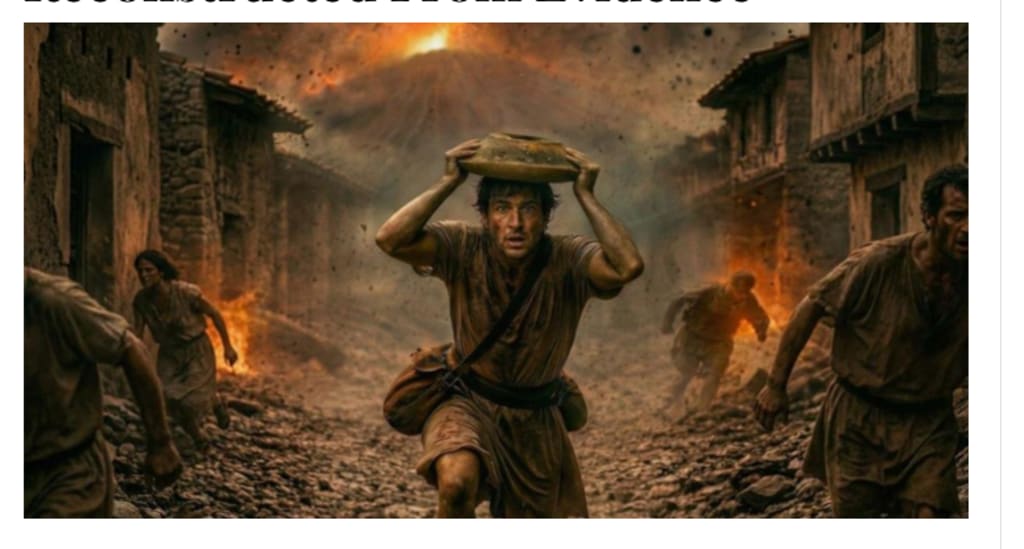
Artificial intelligence has been employed for the first time by archaeologists and scholars at the ancient Roman site of Pompeii to digitally reconstruct the fate of an individual who perished during the devastating eruption of Mount Vesuvius in AD 79. The innovative digital image provides a profoundly new means of connecting with one of the most well-known natural disasters in history and the people who lost their lives in it.
The reconstruction centers on a guy whose remains were found just beyond the walls of the ancient city, close to the Porta Stabia necropolis. The remains of two individuals who were trying to escape toward the coast after the eruption were discovered during excavations in this region.
The older of the two men is shown in the digital portrait. He is thought to have perished when the city was hit by a lot of volcanic debris in the early phases of the disaster.
Discovering a Doomed Man's Last Moments
This victim was found by archaeologists next to a ceramic mortar. Researchers concluded that he used the damaged object, which was placed close to his head, as a temporary barrier to protect himself from the falling lapilli, which are tiny volcanic stones created during the eruption.
This desperate attempt at self-preservation is consistent with historical narratives, such as those found in the letters of the Roman author Pliny the Younger, which describe Pompeii's inhabitants shielding their heads from the ash and rubble that covered the city.
The man carried a number of personal belongings with the mortar, which offer a moving window into his last moments and day-to-day existence prior to the catastrophe. He was discovered carrying a purse full of ten bronze coins, a little iron ring remaining on his finger, and a ceramic oil lamp that was probably used to navigate through the dense ash and darkness. These artefacts show what he considered necessary in his attempt to flee the fatal city.
AI Connects the Past and Present
The Pompeii Archaeological Park and the University of Padua worked together to create the captivating digital reconstruction. To generate a realistic human appearance, researchers combined skeletal data, archaeological measurements, and artificial intelligence photo-editing techniques.
As Mount Vesuvius explodes fiercely in the background, the resulting image shows the man walking along a route strewn in debris, raising the mortar above his head.The Pompeii Archaeological Park's director, Gabriel Zuchtriegel, said, "We will only be able to fully maintain and enrich archaeological data with the use of artificial intelligence. "If used well, AI can contribute to a renewal of classical studies."
A fast-moving pyroclastic flow, a lethal surge of hot gases and ash, most certainly killed the younger man who was discovered nearby. When taken as a whole, their remains offer a terrifying chronicle of events captured on earth. The past becomes more vivid as researchers continue to apply these cutting-edge methods to the enormous amount of data gathered at Pompeii, enabling contemporary audiences to interact with ancient history on a profoundly emotional level.
Aeneas, an artificial intelligence tool from Google DeepMind, promises to revolutionise the way historians examine ancient Roman inscriptions. This ground-breaking AI system, named after the legendary Trojan hero, can identify historical connections between various texts throughout the Roman Empire, forecast missing words in damaged Latin manuscripts, and estimate the location and time of inscription creation, according to The Guardian.
With capabilities that historians would often need decades of specialised knowledge to achieve, the instrument might represent a significant advancement in digital archaeology.
Google DeepMind and Dr. Thea Sommerschield of the University of Nottingham collaborated to develop Aeneas, which was trained on a massive collection of about 200,000 known Roman inscriptions with 16 million characters.
In order to help historians comprehend the social, political, and cultural importance of ancient writings carved in stone around the Roman world, the AI system can analyse incomplete Latin texts from the 7th century BC to the 8th century AD.
Using AI to Transform Historical Research
According to a study published in the Nature magazine, Aeneas can estimate when texts were written within 13 years and place inscriptions to one of 62 Roman provinces with 72% accuracy. In contrast to straightforward word-matching algorithms, the AI finds more profound historical relationships between inscriptions by connecting texts through nuanced linguistic patterns and cultural contexts that even skilled epigraphers might miss.
Aeneas was tasked with analysing the well-known Res Gestae Divi Augusti, Augustus Caesar's autobiographical inscription engraved into monuments throughout the Roman Empire.
The AI accurately matched the scholarly discussion that has persisted for millennia by proposing two possible date periods: either the first decade BC or between 10 and 20 AD. This illustrates how well the algorithm captures the subtle ambiguity that permeates a large portion of ancient historical study.
Aeneas would "enable a wider range of people to work on the texts" by democratising access to the specialised knowledge typically needed for epigraphic research, according to Jonathan Prag of the University of Oxford and Professor Mary Beard of Cambridge University, who called the tool "transformative."
Connecting the Ancient and Modern Worlds
Roman inscriptions, which include everything from love poems, business records, and epitaphs to imperial decrees and political graffiti, represent some of humanity's closest ties to the ancient world. Dr. Sommerschield highlights their special worth.
An estimated 1,500 new inscriptions are found every year, many of which are broken or worn beyond simple interpretation, making the task for experts enormous. The number of academics who can work with these materials effectively is limited because traditional analysis involves a great deal of personal expertise that has been developed over decades.
Aeneas provides quick contextual analysis to get over this bottleneck. The research team experienced "jaw-dropping moments" when the AI examined inscriptions on a votive altar from ancient Mogontiacum (modern Mainz, Germany) and discovered through linguistic similarities how it had been influenced by an older altar in the area.
About the Creator
Enjoyed the story? Support the Creator.
Subscribe for free to receive all their stories in your feed.
Comments
There are no comments for this story
Be the first to respond and start the conversation.