Events
Never Forgotten
Before my mom died I was already working on putting my thoughts together of 25 years ago. I was trying to take all the bits and pieces and craft them together. It may now be 25 years ago but to me it was just yesterday. People are now and for ages as well, been like never forget. I’ve always come back saying, I’ve never forgotten, maybe you have put it out of your mind and now need to remind yourself never to forget.
By WrittenWritRalf2 days ago in History
25 Years Later: How 9/11 Still Shapes America Today
There are certain days that divide time into a before and an after. September 11, 2001, was one of them. Twenty-five years later, the images remain almost impossible to separate from the emotions they created: smoke pouring from the World Trade Center, people staring upward from the streets of Manhattan, the Pentagon burning, and an empty field near Shanksville, Pennsylvania, where United Airlines Flight 93 came down. Nearly 3,000 people were killed. Thousands of families entered a new reality in the space of a few hours. Millions of others watched from classrooms, offices, living rooms, and military bases as the country they knew seemed to change in real time.
By Lawrence Lease3 days ago in History
If You See Me, Then Weep
Some days I write for myself and on others I write hoping it will be read and remembered. Passing along information, having a voice, reaching out to others: all of these have spurred on communication with our fellow citizens of this Earth.
By Judey Kalchik 6 days ago in History
Alternative Reconstruction and Assumption Sensitivity (The Global Catastrophe Prediction Framework - Part 2). AI-Generated.
The Global Catastrophe Prediction Framework distinguishes presently observed evidence from the historical conditions, mechanisms, and rate histories used to transform that evidence into a reconstruction of the past.
By Peter Thwing - Host of the FST Podcast7 days ago in History
The Global Catastrophe Framework
- The Global Catastrophe Prediction Framework - A single, high-energy, worldwide catastrophe involving rapid crustal rupture, violent release of large volumes of subterranean water, large-scale tectonic displacement, rapid sedimentation, mass burial, and subsequent recession of the waters constitutes the primary explanatory event for a wide range of observed geological, paleontological, archaeological, genetic, and cultural patterns. The event permanently altered atmospheric, hydrological, climatic, and crustal states. Pre-catastrophe environmental conditions differed substantially from those of the present. These conditions included greater atmospheric water content or structural layering capable of holding large volumes of water, different temperature gradients, different radiation shielding, different ocean circulation patterns, and the absence or near-absence of permanent polar ice sheets on the scale observed today. The catastrophe is treated as a unique boundary event that cannot be required to recur under present conditions, because the boundary conditions that made it possible no longer exist. - Core Physical Sequence - Pre-catastrophe Earth maintained atmospheric and hydrological structures that stored large volumes of water both above the surface and within the crust and upper mantle. A rapid, large-scale rupture of the crust simultaneously released immense volumes of subterranean water and initiated widespread tectonic displacement. Continents were driven apart from the primary rupture zones and into collision with other crustal masses. Collision and crumple zones formed, producing intensely folded strata, thrust faults, crushed rock, and uplifted mountain belts. Major fracture systems opened across what are now ocean basins, including the systems that became the present mid-ocean ridge network. The sudden release of subterranean water, combined with the collapse of the pre-catastrophe atmospheric water structure, produced a global inundation. Enormous quantities of sediment, rock, vegetation, and organisms were eroded from continental surfaces, transported by high-energy flows, and deposited where energy decreased. Living organisms entered the burial process according to a combination of factors: original ecological elevation, habitat type (marine, coastal, lowland, upland), mobility and swimming ability, body density and buoyancy, timing of death, and successive waves of inundation and sedimentation. This combination produced ordered fossil assemblages and mass mortality deposits without requiring long intervals of time between successive layers. As the floodwaters began to recede, broad sheet erosion stripped material from large surfaces. As flow concentrated into drainage paths, it carved deep ravines, canyons, gorges, valleys, and terraces. High-velocity flows produced relatively direct, steep-walled channels; lower-energy flows through softer material developed more sinuous courses. The same waters that eroded the continents continued seaward, carrying sediment across continental shelves, through submarine canyons, onto abyssal plains, into trenches, and into ridge-flank basins and fracture valleys. Throughout the rupture, displacement, and inundation, immense quantities of heat were generated by friction, compression, decompression, magma emplacement, and rapid deformation. Circulating hydrothermal fluids extracted, transported, and redistributed much of that heat, producing widespread mineralized fracture systems and hydrothermal alteration. Different minerals, with different closure temperatures and diffusion characteristics, began retaining daughter isotopes at different stages of the cooling and isolation sequence, generating ordered isotope patterns that record relative thermal history rather than uniform long-term accumulation. After the main inundation, the environment remained unstable. Extreme evaporation from warm oceans, heavy precipitation, volcanic aerosols, and altered atmospheric circulation produced rapid early accumulation of polar ice. Erosion rates, residual tectonic activity, volcanism, sediment transport, and atmospheric isotope production all began at very high values and then decayed progressively toward the lower rates observed today. - Explicit Quantitative Predictions - - Water budget: Subterranean water was stored in large crustal and upper-mantle reservoirs that were opened by the rupture. Atmospheric water was stored in the pre-catastrophe structural layering that collapsed during the event. At peak inundation the combined water volume occupied continental surfaces and newly formed or deepened basins. Subsequent crustal deformation (subsidence of ocean basins relative to continents, uplift of continental interiors, and creation or enlargement of major troughs) created the storage capacity that received the retreating water and returned most of it to the ocean basins, leaving the continents progressively exposed. - Sediment mass balance: The volume of material eroded from elevated continental regions during the catastrophe is quantitatively matched by the volume of sediment now present in continental-shelf deposits, submarine fans, abyssal-plain sequences, trench fills, and ridge-associated basins. Source-to-sink continuity is required. Spatial variations in sediment thickness are controlled by distance from continental sediment sources, topographic barriers, current pathways, and the presence of elevated, actively volcanic ridge crests that retained less sediment. - Thermal budget: Rapid displacement of continental-scale masses, frictional heating along faults, release of gravitational potential energy, and emplacement of large volumes of magma generated an enormous total heat budget. Primary dissipation pathways include massive circulation and vaporization of water, hydrothermal transport of heat into the ocean, localized melting and recrystallization, and radiative loss at the surface. The integrated thermal history must remain compatible with the survival of complex multicellular life in limited refuges while still producing the metamorphic grades, mineral assemblages, and hydrothermal alteration patterns actually observed. - Directionality: Crustal blocks moved outward from primary rupture zones and into collision zones. The resulting structures preserve geometrically related directional patterns: orientations of major faults, fold axes, thrust systems, mountain-belt trends, fracture networks, and large-scale sediment-transport directions all reflect the primary vectors of displacement and collision. - Post-catastrophe stabilization curve: Immediately after the event, rates of ice accumulation, erosion, volcanism, residual tectonic adjustment, precipitation, sediment transport, and atmospheric isotope production were extremely high. These rates then decayed progressively toward the lower values characteristic of the present. Stratigraphic, chemical, and isotopic records are therefore expected to show the highest rates in the earliest post-event deposits, followed by a measurable decline. - Civilizational dispersal: The human population that survived the catastrophe was geographically concentrated. Subsequent expansion produced migration traditions, linguistic branching patterns, early settlement distributions, and cultural memories of the flood that radiate outward from one or a few primary centers of survival and early re-expansion. - Predicted Observational Consequences - The framework accounts for the existence of extensive crustal fracture systems, including mid-ocean ridges and their associated hydrothermal activity; mountain belts and zones of intense deformation concentrated at former collision boundaries, with broader, flatter sedimentary basins and plains between them; extremely thick sedimentary deposits containing mass fossil assemblages, articulated large vertebrates, polystrate trees, and buried forests; ordered fossil succession produced by ecological elevation, mobility, buoyancy, and sequential habitat destruction; major erosional canyons, gorges, and valleys paired with corresponding volumes of downstream and offshore sediment; deeply buried and submerged human settlements and structures; severe genetic bottlenecks in humans and many animal kinds, followed by rapid demographic expansion and geographic differentiation; technological and cultural discontinuities followed by relatively rapid reappearance of organized societies; the worldwide distribution of flood traditions that share core elements of overwhelming inundation, survival of a small group, refuge in a vessel or on high ground, preservation of animals, and subsequent repopulation; chemical, isotopic, and climatic evidence of an abrupt environmental boundary; systematic spatial gradients in sediment thickness and heat flow controlled by continental sediment supply, topography, and proximity to rupture axes; and multi-isotope patterns that record ordered thermal and fluid histories rather than uniform long-term accumulation. - Chronological Stance - All conversions of isotope ratios, magnetic polarity patterns, layer counts, genetic distances, sediment thickness, or similar measurements into long intervals of elapsed time are treated as model-dependent inferences. The framework predicts that many natural accumulation and transformation processes operated at sharply different rates before, during, and immediately after the catastrophe. Apparent concordance among different dating methods is therefore examined for shared response to the same extreme conditions or for common calibration assumptions rather than accepted as independent proof of deep time. - Scope and limits - The framework does not assert that every local geological feature on Earth was produced by this single event. It asserts that the dominant, interconnected global patterns enumerated above are most coherently explained by one high-energy catastrophe of the kind described, occurring against a pre-catastrophe environmental background that no longer exists. The model requires sufficient physical specification to generate discriminating, testable predictions. Mechanisms that remain incompletely specified are treated as open research questions rather than as automatic grounds for rejection. --- - Synthesis and Implications - The framework organizes a wide array of physical observations under a single, interconnected causal sequence. Crustal rupture, tectonic displacement, global inundation, ordered ecological burial, receding-water erosion, hydrothermal heat redistribution, and post-event rate decay are not treated as separate phenomena but as linked stages of one event. The same displacement vectors that open fracture systems and create collision belts also organize sediment transport directions and structural fabrics. The same water that inundates the continents later carves the canyons and delivers the sediment to the offshore sinks. The same thermal pulse that drives metamorphism and hydrothermal alteration also disturbs isotope systems in mineral-specific ways that can preserve relative order. Because the framework treats chronological inferences as secondary and model-dependent, it avoids circularity. Measurements of isotope ratios, magnetic patterns, layer counts, and genetic distances remain fully intact as observations. What is withheld is the automatic conversion of those measurements into long ages under the assumption that present rates have always applied. The framework instead predicts that many of those rates changed sharply across the catastrophe boundary and therefore must be demonstrated rather than assumed. The quantitative predictions supply the primary empirical tests. A successful account must close the water budget (source, peak storage, and final disposal), close the sediment mass balance (continental erosion matched by offshore deposition), close the thermal budget (heat generation matched by identified dissipation pathways while remaining compatible with biological survival), reproduce the observed directional patterns in structures and sediment transport, and display the expected nonlinear stabilization curve in early post-event records. Fine-scale global fossil ordering must be shown to arise from the combination of ecological elevation, mobility, buoyancy, and successive inundation pulses under high-energy conditions. Multi-isotope concordance must be shown to arise from ordered thermal and fluid histories rather than from uniform long-term accumulation. Where these constraints can be satisfied, the framework provides a coherent alternative organization of the same physical evidence. Mountain belts, mid-ocean ridges, thick sedimentary sequences, mass fossil deposits, polystrate trees, major canyons, genetic bottlenecks, and the global distribution of flood traditions are no longer treated as unrelated features requiring separate gradual explanations. They become expected consequences of one high-energy sequence operating under boundary conditions different from those of the present day. The chronological stance further implies that any dating method whose rate is sensitive to atmospheric composition, radiation environment, temperature, fluid circulation, or ice-accumulation regime must be re-examined for behavior across the proposed boundary. Apparent deep-time concordances may record common response to the same extreme conditions rather than independent confirmation of long ages. This does not discard the measurements; it changes the interpretive model placed upon them. Taken as a whole, the framework stands or falls on its ability to satisfy simultaneous physical constraints of mass, energy, directionality, stratigraphic order, and rate decay. It does not require that every intermediate mechanism be fully specified before it can be considered. It requires only that its central sequence remain consistent with conservation laws and that its discriminating predictions be testable against the full range of relevant observations. When those conditions are met, the framework supplies a unified causal account of crustal structure, sedimentation, fossil distribution, erosional landscapes, tectonic fabrics, human population history, and cultural memory that does not rely on the extrapolation of present rates across deep time. --- - Alignment with the Genesis Account and Contributions from the Biblical Text - The Global Catastrophe Prediction Framework aligns closely with the narrative sequence preserved in Genesis 6–9 and the immediately surrounding material. The biblical text supplies a coherent, detailed historical description of a single worldwide inundation that matches the physical sequence, quantitative predictions, and observational consequences already set out in the framework. Where the physical model identifies necessary processes and boundary conditions, the Genesis account provides specific mechanisms, initial conditions, and post-event stabilizations that increase the model’s resolution and internal coherence without introducing contradiction. - Correspondence of Core Sequence - Genesis describes a pre-flood world whose environmental and biological conditions differed from the present. Human lifespans were dramatically longer, and the earth is characterized as filled with violence. The text then records a divine decision to bring a global flood that destroys all land-dwelling, air-breathing life outside a single preserved group. The mechanism of inundation is explicitly dual: “the fountains of the great deep burst forth” and “the windows of the heavens were opened.” This matches the framework’s requirement for both subterranean rupture and the collapse of a pre-existing atmospheric water structure. A single family of eight is instructed to construct a large, multi-deck vessel sealed with pitch and to bring representatives of land animals and birds by pairs or sevens according to kind. The vessel preserves both the human population and the terrestrial animal kinds through the inundation. After 150 days the waters begin to recede; the vessel comes to rest on the mountains of Ararat. Birds are sent out to test for dry land. Once the ground is sufficiently dry, the survivors exit, offer sacrifice, and receive a divine command to repopulate the earth. A covenant is established with a permanent visible sign (the rainbow) guaranteeing that a flood of the same global scope will not recur. Immediate post-flood material includes a structured genealogical table of nations descending from the three sons of the survivor and dispersing geographically. Every major element required by the framework is present: different pre-catastrophe conditions, dual water sources, global inundation, preservation of a minimal human population and animal kinds in a constructed vessel, landing on high ground, recession of the waters, command to repopulate, and outward dispersal from a concentrated starting point. - Mechanisms and Specifications Supplied by the Text - The Genesis account supplies several concrete mechanisms and boundary conditions that the physical framework requires but does not itself invent. - Dual water sources: The simultaneous rupture of subterranean reservoirs (“fountains of the great deep”) and the collapse of atmospheric water storage (“windows of the heavens”) provides an explicit physical source for the water volume demanded by the inundation and subsequent recession. - Vessel and biological bottleneck: The detailed construction and loading of the ark supply a precise mechanism for the survival of a minimal human population and the land-animal kinds. This converts the framework’s predicted genetic bottlenecks into a historically specified event with a known starting population size and composition. - Pre-catastrophe environmental difference: Extreme human longevity and a social state of pervasive violence are recorded as features of the world that ended with the flood. These supply observable biological and social markers of the different boundary conditions the framework posits. - Post-event stabilization and covenant: The explicit establishment of seasons after the flood and the permanent sign guaranteeing no repetition of a global flood supply a historical mechanism for the rapid transition to a new climatic regime and for the strong cultural conservation of the memory that such an event would not recur. - Structured dispersal: The Table of Nations (Genesis 10) records an organized geographic and linguistic radiation from the three sons of the survivor. This supplies a concrete historical template for the framework’s prediction of outward civilizational dispersal from a concentrated post-catastrophe population center. - Contribution to Stability and Coherence - The biblical text increases the stability of the framework by converting several of its open quantitative requirements into historically constrained parameters. The water budget is no longer an abstract volume; it is the combined release of subterranean and atmospheric reservoirs described in the text. The human and animal bottlenecks are no longer generic; they begin with a known family and a systematic sampling of kinds. The post-catastrophe stabilization curve is anchored by the immediate appearance of seasons and by a covenant that culturally reinforces the finality of the boundary. The directional dispersal of peoples is given an explicit genealogical and geographic starting point. Because these details are internal to a single, continuous narrative that already matches the physical sequence, they do not function as external additions. They function as higher-resolution specifications of processes the framework already requires. The result is a tighter coupling between the physical predictions and a historically attested account of the same event, increasing both the model’s internal coherence and its capacity to generate discriminating tests against genetic, linguistic, archaeological, and stratigraphic data. - Scope of the Alignment - The alignment does not require that every interpretive tradition attached to the text be adopted. It requires only that the narrative sequence itself (pre-flood conditions, dual water sources, global inundation, vessel preservation of a minimal human and animal population, high-ground landing, recession, repopulation command, covenant, and structured dispersal) be recognized as a coherent historical description that supplies mechanisms and boundary conditions already demanded by the physical framework. Where the text and the physical model converge on the same sequence and the same quantitative necessities, the text functions as a clarifying and stabilizing historical witness rather than as an independent or competing authority.
By Peter Thwing - Host of the FST Podcast8 days ago in History
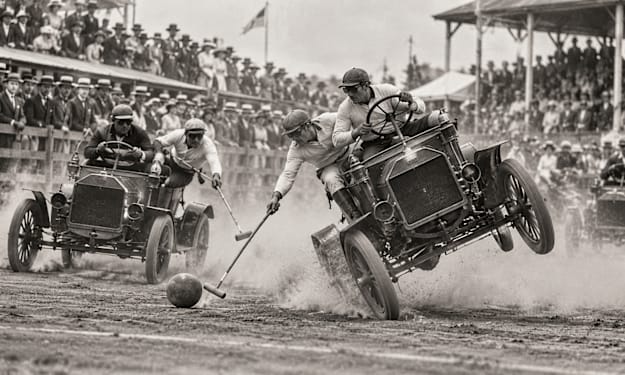
When the Banana Peel Was No Joke
It is one of the oldest jokes in comedy... A man walks confidently down a sidewalk. Perhaps he is wealthy. Perhaps pompous. Maybe he is carrying an important briefcase and has somewhere terribly important to be. Then the audience sees it: a banana peel. He doesn’t. One foot comes down, his legs shoot forward, and his dignity remains suspended in the air approximately half a second longer than the rest of him. And down he goes.
By The Iron Lighthouse8 days ago in History
The Great American Cheese Stockpile
Somewhere beneath Missouri in 1981, the United States government had a problem. It wasn’t nuclear weapons. It wasn’t Soviet espionage. It wasn’t an experimental aircraft or some classified Cold War project buried safely underground. It was cheese... Lots and lots of cheese!
By The Iron Lighthouse10 days ago in History
The Label Meant to Shame Germany Became Its Greatest Advertisement: How “Made in Germany” Was Born
In the second half of the 19th century, Britain was at the height of the Industrial Revolution. The country proudly considered itself the “workshop of the world”, producing machinery, textiles, steel and tools that were exported across the globe.
By Lenka Čihařová14 days ago in History