
It Began with a Debt: How the Fourth Crusade Came to Sack Constantinople
1204: the background, the choices, the destruction, and seven points where it could have been avoided

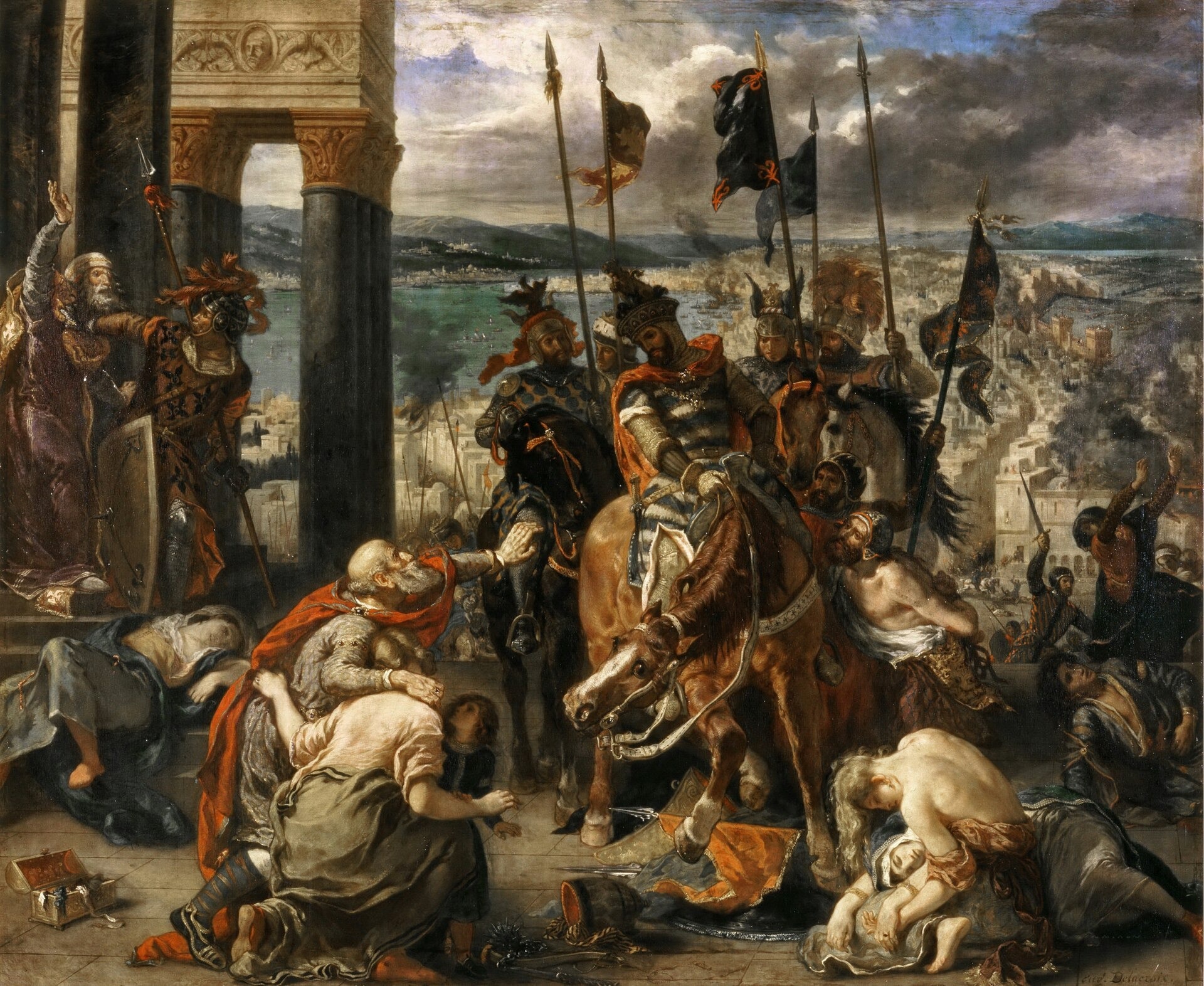
After the events of April 12, 1204, the historian Niketas Choniates fled Constantinople. A Venetian merchant whom Choniates knew helped protect him, his pregnant wife, and their young children by leading them through the streets as though they were his prisoners. Behind them, the army of the Fourth Crusade, which had set out to fight the Muslims of Egypt, had completely plundered the city.
Choniates never forgot what happened. He described how the mules were brought into the sacred Hagia Sophia and loaded with loot, and how a prostitute sat on the patriarch’s throne and sang vulgar songs. Even the Saracens, he added, would not have been so cruel.
How did a crusade intended to attack Egypt end up plundering the streets of the greatest city in Christendom? Although one might assume it was a conspiracy, it should mainly be considered the result of a number of decisions made by men who wanted to do the right thing. And it all began with a debt.
An Empire in Shadow
In order to fully understand the events of 1204, it is necessary to go back to 1180. Manuel I Komnenos died that year, leaving a strong empire still dominating the eastern Mediterranean. However, in the next twenty years much of his legacy was lost.
Manuel’s son Alexios II was still very young, so Andronikos I Komnenos seized power as a usurper in 1182. He did so during a period of strong anti-Western feeling. The Latin quarter of the city (home to thousands of Italian merchants) was attacked and its inhabitants massacred. Three years later Thessaloniki, the second city of the empire, was sacked by a Norman army from Sicily. Andronikos was lynched by an angry mob, and the throne passed to the Angeloi family, who would prove to be outmatched by history. Under Isaac II Angelos, the Bulgarians and Serbs seceded, Cyprus, already in the hands of a rebel, fell to Richard the Lionheart, and in 1189, the German emperor Frederick Barbarossa marched through Byzantine territory on his way to the Third Crusade. He occupied Philippopolis and seriously considered attacking Constantinople.
In 1195 Isaac was overthrown, blinded, and imprisoned by his own brother, who became emperor as Alexios III. The empire was also suffering internally from corruption. Choniates described how the admiral of the fleet, Michael Stryphnos (a brother-in-law of the new emperor), sold the sails, anchors, and even nails of ships for his own profit. When the crusaders arrived in 1203, there were only twenty decayed ships available to fight with.
The West had changed. Venice had been allowed to trade without paying taxes within the empire’s dominion since the 1080s. Its merchants would never forget that Manuel I had ordered the arrest of all Venetians in the empire and the confiscation of their property in 1171. Germany was also interested as Philip of Swabia, king of the Germans, was married to Irene Angelina, the daughter of the blind Isaac II. Pope Innocent III (elected in 1198) wanted to start a new crusade to retake Jerusalem, which had been captured by Saladin in 1187.
Byzantium had become an empire in shadow and was no longer feared as it had been in the days of the Komnenoi.
The Contract
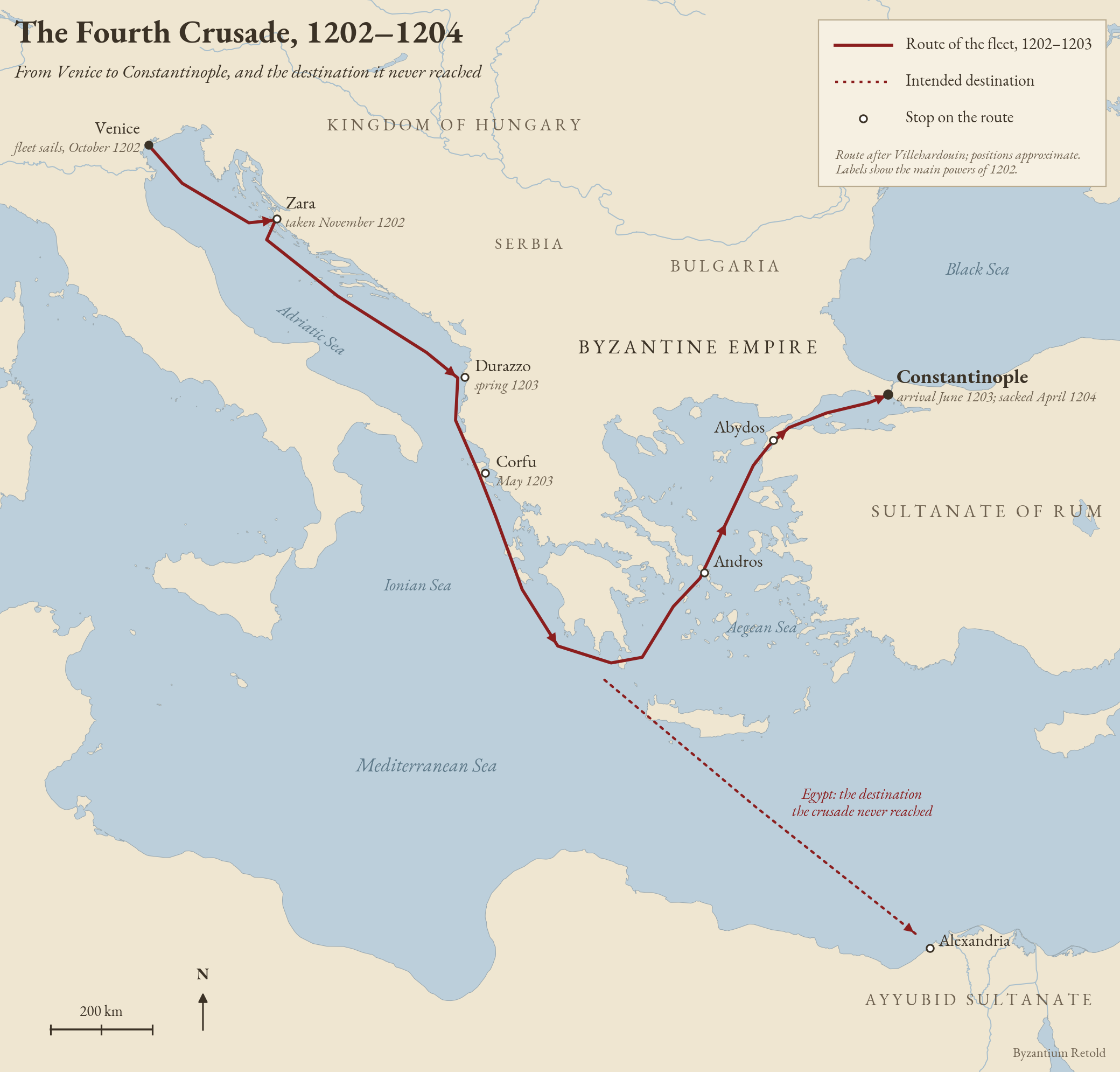
The leaders of the crusade that Innocent called in 1198 intended to invade the heart of Ayyubid power in Egypt. This was considered the key to capturing Jerusalem. However, Egypt could only be reached by sea, and only one Christian power had a fleet large enough to do so. This was Venice.
In April 1201, the crusader representatives, including the marshal of Champagne, Geoffrey of Villehardouin, who wrote the most detailed account of the expedition, signed a contract with Doge Enrico Dandolo. Venice assumed the obligation to build ships for 4,500 knights and their horses, 9,000 squires, and 20,000 infantry soldiers. This would cost 85,000 silver marks. The Republic would also provide fifty war galleys. Venice would be given half of the crusaders’ conquests. Much of Venice’s economy was used to build the fleet.
The fleet was completed on time, but the army was not. When the crusaders gathered on the Lido in the summer of 1202, only a third of the men had arrived. Many had decided to sail from different ports. Even with the barons giving up their silver plate, they were still short by 34,000 marks. Dandolo, in his nineties, offered to wait to be paid if they would help him recapture Zara, a Christian city whose overlord, King Emeric of Hungary, had also taken the cross. Despite Innocent III’s prohibition, they captured the city in November 1202 and were excommunicated by the pope. Some, such as Simon de Montfort, refused to fight and left the army. However, most stayed. The crusade had already attacked Christians.
The Prince
In January 1203 Germany sent emissaries to Zara to negotiate a deal with the crusaders, on behalf of a young man named Alexios Angelos. He was the son of the blind Isaac II; he had fled Constantinople in 1201 and found refuge with his sister and her husband, Philip of Swabia. He offered to reward them with 200,000 silver marks if they placed him and his father on the throne. He also proposed to pay for 10,000 soldiers to fight for a year in Egypt, 500 knights to protect the Holy Land for the rest of his life, and to submit the Greek church to Rome.
It was a proposal hard to refuse. The leader of the crusade, Marquis Boniface of Montferrat, had personal connections to Constantinople since his brother Renier had married a daughter of Manuel I and was murdered there in the chaos of 1182. Another brother, Conrad, had served Isaac II and left the city bitter. Dandolo would be paid and have a friendly emperor on the Bosporus. For the common soldiers it was seen as a slight detour, and they were also told that the people of Constantinople would be pleased to have their rightful prince enthroned.
Twice Besieged
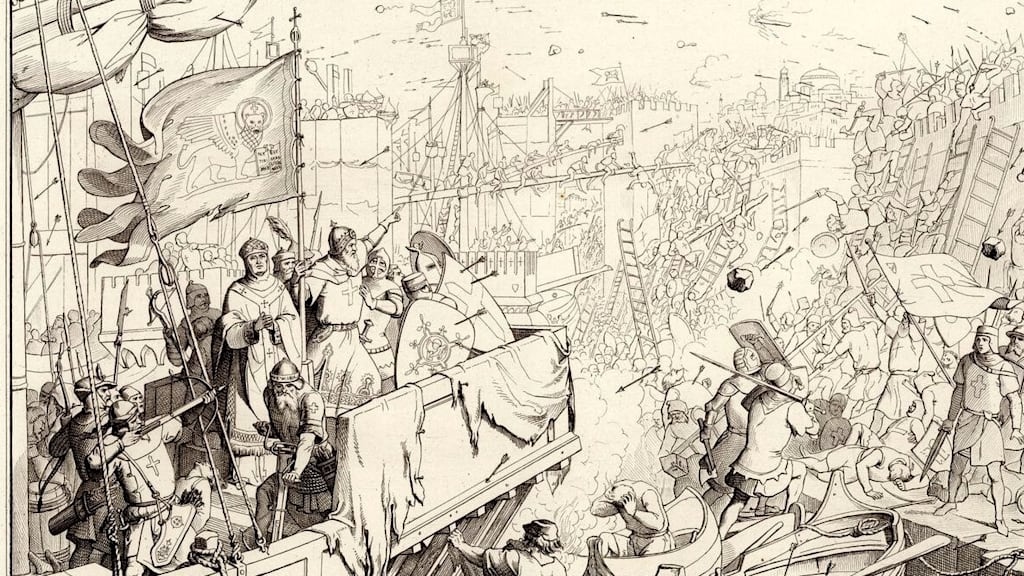
In June 1203, the fleet arrived outside Constantinople and found the gates of the city closed. On July 17 the crusaders attacked both by land and sea. The Frankish knights were repulsed by the Varangian Guard, while the Venetians attacked the sea walls of the Golden Horn. The old doge stood at the front of his galley in full armor, with the banner of Saint Mark in front of him. He ordered his men to put him ashore. The Venetians attacked and managed to take some of the walls. Then, they set fire to the quarter. Later that night Alexios III fled along with his daughter and much of the treasury. The next morning the courtiers took the blind Isaac II out of prison and restored him to the throne. His son was crowned beside him on August 1 as Alexios IV.
However, Alexios IV had promised much more than he had in the treasury. He paid part of the money and took silver from the churches. With every payment he became more hated by his people. In August a group of Westerners attacked a mosque and started a fire that raged for days and destroyed much of the city. By winter the young emperor had stopped the payments, and the crusaders were desperate as they camped across the Golden Horn.
In late January 1204 a nobleman called Alexios Doukas (nicknamed Mourtzouphlos due to his thick overhanging eyebrows) seized power and within days had Alexios IV strangled in prison. Old Isaac died around the same time. Mourtzouphlos, now known as Alexios V, fought hard and reinforced the walls. However, Alexios IV’s assassination provided the crusaders with the excuse they were seeking. Their clergy proclaimed the Greeks schismatics and murderers of their lord.
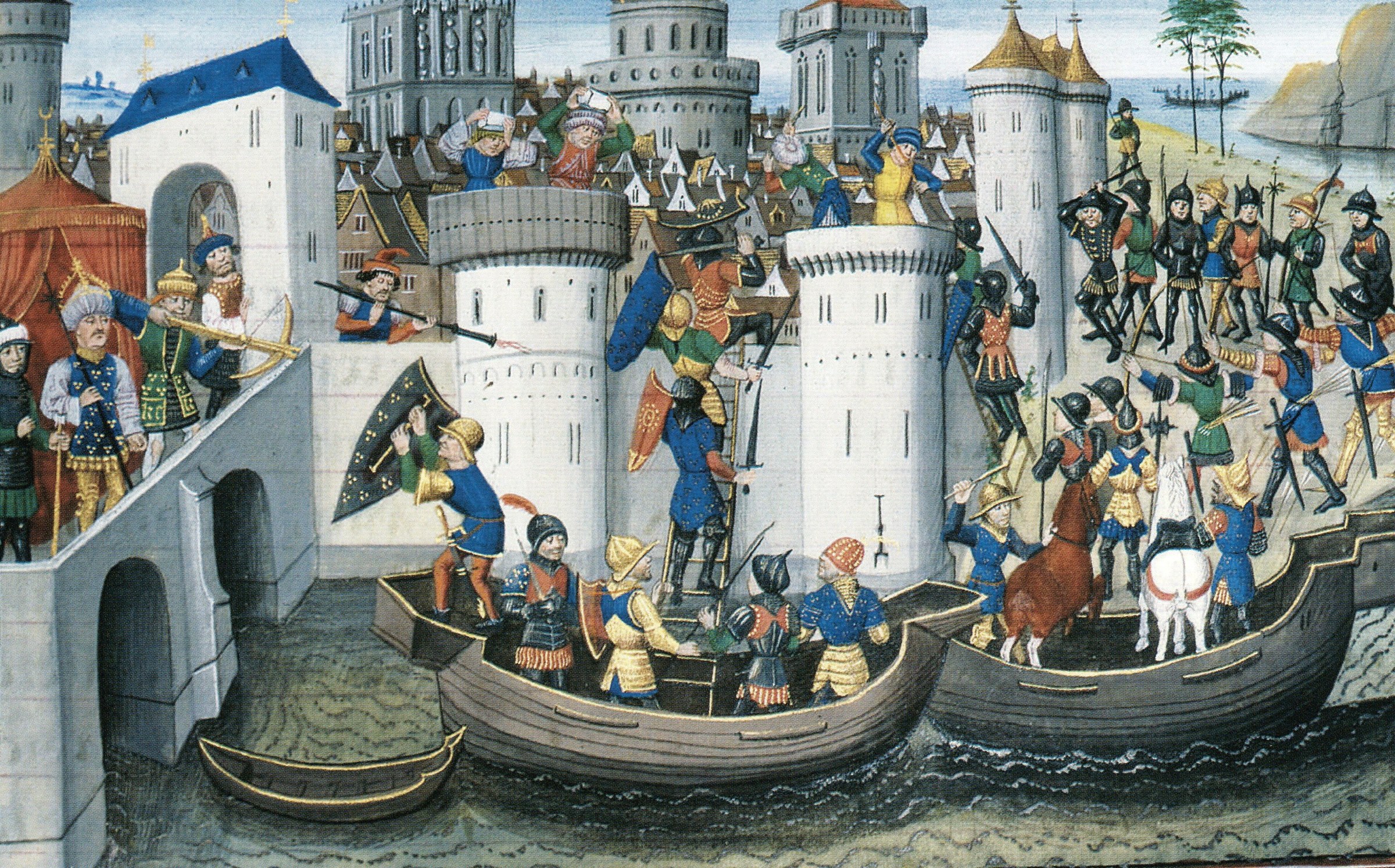
In March 1204 the crusaders and Venetians agreed in advance how they would split the empire. On April 9 they attacked the sea walls but failed. On April 12 they attacked again. Two ships worked together to attack a tower with their flying bridges, while at another spot a cleric named Aleaumes (brother of chronicler Robert of Clari) crawled through a hole in the wall to let the knights in. Mourtzouphlos fled during the night, and by the next morning the city was theirs.
Three Days in April
The city was pillaged for three days. Choniates recounted that the beautiful altar of Hagia Sophia was destroyed by the soldiers and shared among them. Women and nuns were sexually assaulted in the streets. Huge bronze statues, some of them made by the most famous sculptors of antiquity, were melted down to make coins. One of the statues was a huge Hercules attributed to Lysippos. The four bronze horses of the basilica of Saint Mark in Venice were taken at this time. They were probably taken from the Hippodrome. Relics were sent to the West. The monk Gunther of Pairis proudly described how his abbot, Martin, stuffed the folds of his robes with relics from a Constantinople monastery.
Count Baldwin of Flanders was crowned as the first Latin emperor of Constantinople in Hagia Sophia.
Accident or Plan?
For many years historians debated whether there was a plan behind the diversion. Some blamed Venice for secretly making an agreement with the sultan of Egypt to secure its trade routes, while others blamed Philip of Swabia and Boniface of Montferrat. However, most of these theories have been debunked. Donald Queller and Thomas Madden explain in their book about the crusade that there was no plan but rather a series of decisions that had to be made by the crusaders. The first reason for this was the problem of the empty Venetian ships. Michael Angold and Jonathan Phillips show that with the long history of distrust between the Byzantines and Latins, the decisions were easily made. Jonathan Harris shows that Byzantine diplomacy had meant that the empire had very few allies among the Western powers.
The most well-known theory is the one about Dandolo. According to the Chronicle of Novgorod, Emperor Manuel I had ordered him blinded; the legend placed this during his embassy to Constantinople in 1172. This would mean that it was an act of revenge by a blind man in 1204. Although a great story, this is almost certainly false. Thomas Madden has shown that in 1174 Dandolo was still signing documents with a steady hand. His sight was lost later on in his life, most likely due to a blow to the head. Villehardouin comments that Dandolo’s eyes looked normal even though he could not see.
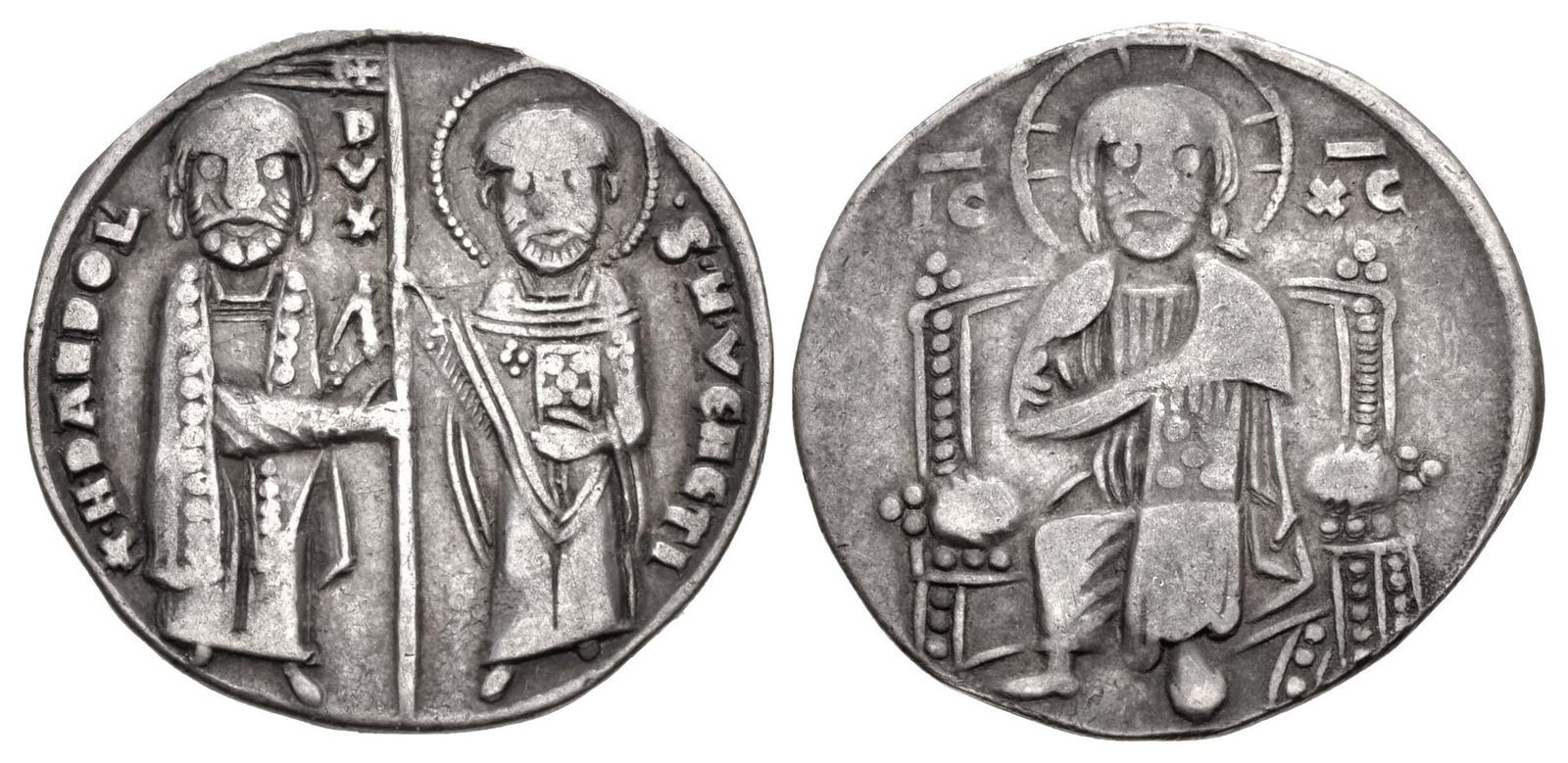
The sacking of Constantinople was not an act of personal revenge. In fact, it was much worse as it was carried out by practical men looking out for themselves.
What Was Lost in 1204?
The empire was divided up as agreed in March. Venice received three-eighths of the empire. The doges referred to themselves as lords of “a quarter and half of a quarter” of the Roman Empire. Boniface became king of Thessalonica. Venice gained control of key ports and islands (including Crete).
The Byzantine world did not die but split. Theodore Laskaris (son-in-law of Alexios III) created an exiled empire in Nicaea. A branch of the Angeloi family created a state in Epirus. Two grandsons of Andronikos I created their own empire in Trebizond on the Black Sea. The Latin Empire was weak from the start. In April 1205 the Bulgarian tsar Kaloyan destroyed its army at Adrianople. Baldwin was captured and died in captivity. Dandolo died in Constantinople a few weeks later and was buried in Hagia Sophia.
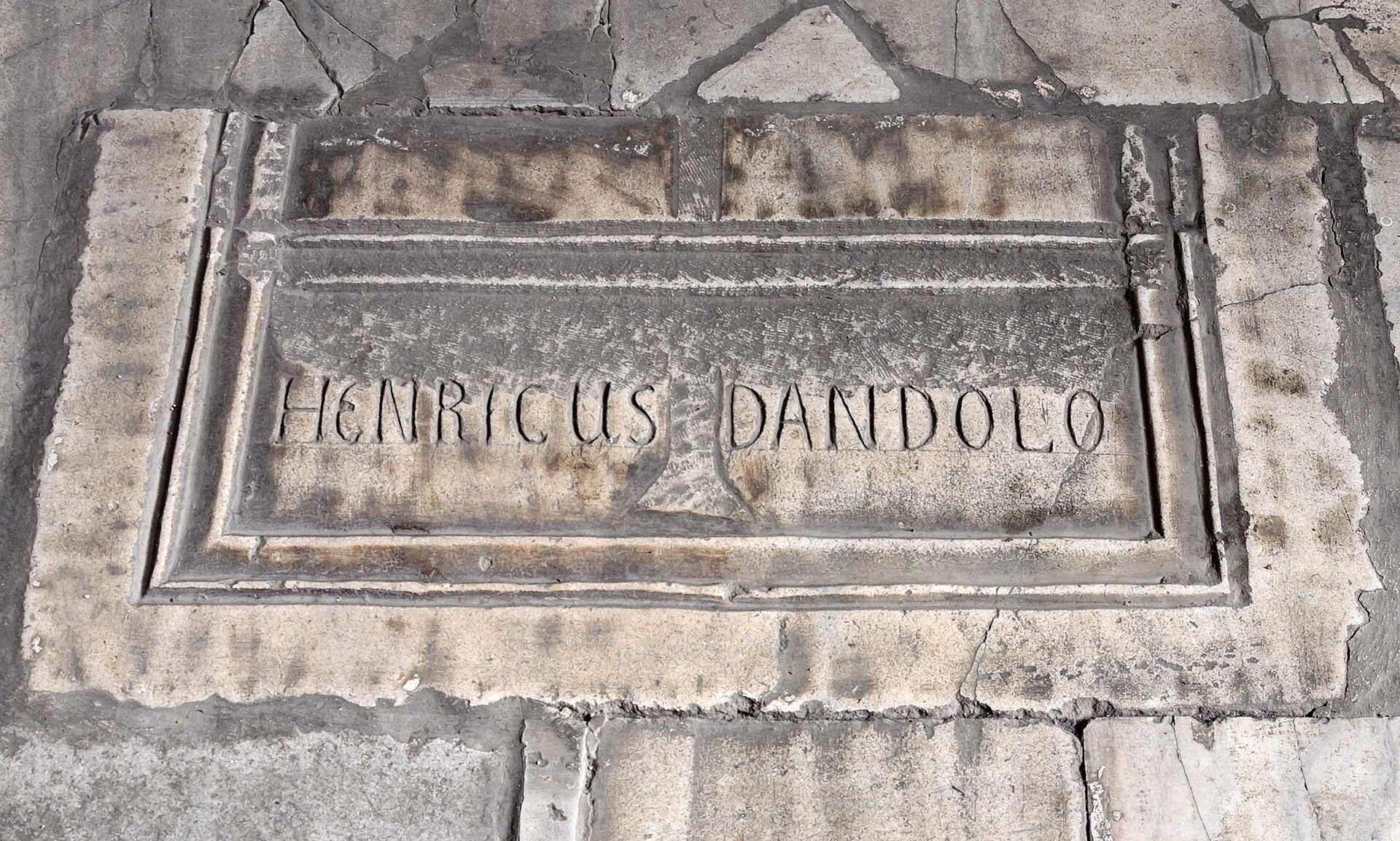
In 1261 the emperors of Nicaea regained Constantinople. However, the empire that Michael VIII Palaiologos restored was a fraction of the size it had been in 1203. It was poorer and smaller. It was surrounded by enemies. When the Ottomans arrived a century later, it had no resources to stop them. The fall of 1453 can be traced back to 1204.
The split between the churches became hatred. Innocent III, who was initially pleased with the news, wrote angrily to his legate in 1205. He wrote that the Greek church now saw in the Latins only “an example of perdition and the works of darkness” and with reason detested them “more than dogs.” Eight centuries later Pope John Paul II told the Ecumenical Patriarch Bartholomew in June 2004 that he shared “the same indignation and sorrow” that Innocent III had expressed over what happened in April 1204. Later that year he sent relics of Saint John Chrysostom and Saint Gregory the Theologian back to the patriarchate.
Seven Lost Chances
Could it have been avoided? While we cannot experiment with history, we can look at points where it could have been stopped.
First, if the crusaders had arrived in Venice with the number of men they promised, there would have been no debt, no Zara, and no leverage. Queller and Madden argue this was the start of everything.
Second, if the empire had had a fleet, the Venetian ships would not have gotten into the Golden Horn in 1203. The navy had fallen into decay during the Angeloi reign. Choniates blames this on the greed of Michael Stryphnos. This left the city vulnerable at its weakest point, the sea.
Third, if Alexios III had not blinded his brother in 1195, or the young Alexios had not fled to the West in 1201, there would have been no pretender to put on the throne. There would have been no reason for the crusaders to sail near the Bosporus.
Fourth, if Alexios III had not panicked in July 1203, the first siege might not have succeeded. He still had a larger army, but he chose to flee during the night.
Fifth, if the young Alexios had only promised what he could pay, the crusaders would have gotten their money and sailed to Egypt. It was the difference between what he promised and what he had in his treasury that turned allies into attackers.
Sixth, if Mourtzouphlos had not murdered Alexios IV, the crusaders would have had no moral or legal justification. Therefore, their clergy would have had no excuse to declare the final attack a just war.
Seventh, if Innocent III had had a way to enforce his bans, the crusaders would have stopped at Zara. He banned the attack on Zara and then Constantinople but had no way to make the army listen.
All of these chances were missed. The real issue was that after the arrests in 1171 and the massacre in 1182 the Byzantines and Latins no longer trusted each other. It was easy for both sides to think the worst.
The Horses of Saint Mark
The four bronze horses (actually copies) still stand on the front of Saint Mark’s in Venice. The originals are kept inside to be protected from the weather. Thousands of tourists take photographs daily, but very few know where they are from. They are the perfect monument to 1204. Beautiful, admired, and stolen.
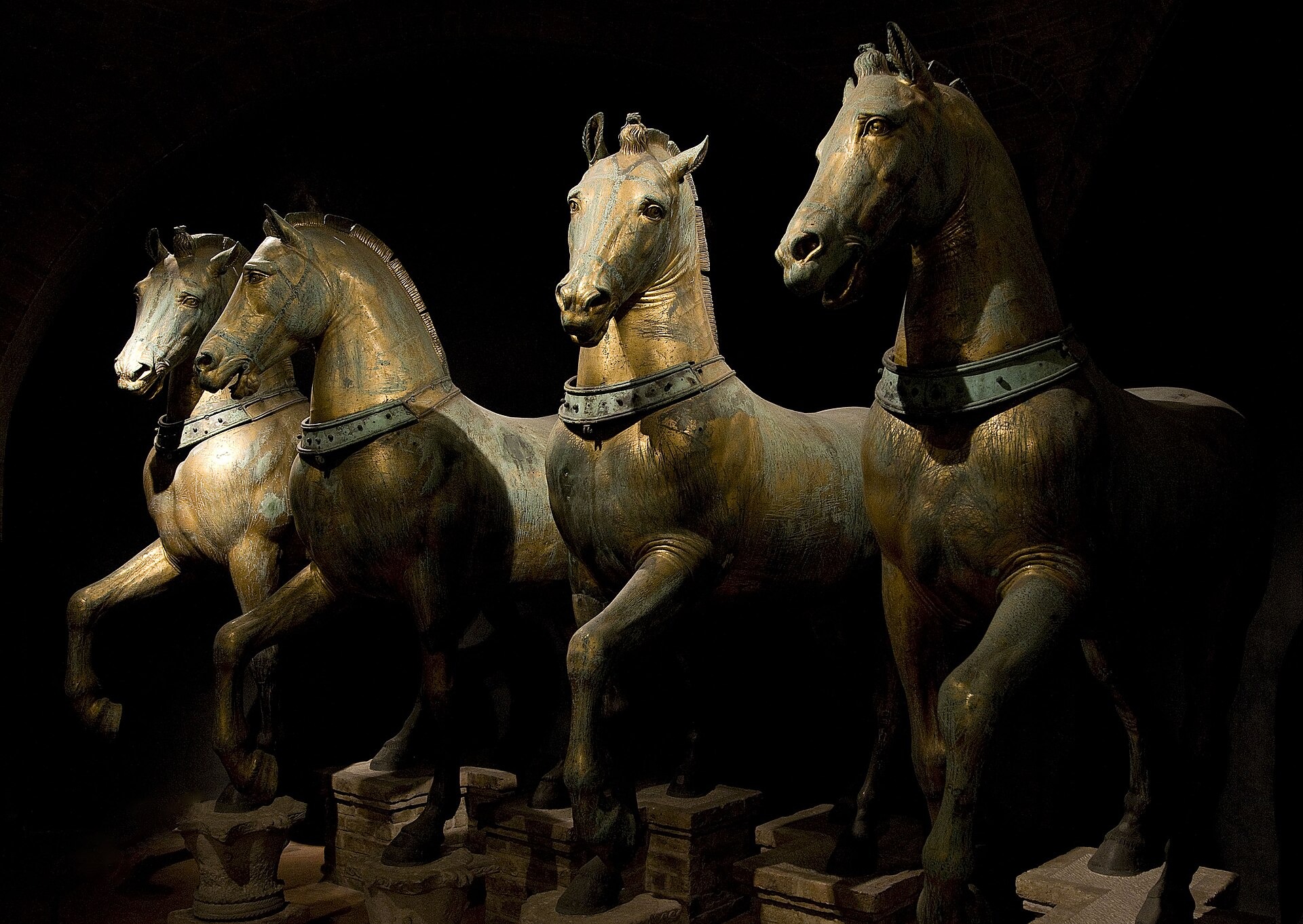
In a previous essay I argued that the momentum of the Komnenian recovery was lost after their defeat at Myriokephalon in 1176. The Fourth Crusade completed the job. Although Constantinople would last until 1453, it would never be the capital of a great power again after April 1204. It became an enticing prize.
Sources and Further Reading
Primary sources
Andrea, Alfred J., ed. and trans. Contemporary Sources for the Fourth Crusade. Leiden: Brill, 2000. Includes the letters of Innocent III.
Brundage, James A., trans. The Crusades: A Documentary History. Milwaukee: Marquette University Press, 1962.
Choniates, Niketas. O City of Byzantium: Annals of Niketas Choniates. Translated by Harry J. Magoulias. Detroit: Wayne State University Press, 1984.
Gunther of Pairis. The Capture of Constantinople: The Hystoria Constantinopolitana of Gunther of Pairis. Edited and translated by Alfred J. Andrea. Philadelphia: University of Pennsylvania Press, 1997.
John Paul II. Address to His Holiness Bartholomew I, Ecumenical Patriarch of Constantinople, June 29, 2004. Vatican.va.
The Chronicle of Novgorod, 1016–1471. Translated by Robert Michell and Nevill Forbes. London: Royal Historical Society, 1914.
Robert of Clari. The Conquest of Constantinople. Translated by Edgar Holmes McNeal. New York: Columbia University Press, 1936.
Villehardouin, Geoffrey of. “The Conquest of Constantinople.” In Joinville and Villehardouin: Chronicles of the Crusades, translated by Caroline Smith. London: Penguin, 2008.
Modern studies
Angold, Michael. The Fourth Crusade: Event and Context. Harlow: Pearson Longman, 2003.
Brand, Charles M. Byzantium Confronts the West, 1180–1204. Cambridge, MA: Harvard University Press, 1968.
Harris, Jonathan. Byzantium and the Crusades. 2nd ed. London: Bloomsbury, 2014.
Kaldellis, Anthony. The New Roman Empire: A History of Byzantium. New York: Oxford University Press, 2023.
Madden, Thomas F. Enrico Dandolo and the Rise of Venice. Baltimore: Johns Hopkins University Press, 2003.
Nicol, Donald M. Byzantium and Venice: A Study in Diplomatic and Cultural Relations. Cambridge: Cambridge University Press, 1988.
Phillips, Jonathan. The Fourth Crusade and the Sack of Constantinople. London: Jonathan Cape, 2004.
Queller, Donald E., and Thomas F. Madden. The Fourth Crusade: The Conquest of Constantinople. 2nd ed. Philadelphia: University of Pennsylvania Press, 1997.
Image credits
Header image: The Venetian fleet storms the sea walls of Constantinople in July 1203, with the doge in the prow beneath the banner of Saint Mark. Engraving after Giuseppe Gatteri, from Storia veneta (Venice, 1863). Public domain, via Wikimedia Commons; cropped.
Grosso of Enrico Dandolo: Classical Numismatic Group, CC BY-SA 2.5 (creativecommons.org/licenses/by-sa/2.5), via Wikimedia Commons.
Grave marker of Enrico Dandolo: Myrabella, CC BY-SA 3.0 (creativecommons.org/licenses/by-sa/3.0), via Wikimedia Commons.
Horses of Saint Mark: Tteske, CC BY 3.0 (creativecommons.org/licenses/by/3.0), via Wikimedia Commons.
About the Creator
S. Kallistos
Greek author of novels set in Byzantine Constantinople (The Keyholder, The Unforgotten). Here I write about Byzantium’s emperors, battles, heresies, and forgotten lives. More in my free newsletter, Byzantium Retold.
Enjoyed the story? Support the Creator.
Subscribe for free to receive all their stories in your feed.
Comments
There are no comments for this story
Be the first to respond and start the conversation.