
Thanksgiving on September 8, 1565, was one of the first
A gathering in St. Augustine, Florida came before Plymouth Rock.
Thanksgiving, as we know it today, is the fourth Thursday in November. Much about the holiday has evolved beyond the traditional 1621 Plymouth Rock story. Virginians acknowledge a day of thanks happened in December 1619. An earlier event occurred on September 8, 1565, in St. Augustine, Florida.
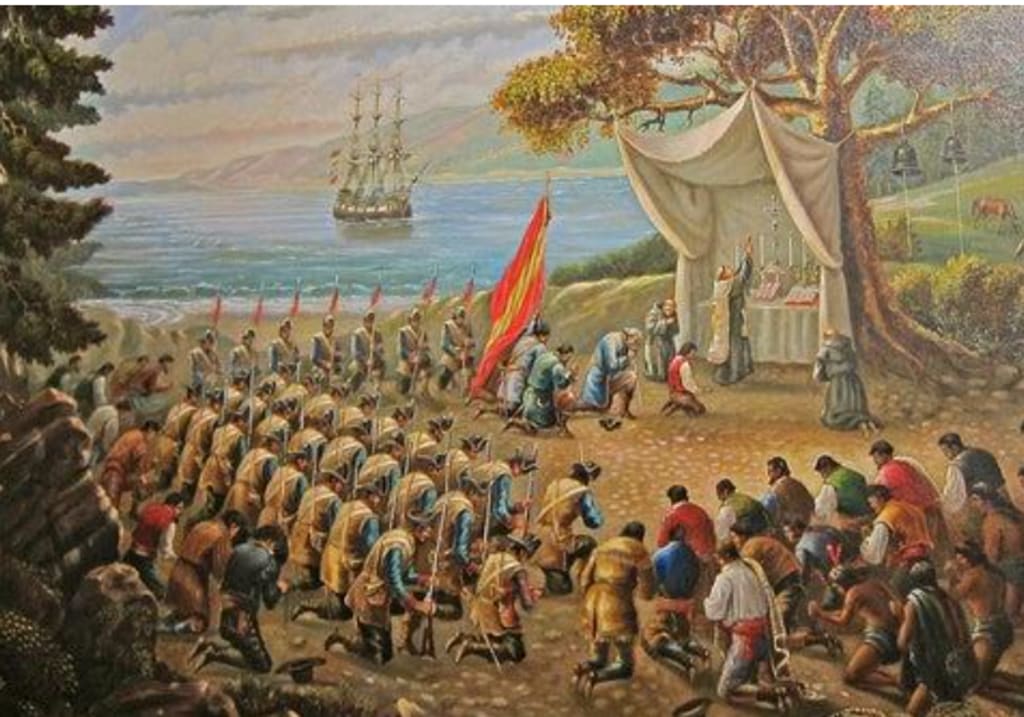
On that day, Spanish Admiral Pedro Menéndez de Avilés arrived in the Sunshine State with around 800 settlers. He first sighted land in Florida on August 28 of that year, which was the feast day of Saint Augustine, a Christian Bishop.
After coming ashore, they celebrated a Catholic Mass of Thanksgiving led by Father Francisco López de Mendoza Grajales. This is when the Admiral named the area for Bishop Saint Augustine of Hippo.
Americans have been told that the Pilgrims and Natives celebrated the first Thanksgiving in 1621, but records indicate that Virginians had a feast at the Berkley Plantation on December 4, 1619.
More than 50 years earlier, in St. Augustine, the settlers who came ashore had the Eucharist (Holy Communion in Protestant churches) to thank the Creator for safe passage.
Following the religious service, Menéndez invited local natives, the Seloy Indigenous community, to share a meal. The Seloy were a group of Timucua Native Americans who lived in Northeast Florida when the Spanish arrived. The Natives were located where the Fountain of Youth Archeological Park is today.
They celebrated America's first colony; historians suggest that, based on the provisions the Spanish had aboard their ships, the meal may have included hard sea biscuits, chickpeas, red wine, and salted pork. This is nothing like the traditional modern meal of turkey and all the trimmings.
If the Indigenous participants contributed local foods, the meal may also have included fish, corn, beans, squash, or venison. This is what was possible and not confirmed as part of the menu.
The National Park Service identifies this as the first community religious service and thanksgiving meal associated with the first permanent European settlement in what is now the United States.
Baby Boomers have, for the most part, upheld the traditions of their ancestors, but younger generations have become creative; Thanksgiving is observed in different ways today.
Most Americans continue to have a traditional turkey dinner with family and friends. Many churches have Thanksgiving services on Wednesday night or Thursday morning. There is Friendsgiving Day where people get together with friends who are not family.
There is a sunrise service at Alcatraz Island on Thanksgiving Day called Unthanksgiving, which honors Indigenous people. Some Americans abstain completely from the holiday. Others are thankful for family and friends but do not believe there is a God.
A majority of Americans will probably always acknowledge the fourth Thursday in November as the official Thanksgiving holiday, but history reveals that there were at least two celebrations, one in Florida and the other in Virginia, before Plymouth Rock.
It is often difficult when something we have believed for many years is challenged or proven wrong. Thanksgiving has evolved in other ways, with different ways to acknowledge the date. Three are the National Day of Mourning, Unthaksgiving Day, and the Drumstick Dash.
The National Day of Mourning is held annually on the fourth Thursday of November in Plymouth, Massachusetts. This is a solemn protest organized by Indigenous peoples to honor Native ancestors and draw attention to the history of genocide, displacement, and broken treaties.
Unthanksgiving Day is an annual sunrise ceremony held on Alcatraz Island in San Francisco by Indigenous activists. The purpose is to commemorate Native survival, sovereignty, and resistance.
The Drumstick Dash takes place on Thanksgiving morning in Virginia, California, Indiana, and Minnesota. The annual race, where you can walk or run, raises money for shelters that care for the homeless.
Gone are the days when a majority of American families gathered around a table to thank God and eat good food, then watched football games. The one constant in life is changed, and Thanksgiving certainly has evolved.
About the Creator
Cheryl E Preston
Freelance writer, newspaper columnist, published author, and poet.
Enjoyed the story? Support the Creator.
Subscribe for free to receive all their stories in your feed. You could also become a paid subscriber, letting them know you appreciate their work.
Comments
There are no comments for this story
Be the first to respond and start the conversation.