
The Beautiful Place That Killed So Many People
The year was 1986 and this beautiful place killed hundreds without warning.

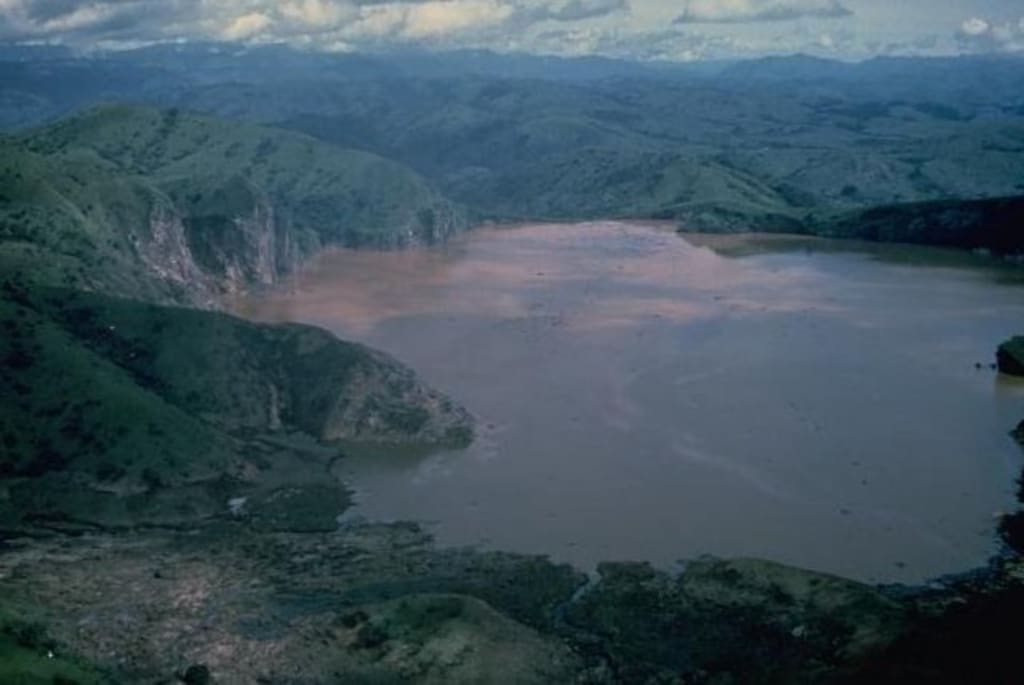
Imagine going to bed one evening beside one of Africa's most beautiful lakes. The water is calm, and the surrounding hills are quiet. The night seems completely ordinary.
There is no approaching storm and no earthquake strong enough to wake you. There are no explosions and no warnings that anything is wrong. But sometime during the night, something deadly begins moving through the darkness.
There’s danger, but it can’t be seen. It has no smell that warns you of its presence as it moves downhill, silently spreading through villages and across the surrounding landscape.
By morning, more than 1,700 people will be dead. And the source of the disaster will be the very thing that made the landscape so beautiful. The lake. This is the story of Lake Nyos in Cameroon, and one of the strangest natural disasters in modern history.
A Beautiful Place Hiding a Terrifying Secret
Lake Nyos sits in northwestern Cameroon, surrounded by green hills and volcanic terrain. At first glance, there is nothing particularly threatening about it. It looks like the kind of place where people might fish, raise families, and build peaceful communities.
But beneath its peaceful surface was an extraordinary geological danger.
Lake Nyos occupies an ancient volcanic crater. Deep beneath the surrounding ground, carbon dioxide was slowly making its way upward from geological sources. The gas entered the lake and accumulated in its deep water.
Ordinarily, carbon dioxide entering a lake can escape into the atmosphere. But Lake Nyos had an unusual structure. Its deeper water remained separated from the upper layers, allowing enormous quantities of dissolved gas to build up over time.
Think of a bottle of carbonated water. As long as the pressure remains high, the gas stays dissolved. Release that pressure suddenly, and the liquid can erupt with bubbles.
Lake Nyos contained something similar, except the consequences would be catastrophic. Scientists had no reason to believe that a seemingly ordinary lake could become such a deadly reservoir.
That was until August 21, 1986.
The Night the Lake Turned Deadly
Something triggered a massive release of carbon dioxide from the lake. Scientists still cannot establish with certainty exactly what initiated the event. The important thing is what happened next.
A tremendous quantity of dissolved gas escaped from the water, creating a dense cloud that spread outward and flowed downhill into the surrounding valleys. Carbon dioxide is invisible, and at sufficiently high concentrations, it displaces oxygen and can cause unconsciousness and death.
The cloud moved through populated areas, catching people and animals completely unaware. According to NASA’s account of the disaster, the gas cloud traveled at more than 100 kilometers per hour. People had virtually no opportunity to understand what was happening, much less escape.
By the time the disaster was over, at least 1,700 people had died. Approximately 3,500 livestock were also killed, along with countless birds and animals. Entire communities had been devastated.
Some survivors were found unconscious. Others had managed to escape the affected areas. What made the disaster particularly disturbing was the absence of the usual signs associated with a catastrophe.
There had been no typical volcanic eruption or towering column of smoke. There was no river of lava or obvious explosion. A lake had released an invisible cloud of gas, and people had died.
Scientists Faced a Mystery
When investigators arrived, they were confronted with a scene that initially seemed almost impossible to explain. Why had so many people and animals died in one particular area? Why had the surrounding landscape escaped the same destruction? And how could a lake cause a disaster of this magnitude without an eruption?
An American scientific team traveled to the region to investigate. Their work involved examining the lake, collecting water samples, studying geological evidence, and investigating the effects of the gas on the victims. The evidence pointed toward carbon dioxide stored in the deep water.
The scientific explanation is known as a limnic eruption. Unlike a conventional volcanic eruption, a limnic eruption involves the sudden release of enormous quantities of dissolved gas from a lake.
The process can begin when deep, gas-rich water rises toward the surface. As pressure decreases, dissolved gas comes out of solution, forming bubbles. Those bubbles can help lift even more deep water upward, potentially accelerating the release. The result can be a massive cloud of carbon dioxide spreading into nearby areas.
The Lake Nyos disaster became one of the clearest demonstrations of how dangerous this phenomenon can be. The investigators published their findings in an 87 U.S. Geological Survey report.
Scientists Find Another Problem
Solving the mystery didn’t immediately solve the danger. There was still an enormous amount of carbon dioxide dissolved in Lake Nyos. If the gas continued accumulating, another catastrophic release could potentially occur.
Scientists needed a way to remove the gas without triggering another disaster. The solution was ingenious.
They installed a long pipe extending into the deeper water of the lake. By carefully allowing gas-rich water to rise through the pipe, they could release carbon dioxide gradually rather than allowing it to accumulate until another dangerous event occurred.
They installed the first degassing pipe in 2001. Additional pipes followed later, and it was an extraordinary example of engineering being used to prevent a natural disaster.
The same scientific principles were also applied to Lake Monoun in Cameroon, where a smaller carbon dioxide release had killed 37 people in 1984. The research on degassing Lakes Nyos and Monoun explains how these efforts reduced the amount of accumulated gas.
Could Another Lake Do This?
Lake Nyos is not the only lake in the world capable of accumulating enormous quantities of dissolved gas. Farther east in Africa, on the border between Rwanda and the Democratic Republic of the Congo, lies Lake Kivu. It’s significantly larger than Lake Nyos.
Lake Kivu contains massive quantities of dissolved carbon dioxide and methane. Millions of people live in its surrounding region.
Scientists have studied the lake for decades because of the unusual geological and chemical conditions that allow these gases to accumulate. There’s a distinction to remember.
Lake Kivu is not Lake Nyos, and scientists don’t believe a repeat of the 1986 disaster is inevitable. Its conditions are different, and it is monitored regularly and studied.
The gases also represent a valuable energy resource, with methane being extracted for use as fuel. Nevertheless, the potential consequences of an uncontrolled release make understanding the lake very important.
Research continues into its stability, gas concentrations, and long-term behavior. The Swiss Aquatic Research Institute Eawag provides an excellent overview of the lake and its characteristics.
Nature Doesn’t Always Give A Warning
The tragedy of Lake Nyos is disturbing for more than the number of people who died. It challenges something many of us instinctively believe: that danger is supposed to look dangerous.
We expect warning signs, explosions, storms, shaking ground, rising water, or something that tells us to run. But nature doesn’t always work like that. Sometimes the most dangerous forces are hidden, masked by something beautiful and familiar.
A quiet lake can conceal an extraordinary amount of energy, and a peaceful landscape can become deadly without the warning signs we have learned to see. The people who lived around Lake Nyos had no reason to believe that the water beside their homes could become the source of such a catastrophe.
Today, scientists understand much more about these unusual lakes. Monitoring systems and degassing technology have made it possible to reduce certain risks. But the lesson remains.
On August 21st, 1986, a lake became a silent killer. And for thousands of people who lived nearby, the last ordinary evening of their lives looked exactly like every other one.
About the Creator
Jason Morton
From fiction to reality there’s tons to share about this crazy life. From being a single father, an officer, and having had many insane adventures while I learned about the world, my imagination runs wild with ideas.
Enjoyed the story? Support the Creator.
Subscribe for free to receive all their stories in your feed. You could also become a paid subscriber, letting them know you appreciate their work.
Comments
There are no comments for this story
Be the first to respond and start the conversation.