
The Second Iconoclasm: Compromise and Survival in 843
Part II of II (815–843): the second phase of Iconoclasm and the permanent restoration of icons

This is the second of two essays devoted to Byzantine Iconoclasm. Part I, which examines the origins and the instigators at the root of the conflict, is accessible here.
At the beginning of the ninth century, the crushing defeats that the Byzantines had suffered in their war against the Bulgars left even the countryside around Constantinople exposed to enemy raids. In June 813, while the army of Emperor Michael I was ready to fight Khan Krum at Versinikia, in Thrace, the patriarch and the people of the capital were holding a litany in the Church of the Holy Apostles. At that moment, a group of iconoclasts forced their way into the imperial mausoleum and threw themselves down before the tomb of Constantine V, the emperor most hated by the defenders of icons. They cried, “Arise and help the State that is perishing!” and then spread the rumor that the dead emperor had risen and ridden out on his horse to vanquish the Bulgarians again. They were arrested by the city prefect. A few days later, Krum routed Michael’s army.
Iconophile writers characterized Constantine V as both a persecutor and a direct enemy of the faith. But in 813, although he had been dead for thirty-eight years, to the military as well as to a large number of Constantinople’s residents, he was still the emperor under whom Byzantium had triumphed. The trick at his tomb failed, but it indicates what many people wanted to believe, and it provides a clearer explanation for the return of Iconoclasm than any theological treatise.
The iconoclast emperors and the argument from victory
A few weeks later, the army elevated General Leo the Armenian to the throne as Leo V. According to an anonymous source of his reign, Leo confided to his advisers his belief that while the iconoclast monarchs Leo III and Constantine V had subdued the empire’s enemies and died on the throne, the emperors who had venerated icons had been defeated, killed, or driven into exile. To reinforce his argument, he renamed his young son Symbatios “Constantine,” so that the military could acclaim the rulers as “Leo and Constantine,” similarly to the two victorious iconoclast emperors of the previous century.
In 814, Leo decided to take action and tasked a learned cleric, John the Grammarian, with assembling the writings of the Church Fathers that would be useful in supporting a return to the policy of 754. In March 815, he deposed Patriarch Nikephoros, who had refused to cooperate, and at Easter of that year he had a more compliant successor enthroned. Soon afterward, a synod convened in Hagia Sophia, and its definition praised the iconoclast emperors of the eighth century, upheld the council of 754, and condemned the veneration of what it called “spurious images.” Nonetheless, it represented a significantly milder version of its model. The historian Paul Alexander showed in his study of the text that the bishops of 815 stopped short of calling icons idols.
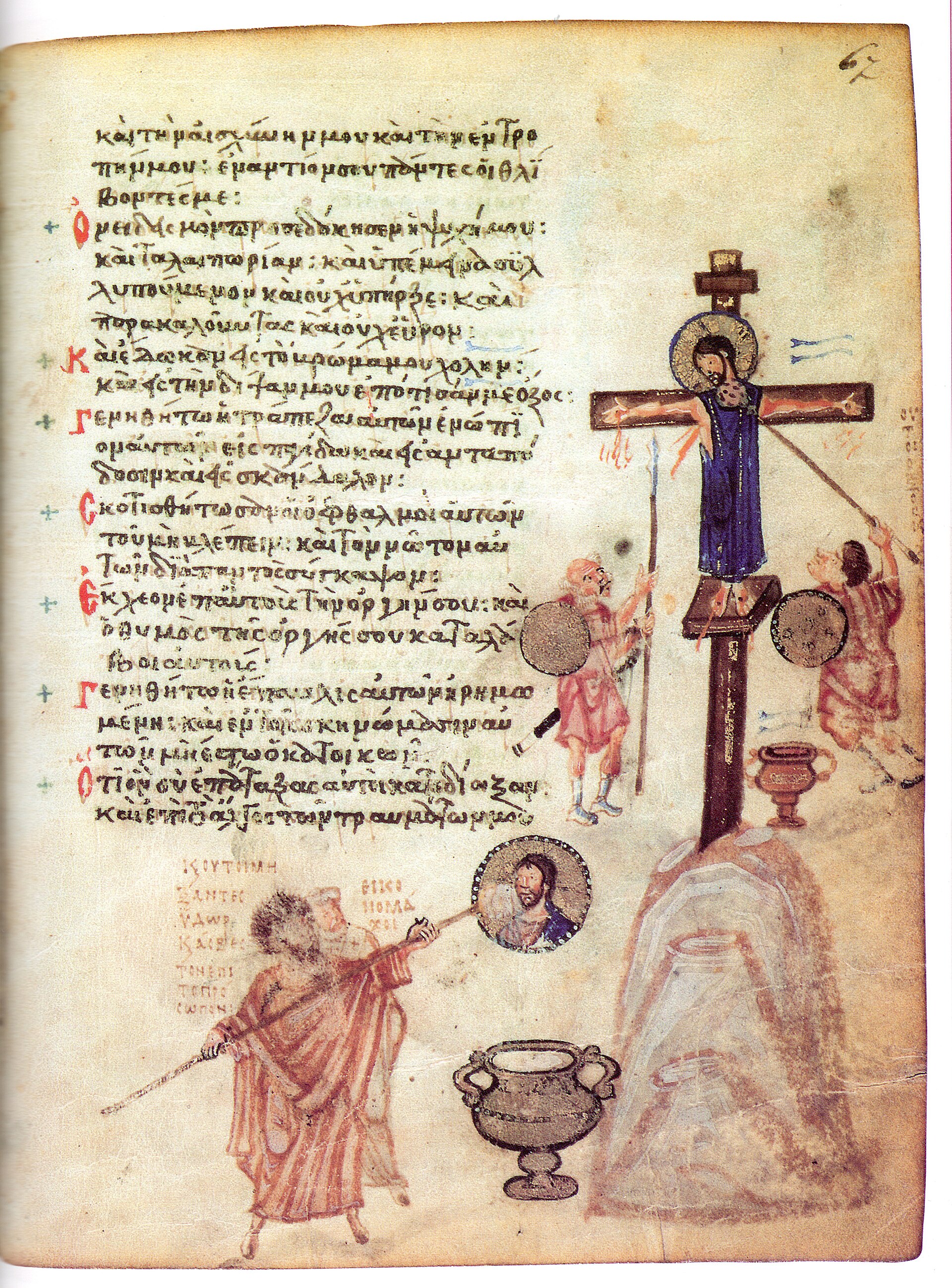
The abbot of the monastery of Stoudios, Theodore, was the leader of the most resolute resistance, which emanated from the monasteries of the capital. On Palm Sunday 815, in an overt act of defiance, his monks carried icons in procession through their monastery, and Theodore was soon sent into exile. From exile, he and the deposed Nikephoros wrote the most sophisticated defenses of images that the entire Iconoclastic Controversy produced.
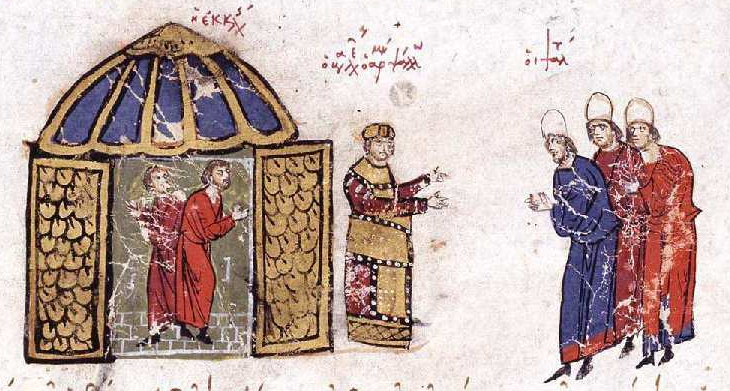
The argument from victory did not save the emperor who expressed it. On Christmas morning 820, assassins disguised as members of the choir infiltrated the palace chapel for the Christmas matins service (Orthros in Greek), and, despite the emperor’s vain resistance, they murdered Leo V before the altar, turning a feast day into a coup. The conspirators acted on behalf of one of his own officers, Michael of Amorion, who seized power as Michael II.
A measured persecution
The extent of the second Iconoclasm was smaller than the first’s in almost every respect. Although Michael II (820–829) recalled many exiles, he refused to restore the icons. In a letter he wrote in 824 to the Frankish emperor Louis the Pious, he complained about the excesses in the cult of icons, such as icons being dressed in robes, used as godparents at baptisms, or having their paint scraped off and mixed into the Eucharist. Whether or not such practices were common, the letter exhibits precisely the anxiety of the iconoclasts of the ninth century. Their main concern was not the art itself, but a popular devotion to icons that seemed to exceed the institutional control of the church.
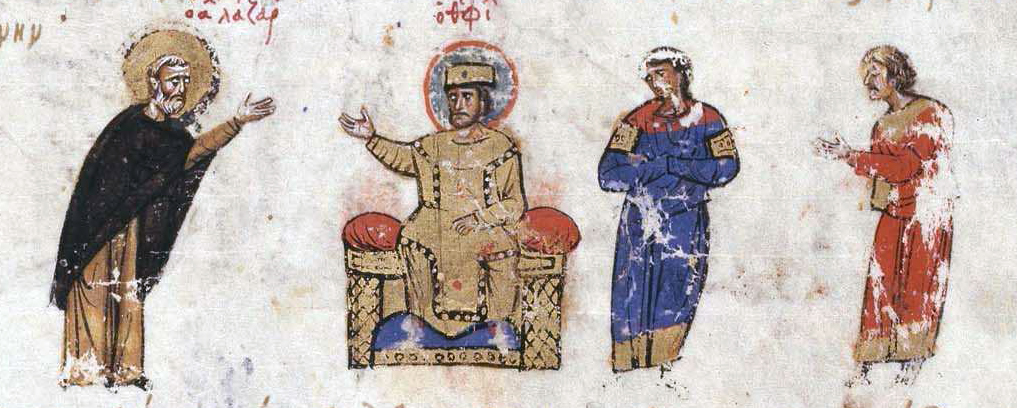
His son Theophilos (829–842) was the last committed iconoclast emperor, and a more energetic one than his father. In 837 he appointed his former tutor, John the Grammarian, as patriarch. He ordered the beating of two monks from Palestine, the brothers Theodore and Theophanes, and had insulting verses tattooed upon their faces, which earned them the sobriquet Graptoi (Greek for “the inscribed”). Furthermore, he had the hands of the icon painter Lazaros burned. Yet the persecution was confined to a small number of prominent defenders of icons and mainly to the capital. Theophilos’s own wife, Theodora, venerated icons secretly in her private apartments, and the iconophile monk Methodios lived at his court.
Meanwhile, the conceptual link between military victory and divine validation was fading over time. In 838 the caliph al-Muʿtasim won an astonishing victory over the empire by capturing and sacking Amorion in Asia Minor, the home city of Theophilos’s own dynasty, in one of the most devastating Byzantine defeats of the century. This was a critical event that demonstrated that an iconoclast emperor was now suffering losses to the Arabs, just as iconophile emperors had been defeated by the Bulgars. Whatever God was punishing, it was evidently not the reverence for icons alone.
The widow, the heir, and the price of peace
On January 20, 842, Emperor Theophilos died from dysentery. Given that his heir, Michael III, was merely two years old, Theodora assumed power as regent, together with a small group of advisers that included, among others, Theoktistos, a loyal official of her husband. She waited about a year and then convened a synod in Constantinople in early March 843. The synod deposed John the Grammarian, appointed Methodios as patriarch, reaffirmed the Second Council of Nicaea, and condemned the leaders of the iconoclast council of 815.
Notably, Theophilos’s name was not included in the list of those condemned, because of Theodora’s insistence on her husband’s exclusion; later sources assert that she assured the bishops that Theophilos had repented on his deathbed and kissed an icon. Regardless of whether this actually occurred, the exemption was a pure example of political necessity. It would have been simply absurd for a regent who ruled in the name of a child to allow the church to declare the child’s father a heretic. On March 11, 843, the first Sunday of Lent, Theodora, Methodios, and Theoktistos headed a procession with icons from the church of the Virgin Mary at Blachernae to Hagia Sophia, where Methodios celebrated the liturgy, signifying the official restoration of icons.
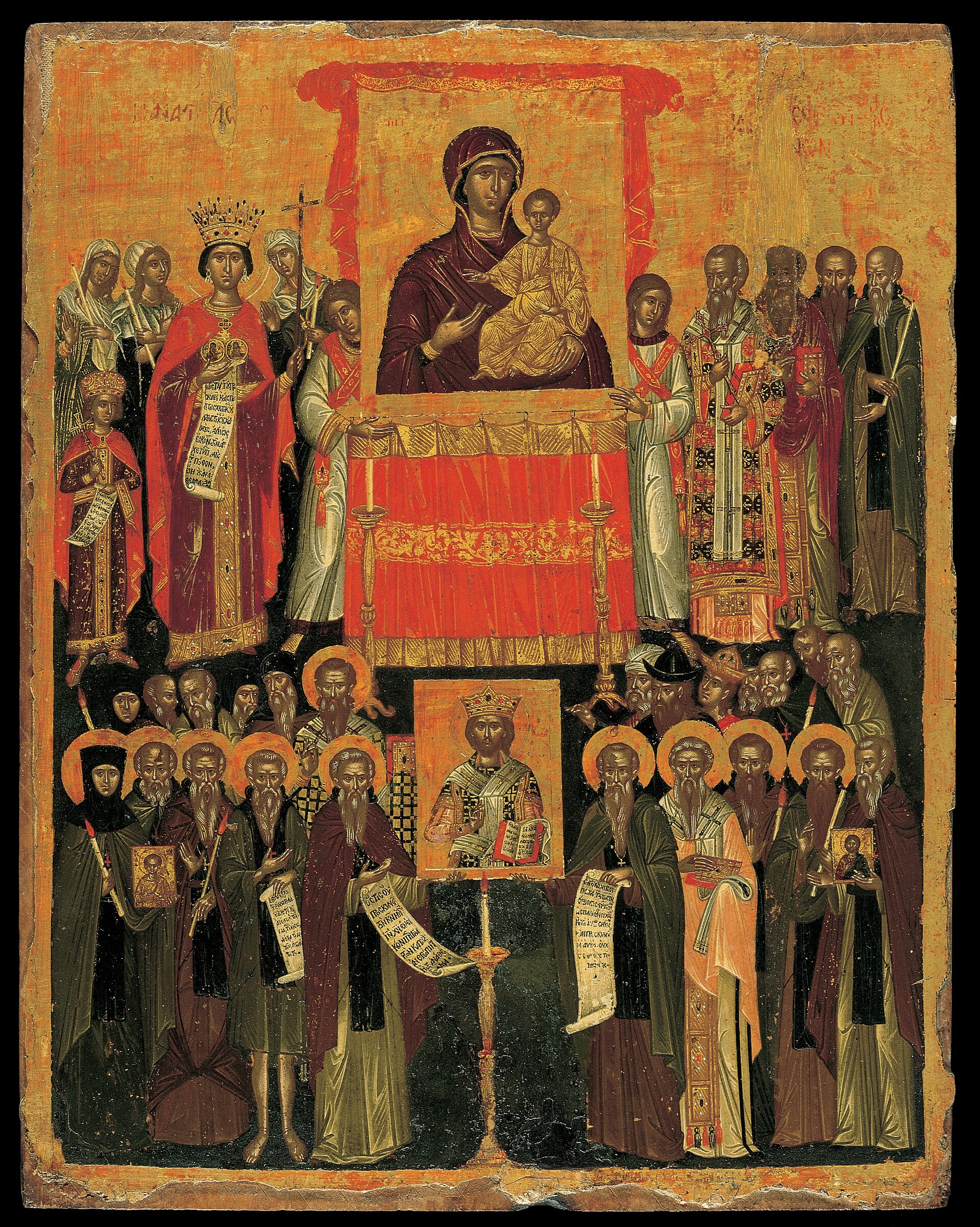
The people who carried out the restoration were not outsiders. Theoktistos had been one of Theophilos’s most trusted officials, while Methodios had lived at the imperial court for years. Even Theodora herself was related by marriage to the very patriarch she ousted. The Triumph of Orthodoxy was a real religious event, still celebrated by the Orthodox Church as such. It also represented an elite compromise, intended to reorient imperial religious policy while preserving the continuity of the Amorian dynasty and the court elite inherited from the last iconoclast emperor.
The anatomy of a final settlement
In contrast to Iconoclasm’s successful reemergence in 815, its permanent demise after 843 exposes the true factors that had originally driven it.
The first factor was the obsolescence of the military justification. Leo V’s argument that God rewarded iconoclastic regimes with victories in battle had died with him, and the fall of Amorion shattered whatever remained of it. That refutation was further affirmed when the empire’s military successes revived in the subsequent decades, and these victories were achieved under the reigns of iconophile emperors.
The second was the decisive settlement of the theological argument. By formulating a precise distinction, Theodore the Studite and Patriarch Nikephoros successfully countered the iconoclast critique. They argued that the image depicts the person of Christ instead of his essence, thus introducing a framework that neither conflated nor divided his dual natures. Their argument was strong enough to leave the iconoclast position without new defenders after 843.
The third was the elimination of the political motivation for resistance, caused by the settlement of 843. Through the deliberate protection of Theophilos’s memory, Theodora succeeded in rendering the return to icon veneration politically safe for both the ruling dynasty and the state bureaucracy that she inherited from her husband. With their offices and legitimacy secured, the imperial elites had no need to revert to the iconoclastic doctrine.
Finally, history was written by the victorious party. The story was firmly promulgated through three main sources: the Synodikon of Orthodoxy read annually on the first Sunday of Lent, the biographies of iconophile saints, and the official chronicles of the tenth century. These texts fixed the story in its present form, complete with the destruction of the Christ icon at the Chalke Gate and the women pulling down the officer’s ladder. The provocative title of Leslie Brubaker’s book, Inventing Byzantine Iconoclasm, captures the essence of this retrospective legacy.
What survived the compromise
Icons were permanently established as central objects of Orthodox worship in the years that followed 843. Their defenders had formulated an exact and detailed definition of the icon and protected it with a sophisticated defense it had never previously possessed. Before the start of the Iconoclastic Controversy, the icon had been simply a pious tradition, while after 843, it evolved into a formal doctrine, having been argued for in exile and paid for in suffering.
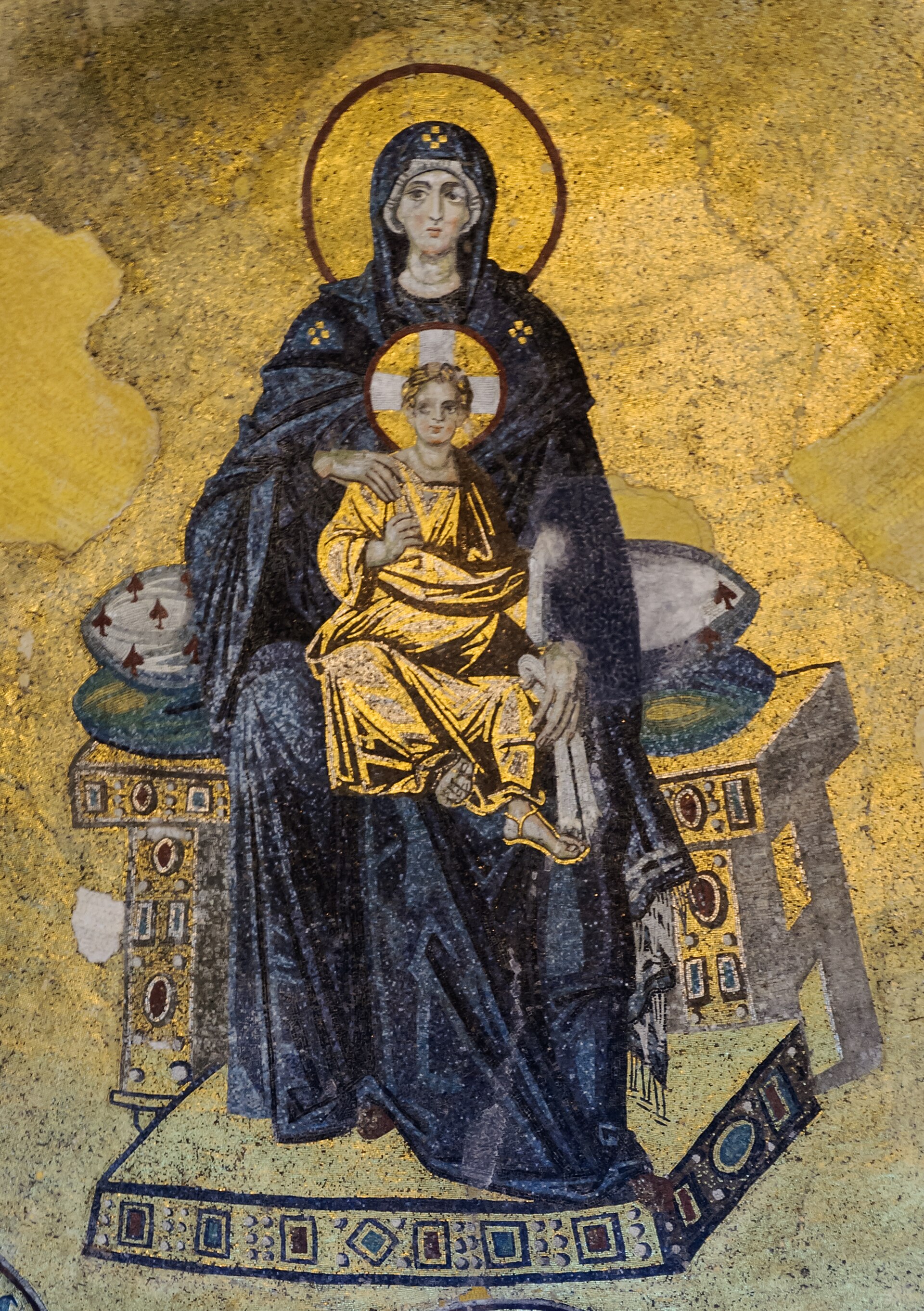
On March 29, 867, the new apse mosaic of the Virgin and Child in Hagia Sophia, which still looks down on the building today, was unveiled, accompanied by the preaching of Patriarch Photios. The subsequent art in the mosaics of the capital, its illuminated manuscripts, and the icons that traveled north to support the conversion of the Slavic world descended from the settlement of 843. Kievan Rus inherited the icon as the center of its religious imagination when it accepted Christianity from Constantinople in 988, entering the tradition in which Theophanes the Greek and Andrei Rublev would later work.
This theological victory shaped a core view of matter and spirit that still separates Eastern Orthodoxy from much of Western Christianity. For the Orthodox, an icon is not just a religious painting but a direct point of contact with the divine. The Western tradition, by contrast, has generally treated religious art as an educational tool for the faithful. The Orthodox view rests on a principle of Basil of Caesarea, later taken up by John of Damascus: the honor shown to an image passes to its prototype.
More than a smoke screen
Both parts of this series have argued against easy explanations. Iconoclasm cannot be conceived of either as a plan to seize monastic wealth or merely as Islam’s influence on Christianity. Nor was theology an excuse for politics. The Byzantines argued about images because they believed that the manner in which their empire prayed would determine its survival, and because the question of who controlled access to the divine was, for them, inseparably political and religious. Once the military crisis eased, the theological argument was settled, and Empress Theodora managed to find a way to resolve the issue by avoiding the condemnation of her own dynasty, the war over images was permanently terminated.
The Orthodox Church still celebrates the Triumph of Orthodoxy annually on the first Sunday of Lent. The icons carried in the procession through Constantinople in March 843 were old ones, brought out of hiding, while those painted later to honor the event are themselves now centuries old. The reasons icons have their current appearance lie in the choices made that spring by a regent, a child, a patriarch, and a minister, who believed at that time that they were settling a question about God and were, without fully realizing it, determining a great many other things.
Sources and Further Reading
Primary sources
Genesios. On the Reigns of the Emperors. Translated by Anthony Kaldellis. Canberra: Australian Association for Byzantine Studies, 1998.
Mango, Cyril, trans. The Homilies of Photius, Patriarch of Constantinople. Cambridge, MA: Harvard University Press, 1958.
Talbot, Alice-Mary, ed. Byzantine Defenders of Images: Eight Saints’ Lives in English Translation. Washington, DC: Dumbarton Oaks, 1998. Includes the Lives of the Patriarch Nikephoros and the Empress Theodora.
Theodore the Studite. On the Holy Icons. Translated by Catharine P. Roth. Crestwood, NY: St. Vladimir’s Seminary Press, 1981.
Theophanes Confessor. The Chronicle of Theophanes Confessor. Translated by Cyril Mango and Roger Scott. Oxford: Clarendon Press, 1997.
Theophanes Continuatus: Chronographiae quae Theophanis Continuati nomine fertur Libri I–IV. Edited and translated by Michael Featherstone and Juan Signes Codoñer. Berlin: De Gruyter, 2015.
Modern studies
Alexander, Paul J. “The Iconoclastic Council of St. Sophia (815) and Its Definition (Horos).” Dumbarton Oaks Papers 7 (1953): 35–66.
Brubaker, Leslie. Inventing Byzantine Iconoclasm. London: Bristol Classical Press, 2012.
Brubaker, Leslie, and John Haldon. Byzantium in the Iconoclast Era, c. 680–850: A History. Cambridge: Cambridge University Press, 2011.
Herrin, Judith. Women in Purple: Rulers of Medieval Byzantium. London: Weidenfeld & Nicolson, 2001.
Humphreys, Mike, ed. A Companion to Byzantine Iconoclasm. Leiden: Brill, 2021.
Hussey, J. M. The Orthodox Church in the Byzantine Empire. Oxford: Clarendon Press, 1986.
Noble, Thomas F. X. Images, Iconoclasm, and the Carolingians. Philadelphia: University of Pennsylvania Press, 2009.
Signes Codoñer, Juan. The Emperor Theophilos and the East, 829–842: Court and Frontier in Byzantium during the Last Phase of Iconoclasm. Farnham: Ashgate, 2014.
Treadgold, Warren. The Byzantine Revival, 780–842. Stanford, CA: Stanford University Press, 1988.
Image credits
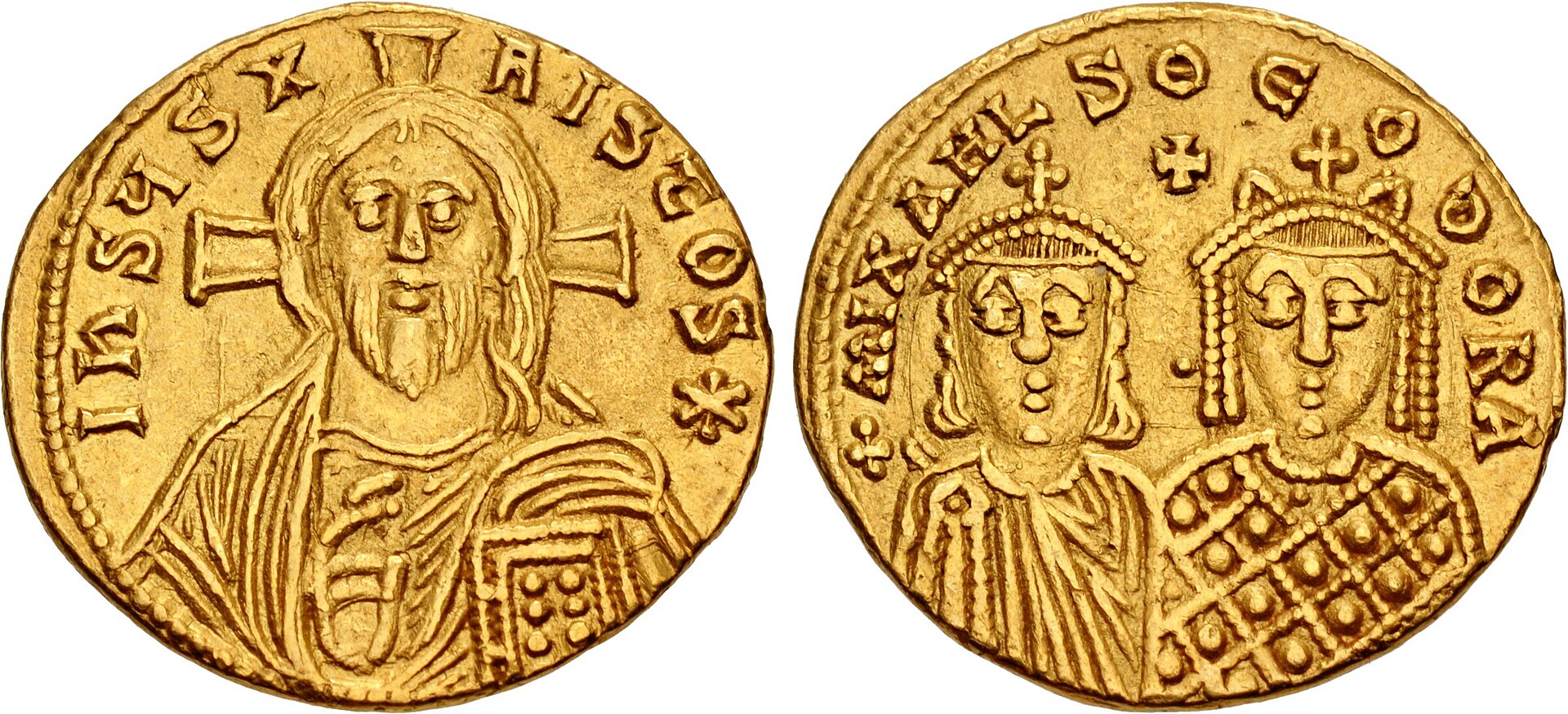
Solidus of Michael III and Theodora: Classical Numismatic Group, CC BY-SA 2.5 (creativecommons.org/licenses/by-sa/2.5), via Wikimedia Commons.
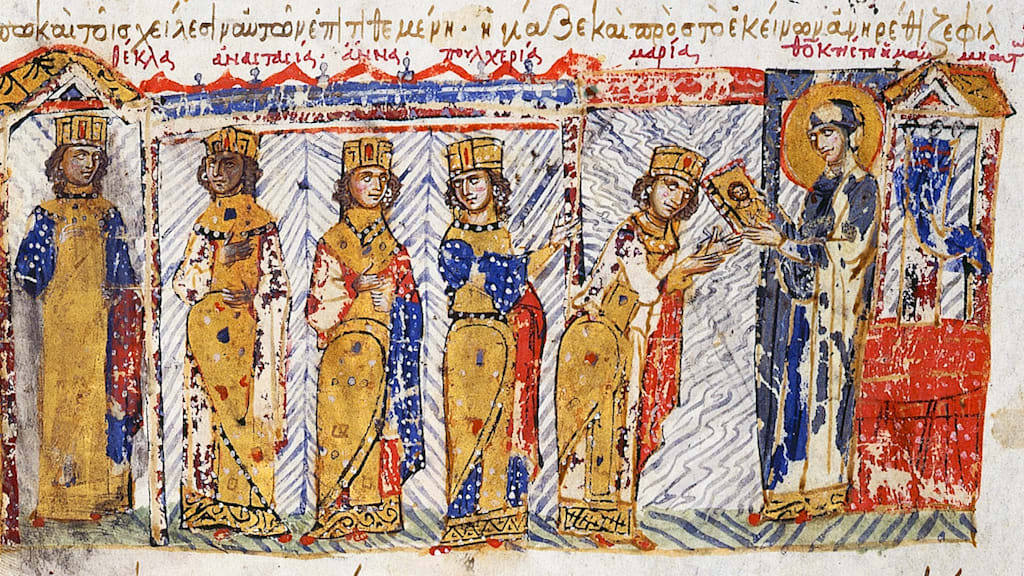
Header image: The daughters of Empress Theodora are taught to venerate icons by their grandmother Theoktiste, in a story set in the palace of the iconoclast emperor Theophilos. Madrid Skylitzes, twelfth century (Biblioteca Nacional de España, fol. 44v). Public domain, via Wikimedia Commons; cropped.
About the Creator
S. Kallistos
Greek author of novels set in Byzantine Constantinople (The Keyholder, The Unforgotten). Here I write about Byzantium’s emperors, battles, heresies, and forgotten lives. More in my free newsletter, Byzantium Retold.
Enjoyed the story? Support the Creator.
Subscribe for free to receive all their stories in your feed.
Comments
There are no comments for this story
Be the first to respond and start the conversation.