
THE BLUE TSUNAMI
AMERICA, BLACK WOMEN HAVE BEEN TRYING TO TELL YOU

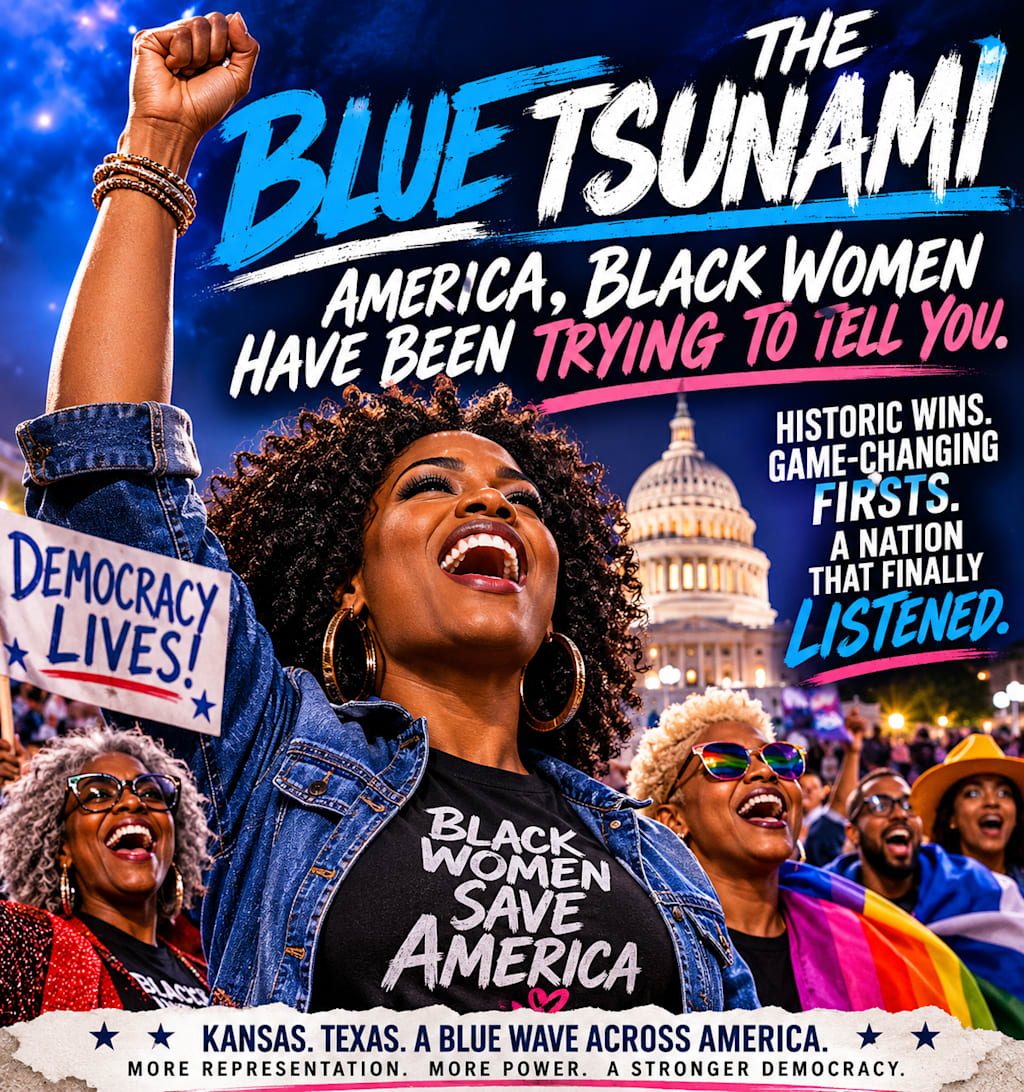
THE BLUE TSUNAMI: AMERICA, BLACK WOMEN HAVE BEEN TRYING TO TELL YOU
From Kansas to Texas, from historic firsts to political upsets, the 2026 midterms delivered a political earthquake. And if America wasn't listening before, perhaps it's time to pay attention now.
I don't know about y'all, but I am still trying to process what the hell happened last night.
And I mean that in the best possible way.
Because I have questions. I have commentary. I have a few things I'd like to say to the Republican Party, and quite frankly, I might need a minute before I stop laughing at some of these election results.
Bitch, THE BLUE TSUNAMI!
This wasn't a little political breeze. This wasn't a couple of Democrats sneaking into office while Republicans weren't paying attention. This was voters showing up across the country and reminding politicians of something they apparently forgot: Those seats belong to the people. Not the party. Not the president. Not the politicians who have gotten a little too comfortable sitting in them.
Democrats took back the House. Democrats took back the Senate. Republican-held seats fell in states that many people considered safe territory. Governors' offices changed hands, and communities that have historically been underrepresented in American politics sent people into positions of power that generations before them could only dream about.
And Kansas?
KANSAS?!
I live here. I know Kansas. I know what it's like to watch this state make political decisions that leave you wondering whether everybody is living in the same reality.
But last night, Kansas made history.
Texas did, too.
And while I'm enjoying the hell out of watching this political map change colors, there's something much bigger happening here that deserves attention.
Black women are making history. Indigenous women are making history. LGBTQ+ Americans are making history. People who have spent generations being told they weren't qualified, weren't wanted, or weren't representative of the people are now being elected to positions of national influence.
And I want to talk about that.
Because this election wasn't just about Democrats winning.
It was about who finally got the opportunity to win.
KANSAS: NINETY-FOUR YEARS. LET THAT SINK IN.
Let's start right here at home.
Democrat Adam Hamilton defeated Republican incumbent Roger Marshall in the Kansas U.S. Senate race.
Do you understand what that means?
Kansas had not elected a Democrat to the United States Senate since 1932.
NINETEEN. THIRTY. TWO.
The last Democrat to accomplish that was George McGill.
That means 94 years passed before Kansas sent another Democrat to the Senate through an election.
I don't know what kind of family reunion the Kansas Democrats are having right now, but somebody needs to bring the good food. This is a milestone worth celebrating.
And before anybody tries to minimize this victory, remember that Kansas is not a state where Democrats have historically been guaranteed these kinds of wins.
This was a Republican-held Senate seat. Voters made a different choice.
Now, does this mean Kansas has suddenly turned into a Democratic stronghold? No. Let's not get carried away.
But it does mean something has shifted.
And I think we should pay attention to that.
Because when a state that hasn't elected a Democratic senator in 94 years finally does, that's not something you casually scroll past on Facebook.
That's history.
TEXAS: SOMEBODY CHECK ON THE REPUBLICAN HEADQUARTERS.
Now, Texas.
For years, we've heard about Texas turning blue.
Every election cycle, there's a prediction. Every election cycle, there's a conversation about demographics, younger voters, changing political attitudes, and whether Republicans are finally losing their grip on one of their most important strongholds.
Well, November 3 gave us something a little more substantial than another prediction.
James Talarico defeated Republican Ken Paxton to win a U.S. Senate seat.
That makes him the first Democrat elected to the U.S. Senate from Texas since 1988.
And Gina Hinojosa defeated Republican Governor Greg Abbott, becoming the first Latina elected governor of Texas.
Let that sink in.
Texas will have a Democratic governor for the first time since Ann Richards left office in 1995. Richards was the last Democrat elected to the position, in 1990.
Democrats also won control of the Texas House of Representatives for the first time since 2003.
That's a significant change in a state that has been one of the Republican Party's most important political strongholds.
And here's what makes this particularly interesting: Texas isn't just important because of its size. It's important because of the influence it carries in presidential elections, congressional representation, and national political strategy.
When Texas changes direction, Washington pays attention.
Republicans have spent years treating the state like a guaranteed part of their political foundation.
Apparently, somebody forgot to tell the voters.
THE NUMBERS: SEVEN SENATE SEATS, FIVE GOVERNORS' OFFICES.
Let's put some actual numbers behind this blue tsunami.
Democrats flipped seven Republican-held U.S. Senate seats:
- Iowa — Josh Turek defeated Ashley Hinson.
- Kansas — Adam Hamilton defeated Roger Marshall.
- Maine — Troy Jackson defeated Susan Collins.
- North Carolina — Roy Cooper defeated Michael Whatley.
- Ohio — Sherrod Brown defeated Jon Husted in the special election.
- South Carolina — Annie Andrews defeated Darline Graham.
- Texas — James Talarico defeated Ken Paxton.
Seven Senate victories.
And Democrats didn't stop there.
They also flipped five Republican-held governorships:
- Georgia — Keisha Lance Bottoms.
- Iowa — Rob Sand.
- Nevada — Aaron Ford.
- Ohio — Amy Acton.
- Texas — Gina Hinojosa.
Five states that changed gubernatorial party control.
Democrats also regained control of both chambers of Congress, giving them the ability to conduct congressional investigations, challenge legislation, and exercise oversight of the Trump administration.
And this is important: Some election results are still being counted. Alaska and Mississippi's Senate races remained outstanding in the reporting available November 4. Those seats should not be included in the seven confirmed Democratic Senate pickups.
But seven is already a hell of a number.
THE STATEHOUSES GOT A LITTLE BLUE, TOO.
One thing I don't want people to overlook is what happened outside Washington.
The federal elections got most of the attention, but state legislatures matter just as much to people's everyday lives.
These are the places where decisions about education, healthcare, voting rights, housing, labor protections, and reproductive rights are made.
And Democrats made substantial gains.
Among the state legislative chambers reported as changing party control or projected to do so were:
- Michigan House of Representatives.
- Minnesota House of Representatives.
- New Hampshire House of Representatives.
- New Hampshire Senate.
- North Carolina House of Representatives.
- Pennsylvania Senate.
- Texas House of Representatives.
- Wisconsin State Assembly.
- Wisconsin Senate.
Georgia's House was also being reported as a potential Democratic flip while counting and projections continued.
The implications are significant.
Michigan Democrats regained unified control of state government. Minnesota Democrats regained their legislative trifecta. Pennsylvania Democrats gained control of the state Senate, and Wisconsin Democrats gained control of both legislative chambers.
In Texas, Democrats regained the state House after more than two decades.
This is why I keep saying this election was bigger than a few congressional races.
Political power isn't just about who sits in the White House or who has the majority in Washington.
It's also about who gets to make decisions in the states where people actually live.
And those decisions affect everybody.
BLACK WOMEN: WE DIDN'T JUST SHOW UP. WE MADE HISTORY.
Now, if you know anything about me, you already know I cannot write about this election without talking about Black women.
Because I have something to say.
I am part of that 92%.
In 2024, national exit polling estimated that 92% of Black women voters supported Kamala Harris.
I was one of them.
And I want people to understand something about that number.
It wasn't just a statistic to be pulled out during election coverage and forgotten when the cameras went off.
It represented millions of women making their voices heard in a political environment where Black women are often expected to carry everybody else's concerns while somehow having our own pushed to the side.
We are expected to organize.
We are expected to educate.
We are expected to vote.
We are expected to show up when everybody needs us.
And yet, when it comes time to discuss who deserves respect, who deserves investment, who deserves protection, and who deserves to be heard, Black women are frequently treated like an afterthought.
Well, I have news.
We are not an afterthought.
And this election brought another reminder of that.
Democrat Keisha Lance Bottoms won Georgia's gubernatorial race, becoming the first Black woman elected governor in American history.
Not the second. Not the third.
THE FIRST.
For 250 years, America had never elected a Black woman governor.
That changed on November 3.
And Bottoms wasn't the only Black political history-maker.
David Crowley became Wisconsin's first Black governor.
Aaron Ford became Nevada's first Black governor.
Juliana Stratton won her U.S. Senate race in Illinois. Her victory means three Black women will serve in the Senate simultaneously for the first time.
Those women are Angela Alsobrooks, Lisa Blunt Rochester, and Senator-elect Juliana Stratton.
New York also elected Adrienne Adams as its first Black woman lieutenant governor.
And let's not forget Maryland's Wes Moore, who won reelection.
The country is also preparing to have five Black governors serving simultaneously: Keisha Lance Bottoms, David Crowley, Aaron Ford, Wes Moore, and Florida's Byron Donalds.
Now, to be clear, Donalds is a Republican. His victory is also historic because he becomes Florida's first Black governor and the first Black Republican elected governor in American history.
Representation doesn't belong to one political party.
But the Democratic victories are especially significant when we consider the history of Black women and Black communities fighting for access to political leadership.
I want to see these women succeed.
I want to see them make decisions that improve people's lives.
I want to see them have the opportunity to do the jobs they were elected to do without constantly having to prove that they belong in the room.
And I want Black girls to see these victories and understand that leadership is not reserved for somebody else's daughter.
INDIGENOUS WOMEN ARE BREAKING BARRIERS, TOO.
Another part of this election deserves its own spotlight.
Indigenous Americans are stepping into positions of national leadership that have historically been closed to them.
Democrat Deb Haaland, a citizen of Laguna Pueblo, won the New Mexico governor's race.
She is now the first Native American woman elected governor in United States history.
Think about that.
The first Native American woman to lead a state.
Haaland already made history in 2018 when she became one of the first two Native American women elected to Congress. She later became the first Native American Cabinet secretary when she served as secretary of the Interior.
Now she's making history again.
And Minnesota's Peggy Flanagan, a citizen of the White Earth Band of Ojibwe, defeated Republican Michele Tafoya to become the first Native American woman elected to the United States Senate.
That's another first.
Kansas also has a reason to celebrate Sharice Davids, a member of the Ho-Chunk Nation, who won reelection to Congress.
New York elected Claire Valdez, a citizen of the Ysleta del Sur Pueblo, who becomes the state's first Native American woman in Congress.
These victories are about more than political milestones.
Indigenous communities have existed on this land long before the United States became a country. Their voices, histories, sovereignty, and concerns deserve more than occasional recognition during election coverage.
And representation matters when decisions about tribal communities, land, healthcare, education, and federal policy are being made.
One important race is still outstanding: Mary Peltola, a Yup'ik Alaska Native and former congresswoman, was running for the U.S. Senate in Alaska. Her race against Republican incumbent Dan Sullivan remained too close to call in the November 4 reporting.
We should celebrate the victories without declaring winners before the votes are counted.
THE LGBTQ+ COMMUNITY HAD ITS OWN POLITICAL MOMENT.
And apparently, the history-making wasn't finished.
LGBTQ+ candidates also made significant gains.
Democratic Representative Chris Pappas defeated Republican John E. Sununu in New Hampshire, becoming the first openly gay man elected to the United States Senate.
Michigan elected Jeremy Moss to Congress, making him the state's first openly gay man in that chamber.
Indiana elected J.D. Ford, the first openly gay man elected to Congress from that state.
New York's Cait Conley defeated Republican incumbent Mike Lawler, flipping the district for Democrats.
California's Marni von Wilpert also won a congressional seat.
Delaware reelected Sarah McBride, the first openly transgender woman elected to Congress.
Other notable victories included:
- Becca Balint, reelected in Vermont.
- Robert Garcia, reelected in California.
- Sharice Davids, reelected in Kansas.
- Kim Ahern, elected Rhode Island attorney general and the state's first openly LGBTQ+ statewide elected official.
- Allison Montgomery, elected as Alabama's first openly transgender state legislator.
- Jaelynn Scott, elected as Washington's first openly Black transgender woman in its state House.
- Bentley Hudgins, elected as Georgia's first openly transgender and nonbinary state legislator.
- Joanna Whaley, elected to Michigan's state legislature as an openly transgender woman.
And this is not the end of the LGBTQ+ story.
The next Congress is expected to have a record number of LGBTQ+ members.
Think about the significance of that.
For years, people were told that being openly gay or transgender would prevent them from being taken seriously as political candidates.
Voters have demonstrated that those assumptions don't necessarily hold.
People want representation.
They want leaders who understand their communities.
And they want the freedom to participate in public life without having to hide who they are.
AND THERE WAS ANOTHER FIRST: AMERICA'S FIRST MUSLIM SENATOR.
Michigan Democrat Abdul El-Sayed defeated Republican Mike Rogers.
He will become the first Muslim American elected to the United States Senate.
That's another historic milestone.
And it deserves recognition because religious representation is part of the broader American conversation about who gets to participate in leadership.
This election produced firsts across race, gender, religion, sexual orientation, and gender identity.
It wasn't one community making history.
It was several.
SO, WHAT THE HELL HAPPENED?
This is the question everybody is going to be asking.
And I don't think there's one simple answer.
People are frustrated.
They're frustrated with the cost of living. They're frustrated with healthcare costs. They're frustrated with housing prices, groceries, and the feeling that working harder doesn't necessarily mean getting ahead.
The economy was a major concern.
The war with Iran, inflation, tariffs, immigration enforcement, and concerns about corruption also became significant issues in the election.
According to Associated Press reporting, dissatisfaction with the administration and frustration over everyday costs helped drive the Republican losses.
And let's be honest: People eventually get tired.
They get tired of being told everything is wonderful when their personal experiences tell them something different.
They get tired of political arguments that don't put food on the table.
They get tired of watching politicians spend more time fighting each other than addressing the issues affecting the people who elected them.
And eventually, they vote.
That's what democracy is supposed to allow.
A president can win an election. A party can win control of Congress. But none of that guarantees permanent loyalty from the electorate.
People are allowed to change their minds.
And voters demonstrated that they are willing to do exactly that.
BLACK WOMEN ARE NOT YOUR POLITICAL EMERGENCY CONTACT.
Here's where I want to get personal again.
I have watched Black women get blamed for political outcomes, praised for political outcomes, criticized for political outcomes, and expected to fix political outcomes.
We are celebrated when somebody needs our votes.
We are criticized when somebody doesn't like how we use them.
We are told we're powerful, but somehow that power only becomes a topic of conversation when somebody needs something from us.
And I'm tired of that conversation.
Black women are human beings.
We have bills. We have families. We have jobs. We have dreams. We have communities that need investment. We have concerns that don't disappear simply because an election is over.
We are not an emergency contact for the Democratic Party.
We are not a political cleanup crew.
And we should never have to save anybody before the country remembers that we deserve to be protected, respected, and represented, too.
That 92% from 2024 is a reminder of the influence Black women have in American elections.
But it should also be a reminder that political loyalty should never be confused with unconditional support.
You want our votes?
Then listen to us.
You want our organizing?
Then invest in our communities.
You want us to show up?
Then make sure the policies you pass actually improve our lives.
That's not asking for special treatment.
That's asking for the same consideration everybody else expects.
And here's something else: I don't want to hear another political conversation that treats Black women's participation as some mysterious phenomenon.
We've been participating.
We've been organizing.
We've been advocating.
We've been doing the work.
The question isn't why Black women keep showing up.
The question is why so many people keep acting surprised when we do.
THE BLUE TSUNAMI IS A BEGINNING, NOT THE FINISH LINE.
I am enjoying this moment.
I'm not going to pretend otherwise.
I'm enjoying watching states that were considered safe Republican territory produce results nobody in those political offices wanted to see.
I'm enjoying seeing Kansas make history.
I'm enjoying seeing Texas make history.
I'm enjoying seeing Black women, Indigenous Americans, LGBTQ+ candidates, and other underrepresented communities step into positions that generations before them were denied.
And I'm enjoying the fact that the American electorate reminded political leaders that voters are not obligated to keep rewarding them.
But I also understand something.
The people who won these elections have work to do.
Democrats now control both chambers of Congress. That means they have the responsibility to govern, investigate, negotiate, protect democratic institutions, and deliver results.
People didn't vote simply to watch politicians celebrate themselves.
They voted because they want something to change.
They want to afford their lives.
They want to feel secure.
They want their rights respected.
They want leadership that understands the difference between serving the public and serving personal interests.
And they want to know that their votes actually mean something.
A blue wave is not a blank check.
Democrats have been given an opportunity, and now they have to demonstrate that they understand what voters are asking of them.
Because winning an election is one thing.
Governing is another.
And just like I was part of the 92% in 2024, I am part of the more than 93% of Black women who showed up again in 2026. We didn't lose our voices, we didn't lose our power, and we damn sure didn't stop paying attention. Black women showed up AGAIN. Maybe this country needs to stop acting surprised.
Black women did not suddenly become powerful on November 3, 2026.
We already were.
We have been here.
We have been fighting, organizing, building communities, raising families, and making our voices heard even when people weren't particularly interested in listening.
America just got another reminder.
And to everybody who thought the political landscape couldn't change, I hope you were paying attention.
Because Kansas changed.
Texas changed.
The Senate changed.
The House changed.
And the faces of American political leadership are changing, too.
THE BLUE TSUNAMI CAME THROUGH.
And if there's one thing I hope the people elected last night understand, it's this:
We didn't send you there to enjoy the view.
We sent you there to do the work.
Now get to it.
About the Creator
Dakota Denise
Every story I publish is real lived, witnessed, survived, by myself or from others who trusted me to tell the story. Enjoy 😊
Enjoyed the story? Support the Creator.
Subscribe for free to receive all their stories in your feed. You could also become a paid subscriber, letting them know you appreciate their work.
Comments
There are no comments for this story
Be the first to respond and start the conversation.