
The Tsar Had No Masterstroke: Why Russia in 1910 Was Already Losing the War It Had Not Started
Nineteen kopecks, 33,000 rifles, and four dreadnoughts
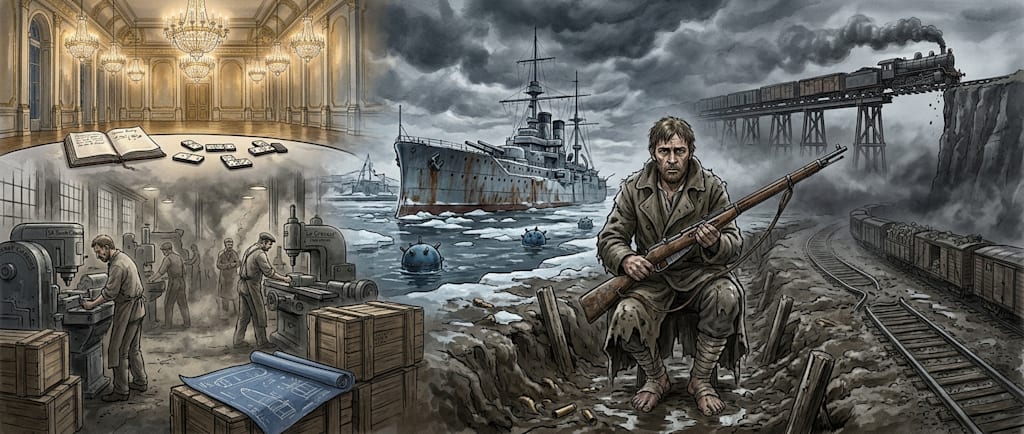
In 1910, the total budget of the Russian state was about 2.7 billion rubles. The army and navy together consumed 710 million, nearly thirty percent. By the standards of the European great powers at the time, that was not a miserly figure.
Turn one more page in the ledger, and things stop making sense.
In the daily consumption quota of a Russian infantry company, a soldier's food allowance was nineteen kopecks a day. In Petersburg, nineteen kopecks could buy two pounds of cheap rye bread and a small piece of salted fat bacon that tasted bitter with salt. Boots were a separate matter. The money in War Minister Sukhomlinov's hands, spread across more than 1.3 million standing troops, was barely enough to give the "grey beasts" a decent pair of boots.
Meanwhile, the three state rifle factories at Tula, Sestroretsk, and Izhevsk together produced 33,000 Mosin-Nagant rifles in all of 1910. Not 330,000. Thirty-three thousand. Russia could not reliably produce qualified special alloy steel for rifle barrels, and large numbers of barrel blanks had to be imported from Austria and even from Krupp in Germany. If the Tsar wanted to re-equip the army with the newest rifles, he first had to pay a deposit to the steel trusts of Berlin and Vienna.
The first problem was not the size of the military budget. It was the industrial chain that stopped military spending halfway. Writing "build more rifles" in the budget table is easy. Machine tools, alloy steel, skilled workers, and quality inspection do not grow out of the ground because of an imperial decree.
The navy budget could not be touched
Someone will say: then do not build the navy. Give the entire naval budget to the army.
In the Russian court of 1910, anyone who said that would lose his official cap the next day. After the annihilation of the fleet at Tsushima, rebuilding the ocean-going navy was not a military question. It was a question of Romanov face. The Tsar himself and members of the imperial family had an almost obsessive love of big ships and big guns.
In 1910, the Baltic Shipyard and the Admiralty Shipyard in St. Petersburg were hammering down the keels of four Gangut-class dreadnoughts. Each ship cost 29 million rubles. Four ships came to 116 million gold rubles. Converted into Mosin-Nagant rifles, that money could have produced more than 3.8 million rifles, enough to give every able-bodied conscript in the Russian army one rifle and two hundred rounds.
In the end, from the outbreak of war in 1914 until the empire vanished in 1917, those four iron turtles spent most of their time lying in Kronstadt harbor. The exits from the Gulf of Finland were sealed by German mines. The fleet could not even poke its bow out. The sailors in the boiler rooms grew bored to mold, and later became some of the first Red standard-bearers to charge into the Winter Palace with bayonets in 1917.
Cut the naval budget? Shipyards, steel mills, the naval officer corps, court patronage, foreign technology contracts: an entire network of interests was tied to those keels. Anyone who raised the matter in court was simultaneously insulting the Tsar's face, the navy's rice bowl, and the order books of France's Schneider company.
Military spending was not allocated according to the needs of war. It was allocated according to court politics and departmental interests.
Shells are not conjured out of money
Take one step back. Suppose you forcibly stop the dreadnoughts and pile the money into artillery and shells.
In 1910, the head of the Russian Army's Main Artillery Directorate was Grand Duke Sergei Mikhailovich, the Tsar's cousin. He firmly believed that the Russo-Japanese War had proved that future wars would be short decisive wars, and that the two sides would settle the outcome within two months of field fighting. Therefore Article 42 of the army's war preparation regulations stipulated that each Model 1902 76.2 mm field gun would receive a wartime reserve of only 1,000 shells. Fire them and that was that.
The entire empire's treasury held only 4.2 million 76.2 mm field-gun shells. When war broke out in August 1914, after less than forty days of rolling through the mud of East Prussia and Galicia, the stock was gone. Every punctuation mark in the daily telegrams from General Zhilinsky, commander of the Northwestern Front, to the Supreme Headquarters was a wail: some artillery batteries were strictly limited to three shells a day, while German heavy artillery poured down on their heads like rain, and Russian gunners could only squat in muddy water and take the pounding.
Why could the rear not produce more?
The Putilov Works in Petrograd was nominally Russia's largest private military enterprise, but more than sixty percent of its shares were in the hands of France's Schneider company. The machine tools for stamping 76 mm shell casings, the lathes for machining fuses, and even the formula for yellow explosive were all patented in French hands. Russia had plenty of oil and coal, but was extremely short of the technology for extracting benzene and toluene in the modern coal-chemical industry. In 1910, the entire country had only two half-dead workshops in the Donbas producing TNT, with an annual output of less than three hundred tons.
By the end of 1914, with national mobilization of military industry, the Putilov and Petrovsky works strained every muscle and managed to produce 35,000 field shells a month. The front's minimum monthly consumption was 450,000. The gap was more than tenfold.
You can go back to 1910 and whip workers and engineers to work overtime. But a machine tool will not turn one more revolution because it is whipped, and a chemical reactor will not produce an extra ton of toluene because the Tsar is anxious. The turner Vasily at Putilov worked 11.5 hours a day in poisonous dust for twenty-five to thirty rubles a month, barely enough to keep a family of four in a basement bunk on Vasilyevsky Island with sour cabbage and black bread. Once war began and inflation lifted its head, the ruble became waste paper, and these workers, who could not even afford shoes, would turn around and hang strike banners in the factory yards.
Without the organic chemical industry and precision machine tools, shells remain ink marks on blueprints.
A railway is not just a line
Take another step back. Suppose you have rifles, guns, and mountains of shells. The next question is how to get them to the front.
The railway data for 1910 are there. East Prussia in Germany had 10.2 kilometers of railway per 100 square kilometers, all double-track lines capable of carrying heavy steam locomotives, with a marshaling yard on average every 8 kilometers. Russian Poland had 1.1 kilometers of railway per 100 square kilometers. A difference of nine times.
Along the entire Russian western front, apart from a few main lines such as Petrograd to Warsaw and Moscow to Brest, more than eighty percent of the railways were single-track. Most stations had passing loops only 450 meters long. A troop train carrying the 2nd Army from Smolensk to Warsaw, meeting an empty train coming the other way, would have to wait two or three hours at some desolate passing station. If the troop train was a little longer, its rear end would still be sticking out onto the main line, and it could not pass at all.
When the mobilization order went out in 1914, the railway network in European Russia was paralyzed by the third day. Tens of thousands of freight cars jammed the marshaling yards at Moscow, Tula, and Vilna and could not move. Soldiers at the front ate grass roots in Galicia while tens of thousands of carloads of Ukrainian wheat rotted and bred maggots on the open wharves of Odessa.
Why not build double-track railways on the western front? Building railways required money, steel rails, time, and a glance at the face of the paymaster. French loans were earmarked for specific purposes. They had to be used to build strategic offensive railways leading to the German border, and were strictly forbidden for Russia's internal economic trunk lines. Paris wanted a grey beast that could charge into Germany's backyard within two weeks of the outbreak of war, not a rich and prosperous Russia.
A railway is not just a line. It is a system of marshaling yards, double-track ratios, locomotive scheduling, signaling, and heavy-haul capacity. Single-track railways cannot support general mobilization.
The alliance was a summons, not an umbrella
The Franco-Russian alliance deserves separate treatment.
From the conclusion of the alliance in 1894, the Tsarist government issued nearly twenty billion gold francs of Russian state debt on the Paris Bourse. That money maintained Russia's gold standard, maintained the Petersburg nobility's debauchery on the Riviera, and maintained Russia's vanity of squeezing into the club of European great powers.
There is no free lunch. The French General Staff's condition was cold-blooded. Once war broke out in Europe, the Russian army must, on the fifteenth day of mobilization, at all costs, even if units were understrength, heavy artillery had not arrived, and logistics could not keep up, throw at least 800,000 troops against the German border in East Prussia.
In 1911, the Russian Chief of the General Staff, Zhilinsky, met with French Army Chief of Staff Joffre in Paris. Joffre held a draft from the Banque de France and pounded the table: we lent you 500 million francs, so why can your western-front mobilization timetable only be advanced to the eighteenth day rather than the fifteenth? A Russian general could only nod and scrape like a schoolboy being scolded by a teacher.
Because if the French financial groups were provoked, if France refused to roll over maturing Russian bonds, or even dumped Russian bonds on the international market, the Tsarist government's finances would technically go bankrupt within two weeks.
So in 1910, would Nicholas II dare to defy the French, delay mobilization, adopt a defensive strategy, and abandon the Balkans? He would not. If he backed out during the Sarajevo crisis and declared Russian neutrality, Britain and France would abandon him the next day. At home, the liberal Duma, Pan-Slavist intellectuals, and the officer corps would regard him as a traitor who sold out the Slavic brothers. The shadow of the 1905 Revolution still hung outside the windows of the Winter Palace, and the Tsar was afraid every night that a second general strike would break out in Petrograd.
Financial sovereignty was hostage to alliance politics. The alliance was not an umbrella. It was a summons to the gallows.
Cousins could not dissolve tariff bills
What about turning to Germany? The Tsar and the Kaiser were cousins, and in 1905 they had secretly signed a treaty aboard the imperial yacht at Bjorko.
The German-Russian conflict in 1910 was not a family matter. Since Bismarck introduced protective tariffs in 1879, Germany had raised the tariff on every ton of Russian wheat to fifty-five marks, directly cutting off the money-making road of Ukrainian landlords and nobles. German industrial goods dumped into the Russian market and beat Moscow's textile industry and the Urals metallurgical industry until they could not lift their heads. Russian landlords hated the high German tariff. The Russian bourgeoisie hated German dumping. Court and country had long since torn faces with Berlin over economic interests.
Not to mention that Germany in the Balkans gave full support to Austria-Hungary's annexation of Bosnia and Herzegovina. Austria-Hungary's guns were pointed at Serbia's forehead, blocking Russia's strategic corridor to the Mediterranean. In 1910, German Lieutenant General Liman von Sanders led a large military mission into Constantinople and took over the Ottoman First Army and the fortifications of the Bosphorus. A spiked military boot was stepping on the throat of the Russian Empire. Retreat one step: economic strangulation. Retreat two steps: national bankruptcy.
The German-Russian contradiction was structural. Cousins drinking a few glasses of vodka could not dissolve tariff bills and the Straits question.
The village behind the wheat exports
Put the map down and go look at a small village called Pokrovskoe in Penza Province.
In the spring of 1910, twenty-two-year-old Vasily Kuznetsov, descendant of a serf, was barefoot on a poor hillside plot of less than three desyatins, plowing. The land was the "allotment" his grandfather had bought from a noble landlord for a huge redemption payment at the emancipation of the serfs in 1861. But the land did not belong to Vasily personally. It belonged to the commune. Every few years the commune redistributed it according to changes in population. You might spend this year manuring and improving the soil, and next year the lot might be drawn by lame Ivan from the east end. No one was willing to fertilize.
Vasily's family of six worked the land every year. After paying the heavy state poll tax and the commune land tax, the rye they harvested had to be sold cheaply to grain merchants for rubles to pay the remaining redemption dues. In autumn, the merchants' carts drove into the village and beat down the purchase price. In the lean March and April of the next year, Vasily went to the landlord's estate to borrow grain at usury and repaid it after the harvest at one and a half times the interest.
The empire shipped several million tons of high-quality hard wheat through Black Sea ports to Western Europe every year in exchange for gold rubles. The tens of millions of peasants who grew that wheat lived all year on adulterated black bread mixed with birch bark and goosefoot seeds. Economists of the time had a name for this: "hunger exports."
When the war machine started in 1914, Vasily was shoved by a conscription notice into the 4th Army, 30th Infantry Division. The recruiting officer did not even issue him a decent pair of military boots. He wrapped his feet in coarse hemp cloth and worn straw sandals, and held an old Mosin rifle with a worn bolt and a crooked front sight. The officer gave him thirty rounds and told him: aim when you shoot, and when you run out, pick up ammunition belts from the dead.
Later, in the swampy forests of Tannenberg, Vasily's company was pinned down in the mud for two days and two nights by the crossing fire of German machine guns from the 17th Army. The company had 170 men, no heavy artillery support, no telephone communications, and no hot bread for two days. Only nine came out of the encirclement alive. Vasily's right leg was shattered. He was captured in a burned-out mill in East Prussia, and later died of typhus in the Cottbus prisoner-of-war camp at the age of twenty-five.
In the casualty files of the War Ministry in Petrograd, his name did not occupy a single line of type. He was folded into the rough figure: "Second Army, missing auxiliary soldiers: 3,421."
General war requires a minimum of political trust among all social strata. Tsarist Russia could not supply it. Peasants had no national identity when conscripted. Workers had no class compromise when exploited. Once inflation lifted its head, strikes spread from factories to the streets.
The Tsar's diary
Only at the end do we come to Nicholas II himself.
In his diary in 1910, the Tsar wrote: "May 14. Weather clear. Walked. Shot three wild cats. Rowed on the river with Alexei." "July 20. Muggy. Rode. Drank tea. Finished a French novel. Played two games of dominoes in the evening."
A mediocre monarch sunk in family trivia and hunting cats, guarding an empire that was financially insolvent, militarily hostage to alliances, industrially short of rifles and medicine, and socially sitting on a powder keg.
But blaming everything on his personal mediocrity is not entirely fair either. Even if he had suddenly become Peter the Great, reform would not have moved. If he forcibly touched the interests of noble landlords and distributed land to peasants, he would most likely have followed Stolypin: shot in the Kiev opera house, or had his skull smashed by Guards officers with a gold cigarette case, as they had murdered Paul I. If he threw himself completely into the arms of Britain and France as a pawn, the historical script would run as before. The finest standing army would be consumed in East Prussia and Galicia. After the veterans were used up, millions of armed peasants who could not eat their fill would turn around, and the Tsar's throne would not last three months. If he chose appeasement and retreat, Britain and France would pull back their loans and trigger a financial avalanche. Germany would cut Russia into a landlocked duck in the Balkans and the Black Sea. The constitutionalists and military hawks at home would immediately launch a palace coup and force him to abdicate.
The Tsarist system had neither the capacity for structural reform nor the space to delay until reform bore fruit.
The cliff behind the window shade
So Russia in 1910 did not lose a particular battle. The state's capacity could not support general war.
Modern war is fought by the roar of stamping presses in hundreds of assembly-line workshops, by the dispatch of locomotives day and night over tens of thousands of kilometers of track, by whether every acre of wheat can, after deducting food for the peasants, steadily produce industrial surplus grain that can be requisitioned, and by whether a country's social strata have the minimum political trust to face a catastrophe together.
In 1910, Tsarist Russia did not have a single one of these things.
From the moment Nicholas II, on the day of his coronation, watched more than 1,400 people crushed to death at Khodynka Field and still attended the French ambassador's banquet in full dress, the empire's countdown clock had been wound to the end. No matter what was done in 1910, it was no more than pulling down the window shade in a steam locomotive hurtling at full speed toward a cliff.
The shade comes down, and outside the window there is still the cliff.
About the Creator
Jin
Writer of reamstories
https://reamstories.com/jin
Enjoyed the story? Support the Creator.
Subscribe for free to receive all their stories in your feed. You could also become a paid subscriber, letting them know you appreciate their work.
Comments
There are no comments for this story
Be the first to respond and start the conversation.