
King Charles Receives an Emotional Gift From His Late Mother: The Photograph That Connected Two Generations
During a visit to one of Britain's leading scientific research centres, the King was presented with a photograph of Queen Elizabeth II. But the most meaningful part of the day was the remarkable work taking place inside the building.

Some gifts are valuable because of their price. Others matter because of the memories they carry.
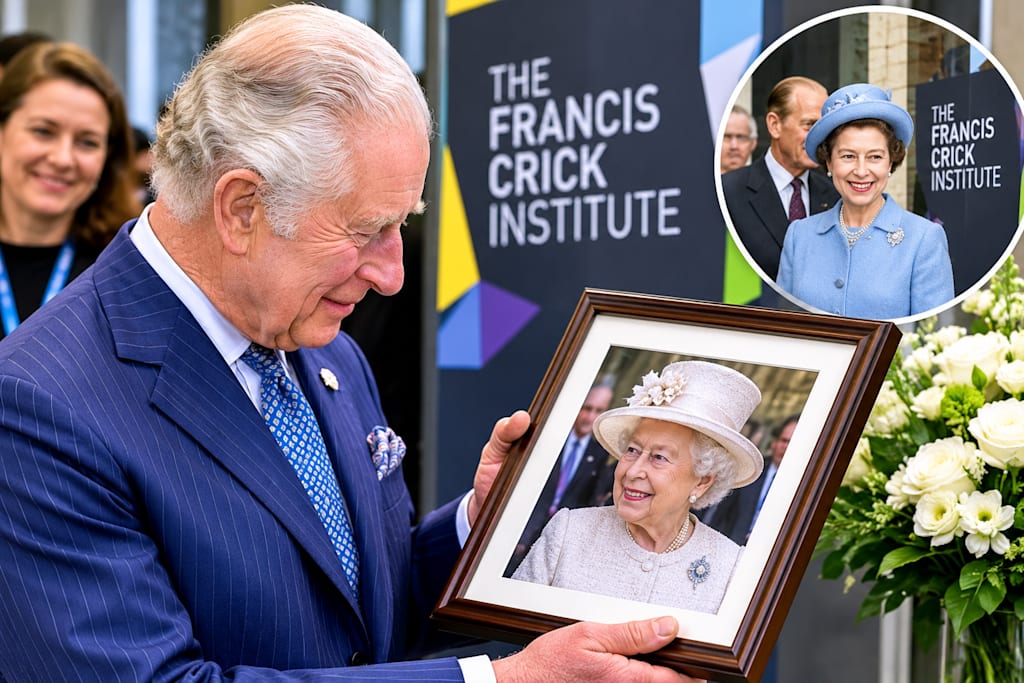
For King Charles III, a photograph presented during his recent visit to the Francis Crick Institute in London was more than a simple anniversary keepsake. It connected two royal generations through a shared moment in the history of British science.
Ten years earlier, Queen Elizabeth II had officially opened the research centre. Now, her son was returning to mark its tenth anniversary and discover how far scientific research had progressed.
The visit, on November 11, 2026, offered a fascinating combination of royal history, medical research and a glimpse into the future of healthcare.
And one particular moment made the occasion especially memorable.
A Photograph That Brought the Past Into the Present
The Francis Crick Institute officially opened in November 2016, with Queen Elizabeth II attending the ceremony alongside the Duke of Edinburgh.
A decade later, King Charles returned to the same institution.
During the visit, the King was presented with a framed photograph showing his late mother at the original opening ceremony. It was a thoughtful reminder of the institute's beginnings and the royal family's connection to its development.
For Charles, the photograph represented more than an official engagement.
It connected the institution's first decade with its next chapter, while remembering the woman who had helped inaugurate it.
The anniversary also provided an opportunity to recognize the scientists, researchers and supporters whose work has helped make the institute an important centre for biomedical discovery.
Inside the Laboratories: Research That Could Change Lives
Although the photograph attracted attention, the scientific work was the central purpose of the visit.
The King toured laboratories and met researchers studying some of the biological processes behind cancer and other serious diseases.
One area of particular interest involved research into lung cancer and the effects of air pollution.
Professor Charles Swanton and his colleagues have investigated how exposure to polluted air can trigger inflammatory processes that may contribute to lung cancer in people who have never smoked.
This research is significant because it challenges the assumption that lung cancer is exclusively a disease associated with smoking.
Understanding how environmental factors affect the body could help researchers identify risks earlier and develop better approaches to prevention.
The King also learned about research exploring how ageing, inflammation and cellular damage can influence diseases, including cancer and neurological conditions.
These are complicated scientific questions, but their potential importance is enormous.
The aim is not simply to understand illness after it develops. Researchers are working to discover what happens inside the body before disease appears.
A Moment of Humour in a Serious Setting
Despite the serious subject matter, the visit included a light-hearted moment.
While touring a laboratory, Charles was offered the opportunity to use a joystick to examine microscopic material.
He politely declined, joking that he would rather let the scientist operate it because it might go wrong if he tried.
The remark brought a little humour to an otherwise technical demonstration.
It also offered a glimpse of the human side of royal engagements. Behind the formal title and official responsibilities was a visitor curious to understand the work being carried out around him.
Charles also met scientists and listened to presentations explaining how modern technology is helping researchers investigate disease.
The institute's work increasingly involves advanced methods, including artificial intelligence and genomic research, to examine complex biological questions.
The Next Generation of Scientists
One of the most important parts of the visit involved meeting young people beginning their careers in science.
The King spoke with degree apprentices who had completed laboratory science studies and gained practical experience at the institute.
Their presence highlighted an important part of the Crick's mission: scientific progress depends not only on today's discoveries but also on preparing the researchers of tomorrow.
A modern research centre needs talented scientists, technicians, apprentices and specialists working together.
Providing young people with opportunities to enter scientific careers can help build the skills needed for future discoveries.
It is also a reminder that some of the people who will make tomorrow's medical breakthroughs are currently taking their first steps into the profession.
Ten Years of Discovery
The Francis Crick Institute was established through a partnership involving Cancer Research UK, the Medical Research Council, Wellcome, University College London, Imperial College London and King's College London.
Its purpose was ambitious: bring outstanding researchers from different scientific disciplines together under one roof.
According to the institute's anniversary reporting, its first decade has produced more than 6,500 scientific publications and helped create 15 spin-out companies that have attracted approximately £2.3 billion in further investment.
These figures illustrate how scientific research can influence more than laboratories.
Discoveries can lead to new technologies, business opportunities, skilled employment and, potentially, improved treatments for patients.
The next decade will bring new challenges, including ageing populations, environmental pressures and diseases that remain difficult to understand.
The institute hopes that collaboration and scientific innovation will help address some of these questions.
A Royal Legacy Beyond the Photograph
King Charles's visit carried a message that extended beyond an anniversary celebration.
The photograph of Queen Elizabeth II represented continuity, but the scientific work inside the building represented progress.
One generation had witnessed the institute's beginning. Another was now seeing what its researchers had achieved.
For the King, the occasion also reflected a longstanding interest in the relationship between the environment, science and human health.
And for the researchers, the royal visit offered recognition of work that often takes years of careful investigation before producing meaningful results.
The most important discoveries do not always happen in front of cameras. They happen quietly, through experiments, questions, failures and repeated attempts to understand something previously unknown.
Perhaps that is what makes this anniversary story so meaningful.
The photograph connected the past with the present, but the real story is about the future: the scientists searching for answers, the young apprentices beginning their careers and the patients who may one day benefit from discoveries being made today.
A decade after Queen Elizabeth II opened the institute, her son returned to see how far that vision had travelled.
And the question now is this: What could another ten years of scientific discovery mean for the future of human health?
About the Creator
Behind the Curtain
"Exploring the untold stories and hidden truths. From royal rumors to cultural deep dives, Behind the Curtain brings you bold, insightful narratives that spark curiosity and conversation."
Enjoyed the story? Support the Creator.
Subscribe for free to receive all their stories in your feed.
Comments
There are no comments for this story
Be the first to respond and start the conversation.