
Researchers Uncover the Mysteries of 9,000-Year-Old Rock Paintings in Kenya
A Longer Story Is Told by Four Layers

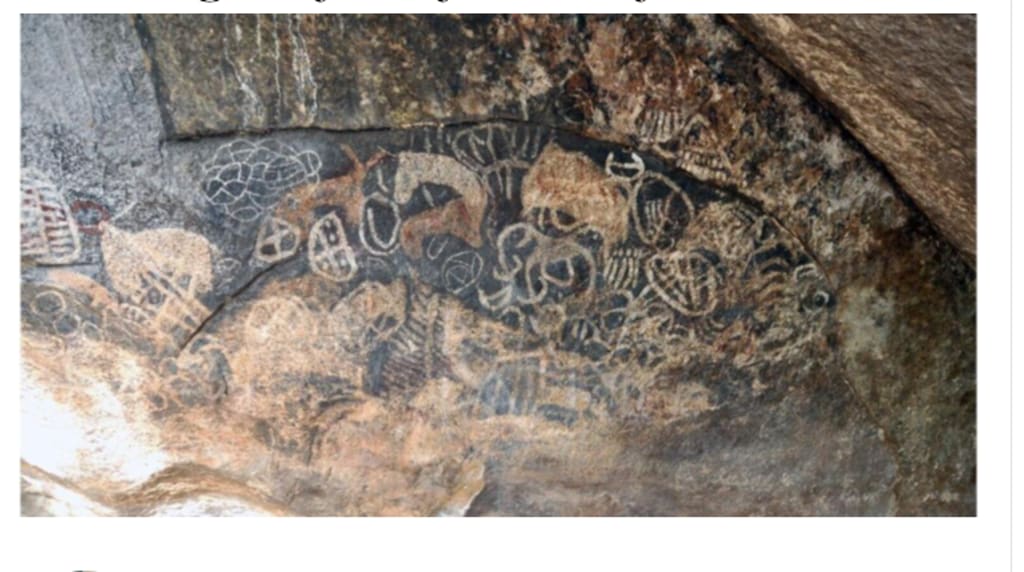
The complex rock paintings at Kakapel, a well-known archaeological site in western Kenya, have a millennium-long history, according to a fascinating new study. Researchers were perplexed for decades by the thick overlapping of photos at this historic rock shelter. The artwork was produced over a period of 9,000 years by at least three different populations, according to careful digital tracing, archaeological excavation, and ancient DNA analysis.
The first millimeter-accurate recording of the Kakapel panels was produced by Dr. Catherine Namono's research, which was published in the journal Azania: Archaeological Research in Africa. The team discovered a temporal sequence that reflects the significant demographic changes in the east evolving from prehistoric hunter-gatherers to later communities that raised cattle.
A Longer Story Is Told by Four Layers
Circles and divided shapes are among the faded red and white geometric drawings found in Kakapel's oldest layer of art. These abstract shapes have been connected by researchers to hunter-gatherer-fisher tribes that lived there thousands of years ago.
According to Science X, this early artistic expression relates to a larger eastern African heritage that is frequently connected to "Twa" forager cultures. These early artists have a strong genetic relationship with contemporary Pygmy communities from Central Africa, including the Mbuti, according to ancient DNA evidence from a skeleton discovered at the site.
At least 25 images of cattle with long horns and no humps are introduced in a later layer. This style is reminiscent of the "Ethiopian-Arabian" and is painted inside profile with horns in a twisted perspective. The Horn of Africa has a long history of rock art. It's interesting to note that experts credit these paintings to Nilotic-speaking agropastoralists who came to the region much later rather than the early farmers who lived there.
The Results Are Supported by DNA and Archaeology
A multidisciplinary approach that goes beyond art analysis supports the study's conclusions. The researchers were able to directly connect the shifting creative styles to certain populations by comparing the rock art sequence with excavation findings and ancient DNA taken from human remains at Kakapel.
For example, the attribution of the cattle art to people closely connected to Western Nilotic speakers is supported by the genetic examination of two skeletons from the Later Iron Age. The younger skeleton appears to be entirely Western Nilotic, most likely descended from modern-day Luo people, whereas the older skeleton preserved a little ancestry component from Pastoral Neolithic groups.
The last layers of rock art are thought to have been created by this latter population, which comprise fine white markings and geometric patterns in thick white and yellow-white.
Maintaining a Link to the Past
The site has great significance for the local people, even though the exact meanings and intentions behind the ancient art of Kakapel are still being investigated. According to Dr. Namono, rock art, is frequently acknowledged by African communities as the creation of their ancestors, offering a concrete link to the past and a compelling reason for its preservation.
The study's co-author, Prof. Benjamin Smith, pointed out that there are still-existing customs and rituals in Kenya that could provide insight into how these paintings were made. Researchers intend to uncover the deeper cultural and spiritual significance of the Kakapel rock art by examining these modern behaviours. As environmental changes and human activity pose dangers to sites like Kakapel
These false beliefs have been disproved since the 1960s by a new wave of studies involving the San and their renowned rock art. Here, renowned expert David Lewis-Williams and his associate Sam Challis demonstrate how an examination of the rock engravings and paintings can provide important insights into San beliefs and mental processes.
This is made feasible by the fact that we have thorough transcriptions of interviews conducted in the nineteenth century with San informants who were shown copies of the artwork and provided their interpretations. The writers alternate between these San texts and the rock art using the Rosetta Stone as an analogy, revealing the nuanced meanings of each.
About the Creator
Enjoyed the story? Support the Creator.
Subscribe for free to receive all their stories in your feed.
Comments
There are no comments for this story
Be the first to respond and start the conversation.