
Greek City Turned Into a Playground: Ptolemais Found More Than 100 Game Boards
In Kenya's Highlands, a Yale archaeologist finds ancient Mancala game boards.

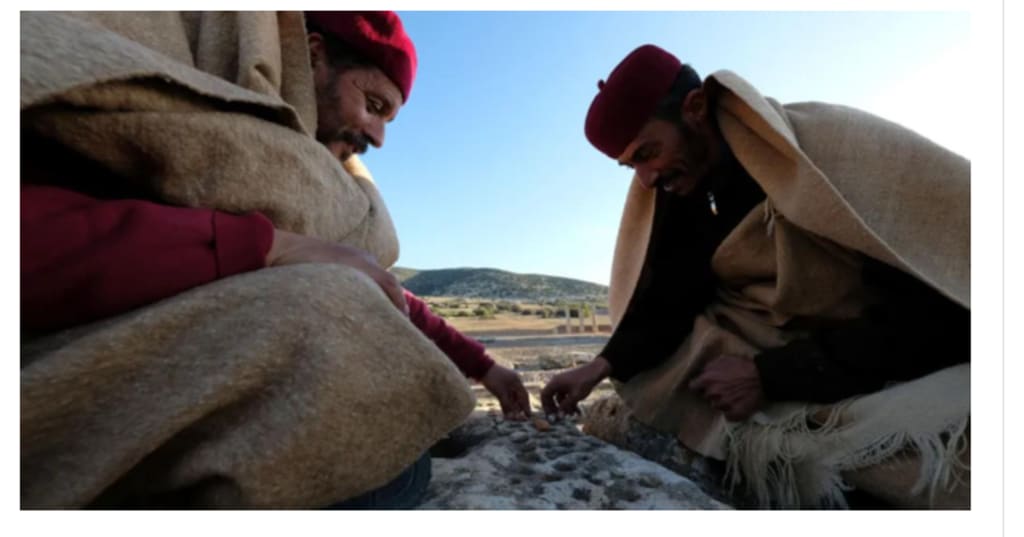
In the ruins of Ptolemais, one of the largest ancient Greek towns in modern-day Libya, archaeologists have discovered something fascinating. Researchers from the University of Warsaw have documented over 100 ancient gaming boards carved into the abandoned city. This finding offers a detailed look at people's daily activities long after the city had fallen.
The discovery, spearheaded by archaeologist Zofia Kowarska, is altering our understanding of post-classical antiquity. These simple grids, which are carved directly into limestone blocks and ancient walls, depict the tranquil daily routines of the local people who used the crumbling Greco-Roman architecture for their own leisure, according to Science in Poland.
Reborn as a Pastoral Playground: A City
Ptolemais was established by Hellenistic Egyptian monarchs in the late 4th century BC and developed into a sizable urban hub. The city was abandoned after the Arab conquest in the seventh century AD. In 2023, Kowarska started a methodical inventory of the etched old gaming boards strewn over the site as the Polish archaeological expedition restarted modern digs.
Kowarska was shocked when the count swiftly surpassed 100, as she had first anticipated finding only a few examples.According to Kowarska, "the boards carved in the ruins suggest that these games were a fairly common pastime."
The actual ancient game boards, which are made up of tiny, circular indentations placed in square or rectangular grids, are surprisingly straightforward. A three-by-three grid is used in the simplest layouts, while seven-by-seven squares are used in more intricate ones.
Shared Gaming Cultures, Shepherds, and Stones
It's difficult to date these humorous inscriptions. Nonetheless, scholars concur that the historic game boards were carved after the city had ceased to serve its intended purpose. Ptolemais becomes a landscape of reuse as a result.
Archaeologists speculate that local shepherds were the main users of these boards. Large areas perfect for grazing encircle the ruins of Ptolemais. The boards, which provide great vantage points, are often located on elevated portions of ruins. Here, shepherds waited, observed, and played while their livestock grazed.
The designs etched into the stone are reminiscent of Middle Eastern and North African gaming customs. Some varieties bear a striking resemblance to the popular family of strategic games known as mancala. The logic of checkers or tic tac toe is mirrored in several formats.
In Contemporary Tolmeita, Living Memory
The ancient ruins are now close to the modern settlement of Tolmeita. Oral traditions endure even after the original games have mostly been forgotten. Kowarska was informed by an elderly local about two game kinds that are still in use:
one that is played on a nine-square grid with the goal of aligning pieces, and another that is centred on capturing the opponent's pawns. Players utilised stones, pieces of pottery, seeds, and even plastic caps as game pieces, which were never standardised.
These straightforward grids serve as a powerful reminder that history is not only inscribed in imposing monuments but also carved into stone by people who had the time to do so among the ruins of the past.
Veronica Waweru of Yale University has discovered what she believes to be an old "arcade" of Mancala game boards in central Kenya, uncovering a new layer of human history in the area through a unique synthesis of academic competence and local knowledge.
This discovery, located within the Lewa Wildlife Conservancy, emphasises the lasting influence of Mancala, one of the oldest known games in the world, and the value of cooperation between academics and local populations in uncovering ancient riches.
A Local Tip Off Results in an Amazing Discovery
Veronica Waweru, a Yale archaeologist who specialises in fieldwork in Kenya, was first pulled to the conservancy on a different mission—to look into the robbery of prehistoric hand axes, according to the Yale University News report.
But after receiving a tip from a local acquaintance, she quickly turned her attention to a more interesting historical story about an old "arcade" where early residents used to congregate to play Mancala, a game renowned for its strategic complexity and broad cultural significance.
Waweru discovered a number of shallow trenches carved into a rock ledge when visiting with Lewa's informed staff. These trenches, which varied in depth and displayed erosion, suggested a lengthy history of playing Mancala, a strategy-based, two-player board game that is still played all over the world. A physical link to the past is provided by the site, which is dotted with about 20 of these old boards, some of which are placed over earlier ones.
Mancala's Ancient History
With early evidence discovered in Ethiopia and Eritrea, mancala is believed to be one of the earliest two-player board games, having been played in ancient Africa circa 700 AD. Although there is no proof that it has ever been played, it is believed to have far older origins.
According to a Daily Kos article, rows of holes that may have served as a type of Mancala have been discovered carved out of stone in Iran from 6300 BC and Jordan from 5900 BC, but it is unclear what their actual use was.
It has been impossible to date the double rows of potential Mancala board pits that have been discovered in Egyptian temples, and they may have been constructed considerably later than the original temple. Similar to Mancala, Roman artefacts and sites from the second century AD feature sets of two rows of five pits.
The Arabic word "Naqala," which means "to move," is the source of the game's name, which spread around the world thanks to Arabian traders. Southeast Asia, the Middle East, Africa, the Baltic republics, and North America were among the regions that adopted mancala due to its simplicity and the vast trading routes of Arabian traders.
Even though it took longer to become well-known in Europe, the game's fun factor helped it become widely popular, ensuring its continued significance from antiquity to the present. Is it possible to demonstrate that Mancala's history dates back thousands of years?
Waweru's most recent discovery and inquiry may lead to new insights about the game's past as well as the region's ancient way of existence. Waweru explains how the water supply has allowed humans to use the area for thousands of years: But since the alleged boards are "carved into 400-million-year-old rock," it will be challenging to determine their actual age.
What can be found around these indents may provide a hint. There are 19 burial cairns nearby, and the date span of the pits may be affected if DNA can be recovered from organic material discovered there.
In order to learn more about the people who played Mancala here and their relationship to contemporary residents, the archaeologist and her team are currently looking for funding to conduct additional research at the site.
Local Archaeological Knowledge
Waweru's approach to archaeology is renowned for its respect for local knowledge and inclusion. She has taught locals and farmers how to locate possible archaeological sites throughout the years, treating them as equal collaborators in the study.
Numerous discoveries, such as fossils, artefacts, and new archaeological sites, have resulted from this partnership, highlighting the importance of integrating expert and local knowledge in scientific study.
A picture of a place rich in human activity and history is painted by the finding of the possible Mancala boards as well as the evidence of burial customs and daily activities.
About the Creator
Enjoyed the story? Support the Creator.
Subscribe for free to receive all their stories in your feed.
Comments
There are no comments for this story
Be the first to respond and start the conversation.