
The Library of Alexandria Wasn't Destroyed Once — It Was Dismantled for Centuries
Library of Alexandria
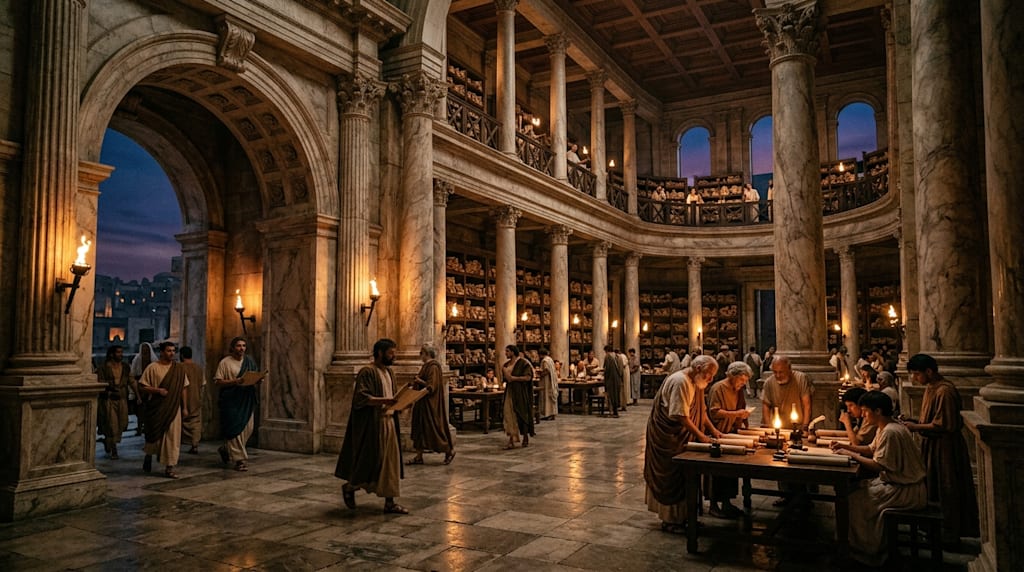
The Library of Alexandria is one of history's most famous casualties. Mention it in most conversations and you will hear about Caesar's fires, or the Muslim conquest, or some combination of both. The story that most people carry is a simple one: an extraordinary repository of ancient knowledge was destroyed in a single cataclysmic event, and with it went irreplaceable wisdom that changed the trajectory of human civilization.
This story is mostly wrong.
The Library of Alexandria was not destroyed in a single fire. It was not lost in one decisive moment. It was dismantled over centuries through a combination of political decisions, institutional decay, funding failures, and deliberate policy choices made by people who had the power to preserve it and chose not to. Understanding how it actually ended tells us something important about how civilizations lose their knowledge — and it is not the dramatic story we have been taught.
The Library as an Institution, Not a Building
First, it helps to understand what the Library of Alexandria actually was. The institution founded by Ptolemy I in the early third century BCE was not a single building but an entire intellectual campus, including the Museum (a research institution in the original sense, not a place for exhibits), the Library itself (which housed scrolls, not books as we understand them), student dormitories, lecture halls, and a botanical garden. At its peak, the Library may have held between 400,000 and 700,000 papyrus scrolls — enormous by ancient standards.
The Library's actual function was not simply to store texts but to produce scholarship. The scholars who worked there — including figures like Euclid, Archimedes, Eratosthenes, and Aristophanes of Byzantium at various periods — were engaged in original research in mathematics, astronomy, geography, medicine, and literature. The Library was less a library in the modern sense and more like a combination of a major research university and a national academy.
This institutional complexity matters when considering how it ended. You cannot point to one building and say it was burned, because the destruction of a campus is a process, not an event.
The Fire That Wasn't a Fire
The most famous incident involving the Library is the claim that Julius Caesar's fire during his siege of Alexandria in 48 BCE destroyed the Library. This is what the story typically says, and it is where most accounts of the Library's destruction begin.
But this is historically inaccurate in several ways. Caesar's fire occurred in the harbour district and was primarily a military action intended to destroy the Egyptian fleet. While it may have spread to some warehouses near the Library and damaged scrolls stored there for export, the Library itself — housed in the royal quarter, not the harbour — was not the primary target or victim.
More importantly, the Library continued to function after 48 BCE. Scholars continued working there for nearly 400 years after the supposed destruction. This alone should be enough to question the single-catastrophe narrative.
The Slow Collapse of Institutional Support
The actual decline of the Library was a centuries-long process driven by the same forces that destabilize any major intellectual institution: the withdrawal of political and financial support, the disruption of the social conditions that allowed scholarship to flourish, and competition from other intellectual centres that drew talent away.
By the third century CE, the Roman Empire's crisis had reduced the flow of funding that sustained the Museum and Library. Scholars left for other centres. The collections were not systematically maintained. Important texts were lost through simple neglect — scrolls deteriorate, copying requires resources, and without institutional support, the maintenance of a collection the size of Alexandria's simply stops.
The Christians and the Muslims — More Complicated Than the Myth
The next phase of the Library's decline typically gets attributed to Christians or Muslims, depending on the narrative. Both accounts are oversimplified.
When Christianity became the dominant religion of the Roman Empire, the old pagan intellectual centres were not immediately destroyed — they were gradually transformed. The Library at Alexandria persisted into the fourth century, and many Christian scholars actually worked within its spaces. The destruction of Serapeum, a subsidiary library, in 391 CE by a Christian mob is often conflated with the main Library's destruction, but the two were separate events, and even this incident was more about religious conflict than a systematic attempt to destroy knowledge.
Similarly, when Muslim forces conquered Egypt in 641 CE, the story claims Caliph Omar ordered the destruction of the Library by burning all its books because they either agreed with the Quran (redundant) or disagreed with it (heretical). This story is almost certainly apocryphal — it appears in no contemporary source and contains internal inconsistencies that historians have identified. The Library was almost certainly no longer functioning as a major research institution by this point. Whatever remained was absorbed into other uses over time.
What We Actually Lost
The more uncomfortable truth about the Library of Alexandria's end is not that we know what was destroyed — we don't, not specifically. The scrolls were largely unique copies of texts that existed nowhere else, and when they were lost, the works themselves were lost. We know that Euclid's Elements existed because medieval scholars had access to Arabic translations. We don't know what else was in that collection that we have no record of at all.
But the loss was not a single event. It was the accumulated result of centuries of underfunding, political instability, and the slow drifting away of the institutional conditions that made the Library possible in the first place. The scholars left. The funding dried up. The copies stopped being made. The scrolls rotted or burned in smaller incidents that attracted no historical attention because by then, the Library was no longer famous enough to notice.
The Lesson That Actually Matters
If there is a meaningful lesson from the Library of Alexandria's end, it is not about the brutality of conquerors or the tragedy of lost knowledge in single fires. It is about the fragility of intellectual infrastructure and the necessity of active maintenance.
Great repositories of knowledge do not survive by their own momentum. They require ongoing investment, political stability, institutional continuity, and a social consensus that the work matters. When those conditions erode — and they can erode for a thousand reasons — the knowledge does not vanish in a dramatic fire. It simply stops being copied, stops being maintained, stops being protected. And eventually, it is gone.
The Library of Alexandria did not end with a bang. It ended with a long, quiet process of neglect, and that is precisely what makes it relevant to every generation that wonders whether its own intellectual heritage is safe.
About the Creator
Enjoyed the story? Support the Creator.
Subscribe for free to receive all their stories in your feed.
Comments
There are no comments for this story
Be the first to respond and start the conversation.