
When Did the Roman Empire Split? The Answer of 395 CE Is Wrong
Although the Roman Empire is said to have split in 395 CE following the death of Theodosius I, Rome had already been divided for over a century by that point — in ways that no official account can explain.

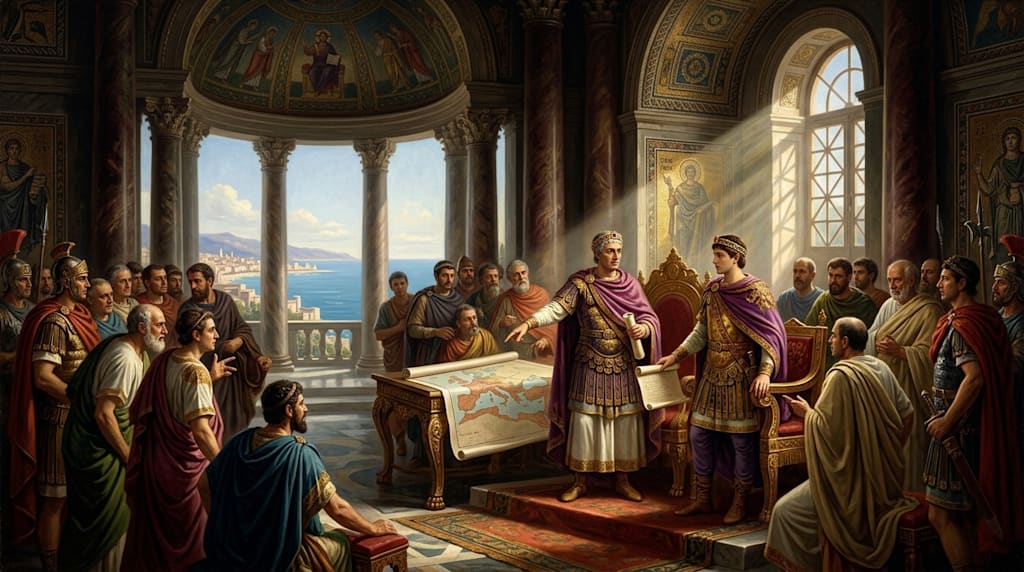
January 17, 395 CE, Milan:
Emperor Theodosius I died. Before his body had even cooled, the empire was divided between his two sons: Arcadius took the East. Honorius took the West.
Two emperors. Two courts. Two administrations. One empire.
Most history books mark this as the moment the Roman Empire split in two. It's clear-cut. It's simple. But it's wrong.
The Roman Empire Split in 395 CE — Or So the Story Goes
The official version is straightforward.
After Theodosius I died, the empire was permanently divided into two: the Western Roman Empire and the Eastern Roman Empire. Each was ruled by its own emperor. Each followed its own path.
The Western Roman Empire collapsed in 476 CE. The Eastern Roman Empire survived as the Byzantine Empire for another thousand years.
You will find this answer everywhere, including under the search query "When did the Roman Empire split?"
However, there is a problem with this answer. It assumes something that was no longer true.
The Empire Had Already Been Running as Two Systems
In 284 CE, over a century before Theodosius's death, Emperor Diocletian quietly made a consequential decision.
He split the job.
Not the empire. The job of ruling it.
Two senior emperors. Two junior emperors. Four capitals. Four courts. This system was called the Tetrarchy, which was Rome's acknowledgment that one man could no longer govern the extent of the Roman Empire.
It was presented as a reform. It was a way to manage the vast territory more efficiently.
However, the structure itself reveals something else.
An empire requiring four emperors is not one empire in any meaningful sense.
Each emperor ruled a different region, commanded his own army, and maintained his own administrative network. Unity remained only on paper.
In practice, it had already fractured.
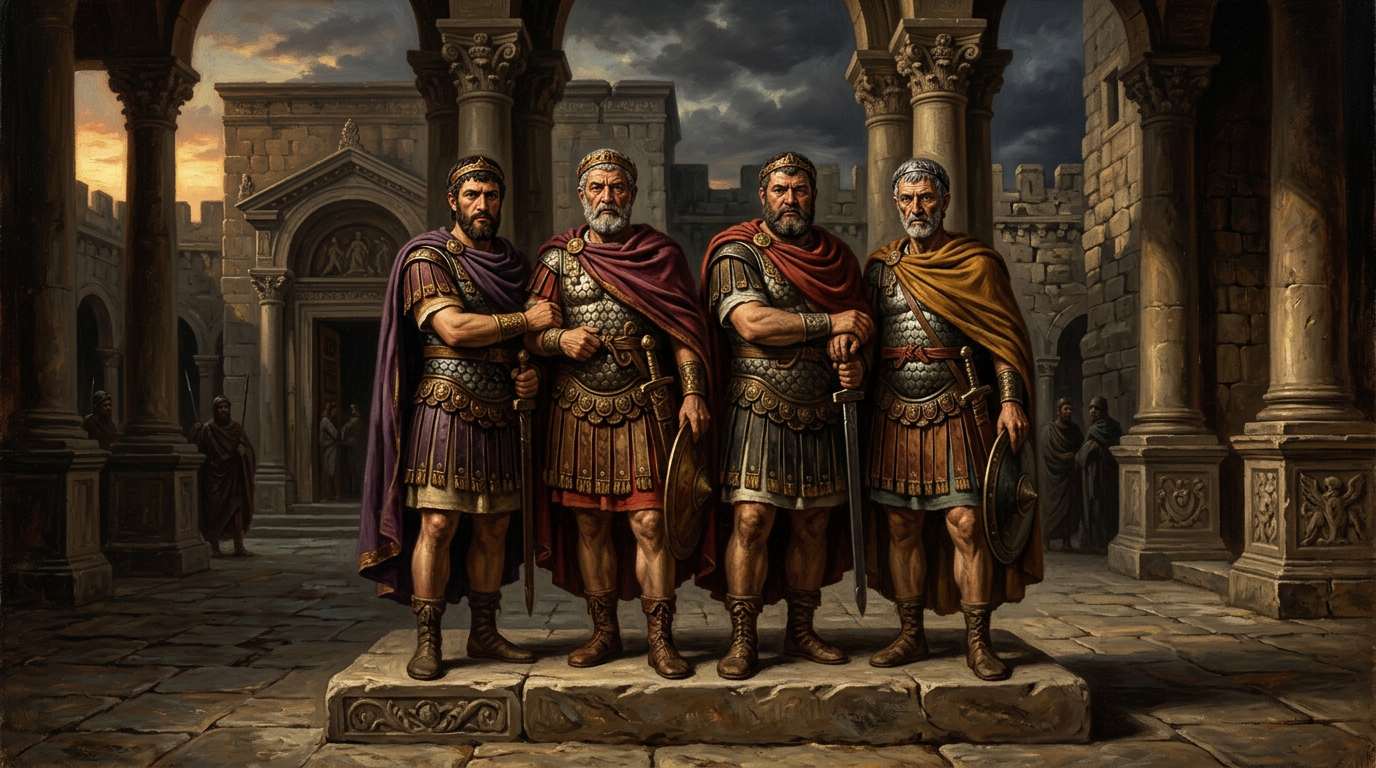
Constantine Didn't Reunite Rome. He Moved It.
In 324 CE, Constantine became the empire's sole ruler. For a moment, it seemed as if Rome were whole again.
Then, he did something no emperor before him had done.
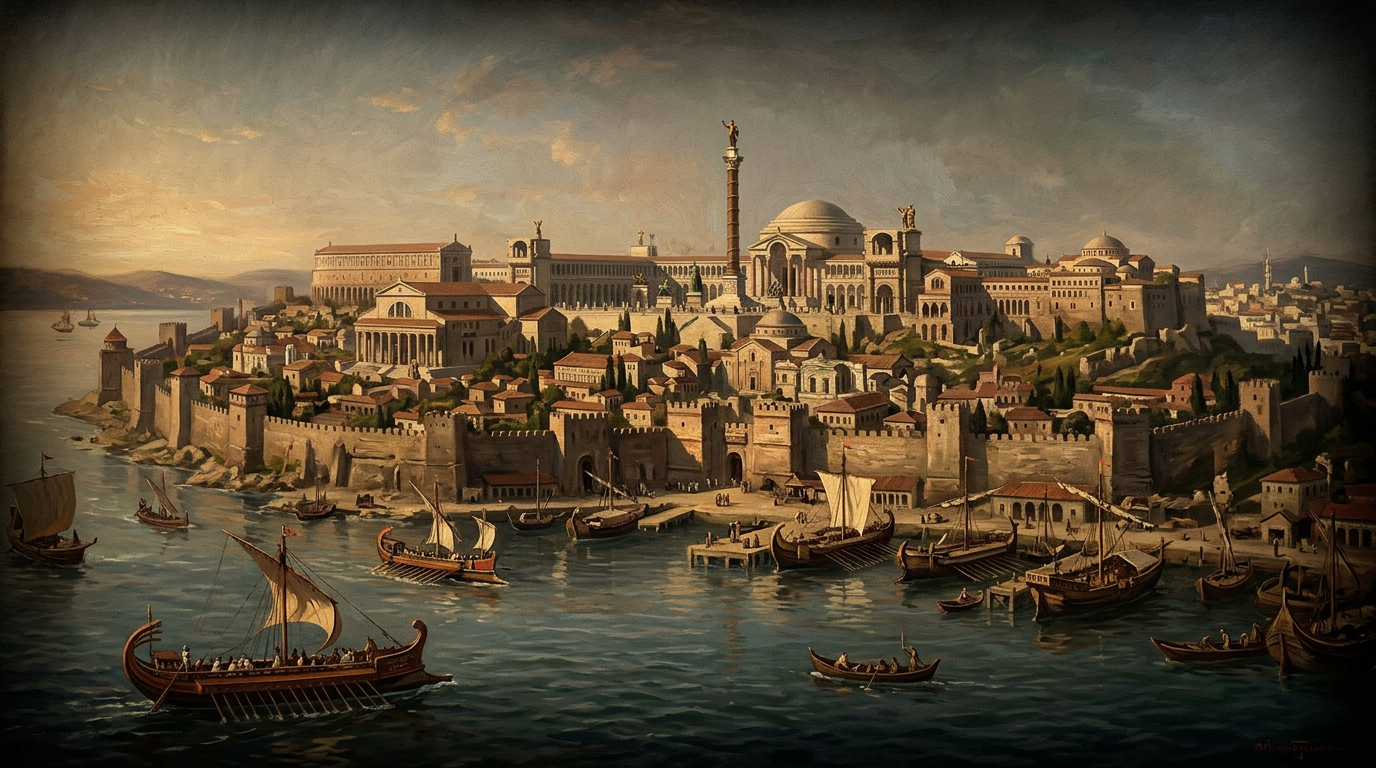
He built a new capital: Constantinople.
It was not a provincial city. Not a temporary residence. It was a second Rome, positioned closer to the wealth of Egypt, the trade routes of Asia, and the frontiers that mattered most.
The political center of gravity shifted. Not officially.
But it did so irreversibly.
Rome still existed. Power had already moved.
The Official Version Cannot Explain the Economy
If the Empire truly split in 395, its two halves should have been comparable.
They were not.
The Eastern Empire controlled Egypt, the primary grain supplier for the entire Mediterranean region. It held the richest urban centers: Alexandria, Antioch, and Constantinople. The Eastern Empire sat astride the main trade routes connecting Europe to Asia and collected revenue at every chokepoint.
In contrast, the Western Empire controlled agricultural land, fewer major cities, and a coastline that generated only a fraction of the East's commercial traffic. Its tax base was narrower. Its currency was less stable. Its ability to fund standing armies was increasingly dependent on what the East was willing to send.
By the late fourth century, the West was no longer a co-equal partner in the shared empire. It was a liability that the East was still choosing to subsidize.
Revenue followed geography. The East grew wealthier. The West grew dependent.
The system appeared unified. It was not.
Here Is What the Official Version Says. Here Is What It Cannot Explain.
According to the official account, the empire split in 395.
However, the administrative systems had already diverged by that point. The economic balance had shifted. The political center had moved east. Emperors had ruled separately for generations.
So what exactly split? A line on a map? Or was it the illusion that the empire had remained intact?
The Military Could No Longer Function as One Body
The Roman army was designed for a world where threats came from predictable directions and legions could advance as a unified force under a single command structure.
By the fourth century, however, that world no longer existed.
Pressure was coming simultaneously from the Rhine, the Danube, and the Persian border. No single emperor could be in three places at once. No single logistics chain could supply three fronts. Coordinating a unified imperial response was no longer difficult — it was structurally impossible.
Command fragmented. Armies became regional. Local commanders made local decisions. Loyalty followed the general who paid, not Rome as an abstract entity.
The consequences were evident in the recruitment rolls. By the late third century, the legions were drawing heavily from the populations they had once been deployed to contain: Germanic tribes, Goths, and Vandals. These soldiers were not disloyal. However, their loyalty was personal, not institutional. When their commanders moved, they moved with them.
An army that fights for a man is not the same as an army that fights for an empire.
The empire still claimed unity. But its military reality said otherwise.
The Obvious Explanation Is Political Division. Three Facts Make That Explanation Impossible.
First, political division assumes a single system is split. However, Rome had already been governed by multiple systems for over a century.
Second, political division assumes equal halves. The East and West were not equal in terms of wealth, stability, or capacity.
Third, political division assumes a single moment. Everything that mattered happened gradually over the course of a century.
The divide did not begin in 395. It acknowledged it.
The Pattern Repeats
Empires rarely collapse the moment they change form.
They fracture long beforehand. The official moment—the treaty, the announcement, or the handover ceremony—is almost always the administrative confirmation of something that stopped being true years earlier.
Consider the British Empire.
Its formal end is usually dated to the postwar decades: Indian independence in 1947, the Suez Crisis in 1956, and the steady withdrawal from Africa throughout the 1960s. According to most official accounts, Britain held a global empire until at least the mid-20th century.
However, the structural reality had shifted a generation earlier.
By 1918, Britain had borrowed so heavily to fight in World War I that it owed more to American creditors than its entire annual economic output. The pound, which had underwritten global trade for over a century, was no longer the currency of an independent financial power. It was the currency of a heavily indebted nation.
India, the administrative and economic center of the empire, required 100,000 British personnel to govern its 300 million inhabitants. By the 1930s, this ratio had become untenable. The control apparatus was costly, increasingly unpopular, and showing visible signs of strain. The question was no longer whether Britain would leave India. Rather, it was a matter of how long the fiction of permanence could be sustained.
The Suez crisis of 1956 did not mark the end of British imperial power. Rather, it publicly and humiliatingly confirmed that the power had already disappeared.
Three formal moments. One long process.
Rome followed the same logic. The legal structure survives longer than the reality it claims to describe. By the time the paperwork changes, the system is already gone.
This pattern appears in nearly every imperial collapse examined on this channel, including the fragmentation documented in "Ten Armies Marched into Russia." Here is what happened to each of them.
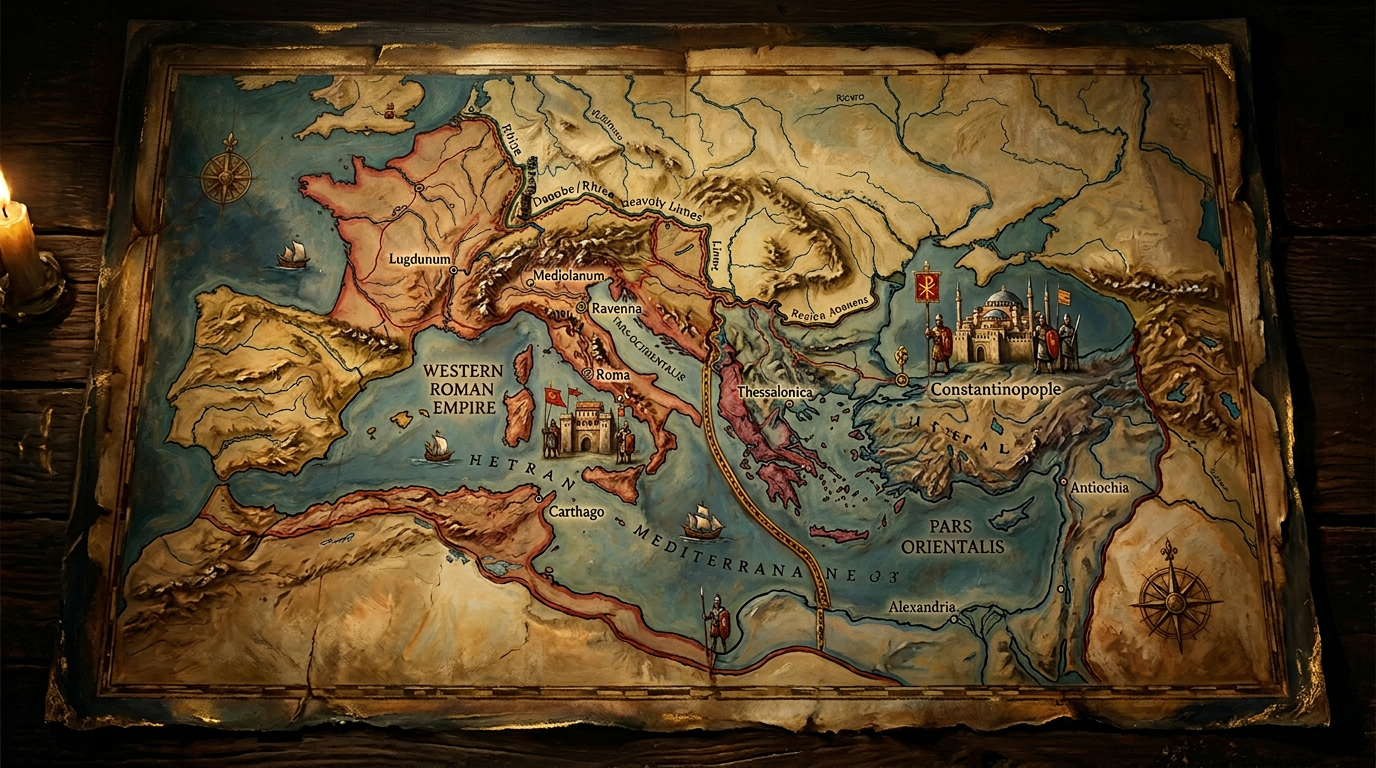
What Actually Happened to Rome
The Roman Empire did not split in 395 CE.
Rather, it became ungovernable as a single system sometime in the late third century. Diocletian acknowledged this. Constantine reinforced this idea. Theodosius formalized it.
Three moments. One process.
The "split" was not a single event. Rather, it was the final admission that unity had already been lost.
If an empire can exist for over a century after effectively becoming two systems, the real question is no longer when Rome split.
Rather, it is how long any state can survive after becoming something else.
If this investigation interested you, you might also find these compelling:
— Rome Had Markets, Banks, and Trade Routes, Yet It Never Built Capitalism.
— The Antonine Plague That Destroyed Rome — And We Have Been Calling It the Wrong Thing
For announcements: Telegram · Twitter/X
About the Creator
Chronicle and Void
Every collapse has a cover story. Every war has a cause that didn't make it into the history books. History is not an accurate record of what happened. It's a record of what they allowed to survive.
Enjoyed the story? Support the Creator.
Subscribe for free to receive all their stories in your feed.
Comments
There are no comments for this story
Be the first to respond and start the conversation.