
Significant Genetic Variability Found in Native Americans
Ancient Migrations and a Million New Variants

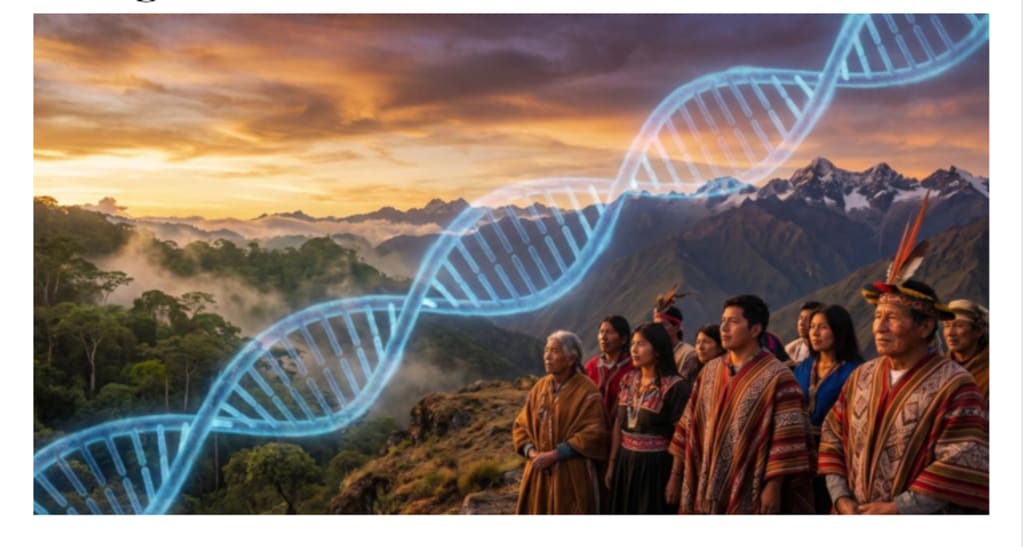
The broadest and most complete genetic dataset of Indigenous American populations to date has been assembled by a ground-breaking worldwide study. The study, which was published in the journal Nature, sequenced 128 high-coverage entire genomes from persons in eight Latin American nations, providing fresh insight into the intricate evolutionary history, distinctive genetic diversity, and health consequences for Indigenous peoples. The study unearths a third wave of migration into South America and identifies more than a million genetic variants that were previously unknown.
As part of the Indigenous American Genomic Diversity Project, the study analysed 199 modern Indigenous people from 53 communities in addition to ancient DNA data by combining freshly sequenced genomes with databases already in existence. The goal of this historic endeavour is to remedy Indigenous American populations' historical under-representation in genetic research, It has created important gaps in our knowledge of human evolution and variety.
Ancient Migrations and a Million New Variants
The identification of more than a million genetic variations that had not been seen in other global populations is among the most startling discoveries. These variations demonstrate the distinct genetic diversity of Indigenous Americans, which has been influenced by their adaptability to a variety of settings, including the high-altitude Andes and the Amazon jungle.
In order to show how these populations evolved to different ecological constraints, researchers found genetic signs of natural selection pertaining to growth, metabolism, and immunological response.
The study offers a better understanding of the migration patterns that populated the Americas, going beyond genetic variety. Although the majority of Indigenous Americans are thought to have descended from a migration across Beringia approximately 15,000 years ago, followed by a second wave 9,000 years ago, this new research has found evidence of a third wave.
Indigenous groups from Mesoamerica moved into South America and the Caribbean approximately 1,300 years ago, leaving a genetic legacy that is still discernible today.
Archaic Ancestry and the Australasian Connection
Intriguing ancestral relationships were also uncovered by the genomic data. According to the study, some indigenous communities in South America have about 2% of their genomes that are genetically similar to populations in Australasia, which includes Australia and New Guinea. The Ypykuʻ (Y-lineage) connection indicates ancient intermixing with an unsampled Asian population more than 10,000 years ago.
Additionally, the study indicates that archaic hominids such as Neanderthals and Denisovans account for 1% to 3% of the genome of Indigenous Americans. Significantly, these distant relatives provided genetic variations that were essential for adjusting to the varied habitats of the American continent.
Overcoming the Colonisation Bottleneck
The significant "bottleneck" effect brought about by European colonisation, which wiped off Indigenous populations by up to 90%, is also graphically depicted in the paper. The researchers found amazing genetic continuity stretching over 9,000 years in some areas despite this devastating loss of genetic variation, highlighting the communities' tenacity.
According to Tõita Hünemeier, principal investigator at the Institute of Evolutionary Biology, "current genetic diversity is only a fraction of the original." "Even so, we can see genetic continuity spanning more than 9,000 years in some regions."
Incorporating Indigenous populations into genomic research has important implications for the future as well as for comprehending the past. This collection offers chances to enhance biomedical research, disease prevention, and drug design for both Indigenous people and the global population by uncovering hitherto unidentified genetic variations with medical significance.
The genetic diversity of South America's indigenous peoples was formed by three significant dispersals. Each panel depicts one of these dispersals from left to right. The third dispersal (less than 1,300 years), linked to Mesoamerican groups that made significant contributions to South America and the Caribbean, is seen in the right panel.
For up to 9,000 years, these populations maintained genetic continuity in the Andes and the Southern Cone by mixing with populations from the first dispersal (including contributions from Population Y) and, in these areas, mostly with populations from the second dispersal.
About the Creator
Enjoyed the story? Support the Creator.
Subscribe for free to receive all their stories in your feed.
Comments
There are no comments for this story
Be the first to respond and start the conversation.