
Secrets of Hyperborea: The Discovery of an Ancient Arctic Civilisation?
The Legendary Beginnings of Hyperborea

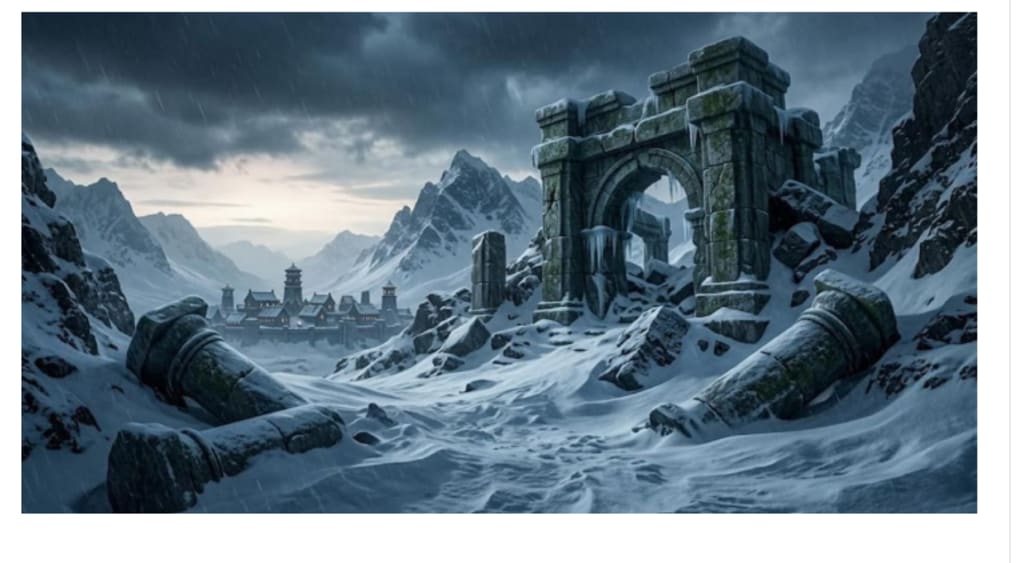
The story of a paradise concealed at the top of the earth has fascinated explorers, historians, and mythologists for generations. Ancient Greek writings describe this as a region of perpetual spring where a race of giants lived for a millennium without illness or conflict. It was referred to as Hyperborea, a world that existed "beyond the North Wind." But could this fabled utopia have been more than a myth?
A contentious subject is being raised more and more by contemporary scholars and alternative historians: Is it possible that a highly developed Arctic civilization existed close to the North Pole prior to the last Ice Age? Strong anomalies are appearing as the polar ice caps continue to move, revealing truths that have been hidden for millennia.
From bizarre megalithic constructions in the barren north of Russia to old maps showing landmasses where only ice should exist, the enigma of Hyperborea is emerging from mythology into the harsh light of contemporary research.
We must first examine the old documents that gave rise to the legend in order to comprehend the hunt for a vanished Arctic civilisation. The far north was regarded by the Greeks as the domain of Boreas, the deity of the chilly north wind, and the earth was divided into discrete zones. But beyond his frigid breath was a place that was constantly illuminated by sunlight.
The Legendary Beginnings of Hyperborea
Around 500 BC, the poet Pindar wrote about Hyperborea, describing it as a land where the muse never stopped singing and where people lived free from illness and the ravages of ageing. It was a place with strong ties to the divine, particularly to Apollo, the god of prophecy, light, and music. Every winter, Apollo is said to have travelled to Hyperborea in a chariot pulled by swans to live among his favourite people.
In 450 BC, the "Father of History," Herodotus, wrote about the Hyperboreans and mentioned that they brought enigmatic presents to the holy island of Delos wrapped in wheat straw. The ancients saw these stories as geographical facts ingrained in their worldview, not just fairy tales. They were even referred to as a true civilization by the Roman author Pliny the Elder, who said that they had a perfect temperature and six months of nonstop daylight.
However, if traditional Mediterranean cultures had never visited the arctic region, how could they have such intricate ideas about it, including the occurrence of the midnight sun? Some scholars contend that Hyperborea was not created by the Greeks. Rather, they inherited the legacy of a pre-glacial Arctic civilization that had to relocate south due to a significant shift in climate.
Following the Traces of a Vanished Arctic Civilisation
Where is the proof that there was an old Arctic civilization? The Kola Peninsula and the White Sea region in Russia's far north have been the main targets of the hunt. Some of the world's most puzzling archaeological anomalies can be found in this isolated, frigid region.
Megalithic constructions and enormous stone blocks that defy simple explanation have been discovered during expeditions to the Kola Peninsula in recent decades. Russian researchers launched expeditions in the late 1990s and early 2000s that discovered massive, geometrically accurate stone slabs arranged in ways that suggested artificial construction. The well-known topic of how prehistoric hunter-gatherers could have moved is raised by the estimated hundreds of tonnes of weight of some of these stones.
Ancient stone labyrinths can also be found throughout the area, especially on the Solovetsky Islands. These intricate, spiralling stone designs bear striking resemblance to labyrinths seen in Scandinavia, Ireland, and even the Mediterranean. Although these northern labyrinths are sometimes associated with shamanic rituals or depictions of the underworld, their actual purpose is still unknown. Are they the last traces of the Hyperborean people's culture?
Unusual Things on the Ice: Are Myths True?
Beyond the megaliths, speculations of a vanished civilisation have been stoked by the Arctic's topography. One of the most convincing pieces of evidence is found in Renaissance maps rather than on the ground. The most well-known is the map made in 1569 by Gerardus Mercator. Master cartographer Mercator portrayed the North Pole as a vast, separate landmass split into four islands by swift-moving rivers rather than as an ocean of ice.
There was a huge black magnetic rock in the middle of this landmass. According to Mercator, his portrayal was derived on much older, lost source maps. Oddly, certain geological features have been identified by contemporary bathymetric investigations of the Arctic Ocean floor.
The Lomonosov Ridge and Mendeleev Ridge are examples of underwater mountain ranges, however they do not resemble Mercator's design of four symmetrical islands separated by rivers.
The Evidence from Geology and Climate
From a scientific perspective, the notion of a warm, habitable Arctic is really a question of timing. Paleoclimatologists verify that the Arctic had a tropical environment with palm trees and alligators millions of years ago, during the Eocene period. But this was a long time before modern humans evolved.
The Holocene Climatic Optimum, an interglacial period that took place between 5,000 and 9,000 years ago, is a more pertinent time period. The northern latitudes had noticeably higher temperatures during this interval. The Arctic was far more habitable than it is now, even though it wasn't really the "eternal spring" of Greek mythology.
Could it be that early human populations flourished in these northern areas during this warmer period, creating sophisticated cultures and sophisticated survival strategies that were later idealised by southern civilisations? The freezing north may still reveal its ancient secrets when the ice melts in the twenty-first century, demonstrating that the myth of an Arctic civilisation was based on a long-forgotten fact.
About the Creator
Enjoyed the story? Support the Creator.
Subscribe for free to receive all their stories in your feed.
Comments
There are no comments for this story
Be the first to respond and start the conversation.