
The Zeigarnik Effect: Why Unfinished Things Haunt the Mind
How incomplete tasks occupy mental space and shape attention, memory, and motivation

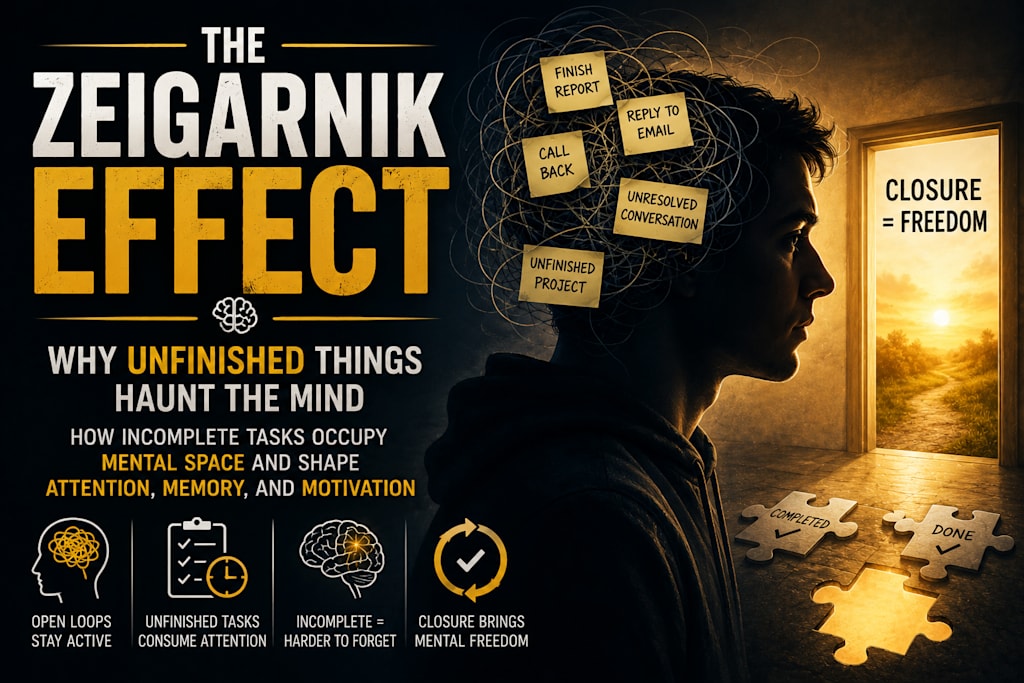
Have you ever noticed how an unfinished task can linger in your mind for days, while completed tasks are quickly forgotten? A half-written email, an unresolved argument, an abandoned project, or a book left unfinished often seem to occupy far more mental energy than things we have already completed. This phenomenon is known as the Zeigarnik Effect, a fascinating subcategory of cognitive psychology that explores how the psyche responds to incompleteness.
The Zeigarnik Effect is named after Soviet psychologist Bluma Zeigarnik, who made a curious observation in the 1920s. She noticed that restaurant waiters often remembered unpaid orders in remarkable detail, yet quickly forgot them once the bill had been settled. This observation inspired research that revealed a surprising psychological pattern: unfinished tasks are often remembered more vividly than completed ones.
At first glance, this seems inefficient. Why would the brain devote valuable resources to things that are incomplete? The answer lies in the psyche's fundamental desire for closure. Human cognition is naturally organized around patterns, resolutions, and completed narratives. When something remains unfinished, the mind treats it as an open loop that demands attention.
Think about watching a television series that ends on a dramatic cliffhanger. The unresolved storyline remains in your thoughts long after the episode is over. By contrast, a fully resolved story is easier to put aside. The same principle applies to everyday life. Incomplete experiences create psychological tension, and the mind continues revisiting them in search of resolution.
This tension is not necessarily conscious. Many people experience the Zeigarnik Effect as a vague feeling of mental clutter or background anxiety. They may not be actively thinking about a forgotten task, yet part of their attention remains tied to it. The psyche quietly keeps track of unresolved obligations, creating a subtle cognitive burden.
One reason unfinished tasks feel so persistent is that they challenge the brain's predictive systems. The human mind constantly generates expectations about what should happen next. When a task is interrupted before completion, those predictions remain unresolved. The brain continues allocating attention to the task because it expects a conclusion that never arrives.
This explains why procrastination often feels mentally exhausting even before any work begins. Contrary to popular belief, avoiding a task does not eliminate its psychological cost. In many cases, avoidance increases cognitive strain because the task remains active in the background. The mind repeatedly reminds itself of the unfinished obligation, creating cycles of guilt, stress, and distraction.
The Zeigarnik Effect also influences memory. Research suggests that incomplete tasks remain more accessible because the brain treats them as unfinished business. Once a task is completed, the associated tension disappears, making it easier to forget details. In a sense, completion grants the psyche permission to let go.
This phenomenon plays a significant role in learning. Students often remember partially mastered material more effectively than information they feel they have fully learned. The sense of incompleteness keeps the brain engaged. Some educators intentionally use this principle by ending lessons with unresolved questions or thought-provoking problems, encouraging continued mental engagement after class ends.
Creative professionals frequently experience the Zeigarnik Effect as well. Writers, artists, musicians, and designers often report that unfinished projects remain mentally active even when they are not consciously working on them. Ideas continue evolving in the background, leading to unexpected insights. What feels like subconscious creativity may partly reflect the psyche's ongoing effort to resolve incomplete cognitive loops.
Interestingly, marketers and storytellers have long exploited the Zeigarnik Effect. Cliffhangers, mystery plots, and serialized content all rely on the mind's discomfort with unresolved narratives. When a story leaves important questions unanswered, attention remains locked onto it. The desire for closure becomes a powerful motivational force.
Relationships are another area where the Zeigarnik Effect exerts considerable influence. Unresolved conversations, unanswered questions, and ambiguous endings often linger far longer than clear conclusions. A friendship that ends without explanation may occupy mental space for years. The psyche struggles not necessarily because of the loss itself, but because the story lacks resolution.
This is one reason breakups with unclear endings can feel particularly painful. When closure is absent, the mind continues searching for explanations. Individuals replay conversations, imagine alternative outcomes, and revisit memories repeatedly. The emotional discomfort stems not only from grief, but from cognitive incompleteness.
Social media has amplified the Zeigarnik Effect in modern life. Notifications, unread messages, partially consumed content, and endless scrolling create countless open loops throughout the day. Each unresolved interaction competes for attention. The result is a fragmented mental environment where the psyche rarely experiences full closure.
This constant exposure to incompleteness may contribute to the sense of mental fatigue many people report. The brain evolved to handle a limited number of unresolved concerns at a time. Digital environments, however, generate dozens or even hundreds of open loops daily. The psyche becomes overloaded with unfinished cognitive commitments.
Fortunately, understanding the Zeigarnik Effect offers practical benefits. One effective strategy is externalization. Writing tasks down reduces the need for the brain to keep actively tracking them. A trusted to-do list functions as an external memory system, allowing the psyche to release some of the cognitive tension associated with unfinished obligations.
Another useful approach is breaking large projects into smaller, clearly defined steps. Massive tasks often feel overwhelming because the endpoint seems distant and ambiguous. Completing small components creates moments of closure that reduce psychological strain and maintain motivation.
Paradoxically, simply starting a task can also relieve anxiety. Research suggests that beginning a project often reduces the mental burden associated with procrastination. Once action is underway, the psyche shifts from worrying about the task to engaging with it directly.
Mindfulness practices can help as well. By observing thoughts without immediately reacting to them, individuals become less controlled by unresolved cognitive loops. Rather than fighting incompleteness, they learn to acknowledge it without allowing it to dominate attention.
Ultimately, the Zeigarnik Effect reveals something profound about human psychology. The mind is not merely a storage system for information; it is an engine designed to seek completion, meaning, and resolution. Unfinished tasks linger because the psyche views them as important. They represent stories without endings, questions without answers, and actions without conclusions.
Understanding this principle helps explain why some thoughts refuse to leave us alone. It also offers a reminder that mental peace often depends not on eliminating responsibility, but on creating closure where possible. Every completed task, resolved conversation, and finished project frees a small portion of cognitive space.
In the end, the Zeigarnik Effect shows that the psyche has a deep relationship with incompleteness. We are creatures who naturally seek endings. The mind wants chapters to close, puzzles to be solved, and narratives to make sense. When those endings remain out of reach, the unfinished quietly follows us, waiting for the moment when we finally bring it to completion.
About the Creator
Kyle Butler
Sharing fascinating facts and insights from every category, with a special passion for longevity and healthy living. Join me on a journey to discover the secrets of a longer, better life.
Enjoyed the story? Support the Creator.
Subscribe for free to receive all their stories in your feed.
Comments
There are no comments for this story
Be the first to respond and start the conversation.