
The Psychology of Impostor Syndrome
Why capable people often feel like frauds despite evidence of success

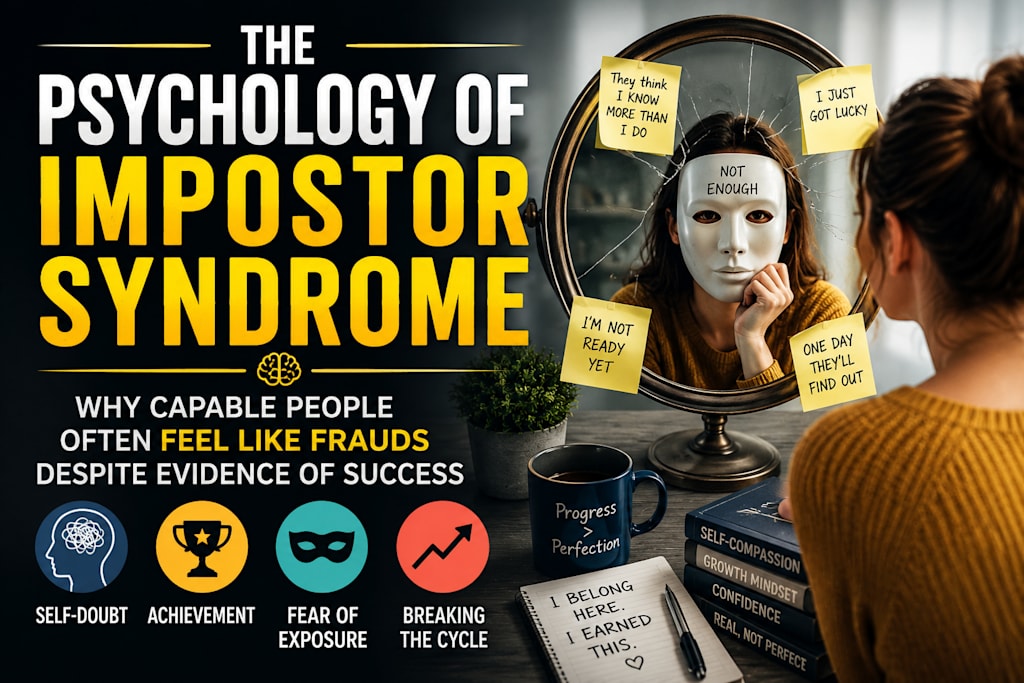
There are people who achieve remarkable things—earning degrees, building careers, creating art, leading teams—yet privately believe they are only pretending to be competent. They fear that eventually others will “discover” they are not as intelligent, talented, or capable as they appear. This phenomenon is known as impostor syndrome, a psychological pattern that falls within the subcategory of self-perception and achievement psychology. Despite its name, impostor syndrome is not a clinical disorder. It is a deeply human experience tied to identity, self-worth, and the fear of inadequacy.
Impostor syndrome was first identified in the 1970s by psychologists Pauline Clance and Suzanne Imes, who observed that many high-achieving individuals struggled to internalize their accomplishments. Instead of attributing success to ability or effort, they credited luck, timing, charm, or external circumstances. Even after repeated achievements, the underlying sense of fraudulence remained intact.
One of the most fascinating aspects of impostor syndrome is that it often affects highly capable people rather than those lacking skill. Individuals with strong abilities tend to be more aware of what they do not know, making them more likely to doubt themselves. The psyche interprets awareness of limitations as evidence of incompetence, even though true incompetence is often marked by overconfidence rather than self-reflection.
Impostor syndrome thrives in environments that emphasize performance and comparison. Academic settings, competitive workplaces, and creative industries frequently reward visible achievement while ignoring the emotional experience behind it. People begin to equate worth with constant success, creating internal pressure to always appear capable and composed. Any mistake or uncertainty then feels dangerous because it threatens the identity they have worked hard to maintain.
Childhood experiences also shape the development of impostor feelings. Children praised primarily for intelligence rather than effort may grow up believing they must naturally excel at everything. When they encounter difficulty later in life, they interpret struggle as proof that they were never truly talented. Similarly, children raised in highly critical or perfectionistic environments may internalize the belief that success is never sufficient and that mistakes define their value.
Perfectionism and impostor syndrome are deeply connected. The impostor mindset creates impossible standards: success must be flawless, immediate, and effortless to count as legitimate. If success requires hard work, the person may think, “If I were truly smart, this wouldn’t be difficult.” This creates a psychological trap where achievement provides only temporary relief before self-doubt returns.
Social comparison intensifies these feelings. In the digital age, people constantly encounter curated images of others’ accomplishments. Promotions, awards, travel, creative projects, and polished lifestyles are displayed publicly, while insecurity and failure remain mostly hidden. The psyche compares private struggles to public confidence, creating the illusion that everyone else feels more certain and capable.
Interestingly, impostor syndrome often becomes stronger during transitions or growth. Starting a new job, entering university, becoming a parent, or taking on leadership roles can trigger intense self-doubt. This happens because the psyche has not yet integrated the new identity. A person may objectively deserve the role they have entered, but emotionally they still feel like someone “pretending” to belong there.
The emotional consequences of impostor syndrome can be severe. Chronic self-doubt leads to anxiety, burnout, overworking, and fear of failure. Some people become trapped in cycles of over-preparation, believing they must compensate for their perceived inadequacy through relentless effort. Others avoid opportunities entirely, fearing exposure or humiliation. In both cases, the psyche becomes organized around self-protection rather than authentic growth.
One particularly paradoxical feature of impostor syndrome is that external validation rarely solves it. Compliments, awards, or achievements may provide temporary reassurance, but they often fail to penetrate deeply held beliefs of inadequacy. The person may reinterpret praise as politeness or luck. Because the issue is rooted in identity rather than evidence, external success alone cannot fully resolve it.
Another important psychological factor is attribution style. People with impostor tendencies often attribute success externally and failure internally. If something goes well, they believe it happened because circumstances favored them. If something goes poorly, they see it as proof of personal deficiency. This distorted pattern reinforces self-doubt while preventing achievements from strengthening self-confidence.
Despite its challenges, impostor syndrome reveals something meaningful about human psychology: competence and confidence do not always grow together. Many people assume confidence naturally follows success, but the psyche is more complicated than that. Confidence is not simply built from achievements; it develops through learning to tolerate uncertainty and imperfection without collapsing into self-rejection.
One of the most effective ways to reduce impostor feelings is normalization. Many successful individuals—including scientists, artists, executives, and athletes—have openly described experiencing impostor syndrome. Understanding that self-doubt is common helps weaken the belief that insecurity itself is evidence of fraudulence.
Cognitive restructuring can also help challenge distorted thought patterns. Instead of asking, “What if I’m not good enough?” individuals can ask, “What evidence supports that belief?” Often, the evidence overwhelmingly points toward competence, effort, and growth. The goal is not blind confidence, but balanced thinking.
Self-compassion is another powerful tool. People with impostor syndrome often treat themselves more harshly than they would ever treat others. A compassionate internal dialogue recognizes that uncertainty and learning are natural parts of growth. Being inexperienced at something does not make a person fraudulent; it makes them human.
Mentorship and honest conversation also play important roles. When experienced people openly discuss their own doubts and failures, they dismantle the illusion that competence means constant certainty. This creates healthier psychological environments where growth is valued over perfection.
Importantly, overcoming impostor syndrome does not mean eliminating self-doubt forever. Doubt is a natural part of stepping into new challenges. The goal is not to feel completely fearless, but to stop interpreting uncertainty as evidence of worthlessness. Psychological resilience comes from learning that competence can coexist with vulnerability.
Ultimately, the psychology of impostor syndrome reveals how deeply identity shapes perception. The mind can reject even overwhelming evidence when old beliefs about worth and capability remain unchallenged. Yet it also shows the psyche’s remarkable ability to evolve. By recognizing distorted patterns, practicing self-compassion, and allowing imperfection, individuals can slowly shift from feeling like impostors to feeling like learners.
In the end, growth rarely feels comfortable or complete. Most people are improvising more than they admit, learning as they go while quietly carrying doubts of their own. Understanding this does not diminish achievement—it humanizes it.
About the Creator
Kyle Butler
Sharing fascinating facts and insights from every category, with a special passion for longevity and healthy living. Join me on a journey to discover the secrets of a longer, better life.
Enjoyed the story? Support the Creator.
Subscribe for free to receive all their stories in your feed.
Comments
There are no comments for this story
Be the first to respond and start the conversation.