
The Fear of Being Perceived
Why many people feel psychologically exposed simply by existing around others

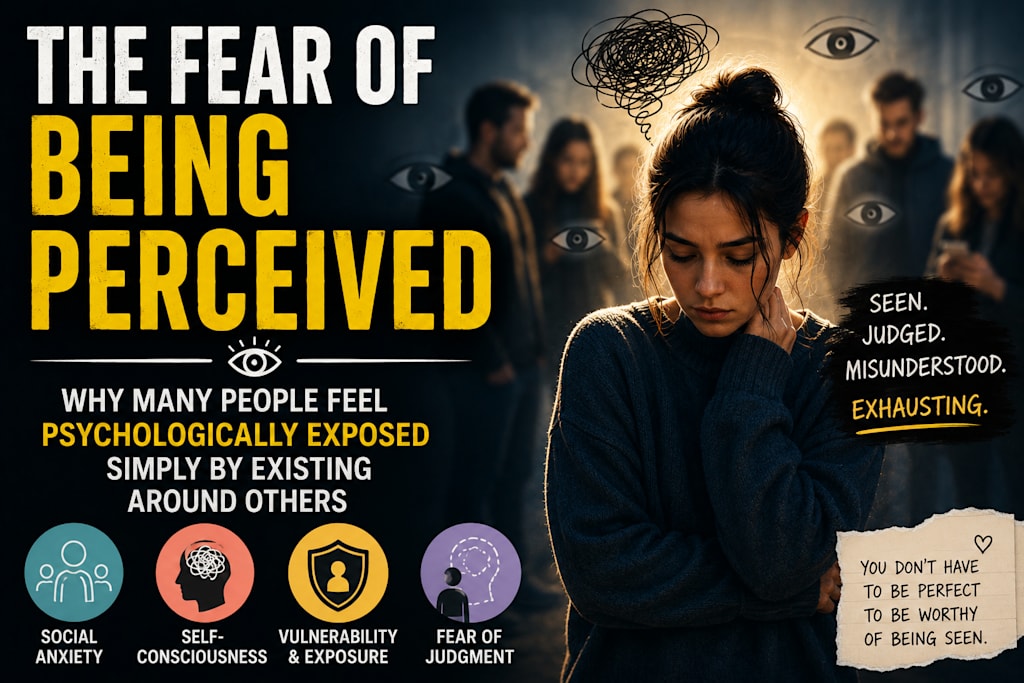
There is a peculiar kind of anxiety that many people experience but struggle to describe. It is not exactly social anxiety, insecurity, or shyness, though it overlaps with all three. It is the discomfort that arises from simply being noticed, observed, or mentally “held” in another person’s awareness. This phenomenon, often referred to informally as the fear of being perceived, belongs to the subcategory of social and self-conscious psychology. It explores the tension between identity, visibility, and emotional vulnerability.
At first glance, the fear of being perceived may seem irrational. After all, human beings are social creatures who naturally seek connection and recognition. Yet for many people, visibility itself feels emotionally dangerous. Being looked at, complimented, photographed, judged, remembered, or emotionally understood can trigger discomfort that goes far beyond ordinary nervousness. Even positive attention can feel intrusive.
One reason this fear develops is because perception creates psychological exposure. The moment another person forms an opinion about us, we lose complete control over how we exist in their mind. They may misunderstand us, idealize us, criticize us, or reduce us to a simplified image. The psyche often experiences this loss of control as vulnerability. To be perceived is to become emotionally accessible, and accessibility always carries risk.
Childhood experiences play a major role in shaping this sensitivity. Individuals raised in highly critical, unpredictable, or emotionally invasive environments often become hyper-aware of how they are seen by others. A child who was constantly scrutinized, mocked, or emotionally monitored may learn that visibility leads to danger rather than safety. Over time, the psyche develops protective strategies: blending in, staying quiet, avoiding attention, or carefully curating self-expression.
Interestingly, the fear of being perceived is not always linked to low self-esteem. Some people fear perception precisely because they value authenticity deeply. They worry that once others interpret them, their identity will become distorted. The internal self often feels nuanced and complex, while external perception feels simplified and limiting. The psyche resists being reduced to categories, labels, or assumptions.
This tension becomes especially visible in the digital age. Social media intensifies awareness of being observed. Every photo, opinion, or creative project becomes something that can be analyzed, shared, praised, or criticized. People are no longer simply interacting socially; they are continuously presenting versions of themselves to invisible audiences. The result is a heightened state of self-consciousness where even ordinary acts can feel performative.
Many individuals cope by becoming highly selective about visibility. They may delete posts immediately after sharing them, avoid posting personal achievements, hesitate before sending messages, or feel uncomfortable receiving compliments. Some people even avoid pursuing creative passions because the idea of others witnessing their efforts feels unbearable. The fear is not always failure—it is exposure.
Psychologically, this fear is connected to self-objectification. Instead of experiencing life directly, individuals begin observing themselves from an imagined external perspective. They monitor facial expressions, tone of voice, body language, and reactions in real time, almost as though they are both actor and audience simultaneously. This constant self-monitoring creates mental exhaustion and emotional detachment.
The phenomenon also overlaps with rejection sensitivity. When the psyche strongly associates perception with judgment, every interaction can feel high-stakes. A delayed response, subtle shift in tone, or lack of enthusiasm may be interpreted as evidence of negative evaluation. The individual becomes hyper-attuned to social cues, searching constantly for signs of approval or disapproval.
Ironically, the fear of being perceived often creates loneliness. Human connection requires a degree of emotional visibility. To be understood, people must allow others to witness aspects of their inner world. When visibility feels threatening, relationships may remain emotionally shallow, even if the person deeply desires closeness. The psyche becomes caught between longing for connection and fearing exposure.
Perfectionism frequently develops alongside this fear. If being seen feels dangerous, the individual may try to control perception through flawless presentation. Every interaction becomes carefully managed to minimize vulnerability. However, perfectionism intensifies anxiety because maintaining an idealized image requires constant emotional effort. The more a person tries to avoid criticism, the more psychologically fragile visibility becomes.
There is also an existential dimension to the fear of being perceived. Human beings naturally want to feel known, but being truly known also means risking disappointment, misunderstanding, or rejection. The psyche struggles with this contradiction. Complete invisibility creates isolation, but complete visibility feels emotionally unsafe. Much of human social behavior exists within this tension.
Cultural expectations further complicate the issue. Modern society encourages visibility while simultaneously punishing imperfection. People are told to express themselves, build personal brands, and share their lives publicly, yet they are also subjected to relentless comparison and criticism. This creates a psychological environment where visibility becomes both socially rewarded and emotionally risky.
Despite its intensity, the fear of being perceived is not permanent. One of the most effective ways to reduce it is through gradual emotional exposure. This means allowing small moments of authentic visibility without immediately retreating or self-censoring. Over time, the psyche learns that being seen does not automatically lead to humiliation or rejection.
Self-compassion is equally important. Many people with this fear hold themselves to impossible standards of presentation. They believe they must appear perfectly articulate, attractive, intelligent, or emotionally composed to deserve visibility. Learning to tolerate imperfection weakens the association between perception and danger.
Another important shift involves redefining what perception means. Being perceived does not require total control over others’ interpretations. Every person views the world through their own experiences, biases, and emotional frameworks. Misunderstanding is unavoidable. Psychological freedom begins when individuals accept that they cannot fully manage how others perceive them.
Mindfulness practices can also reduce self-objectification. Focusing attention outward rather than constantly monitoring oneself helps restore a sense of presence. Instead of asking, “How am I being perceived right now?” the individual begins engaging more directly with the actual moment and the people within it.
Ultimately, the fear of being perceived reveals how deeply human beings connect identity with emotional safety. Visibility is never just visual—it is psychological. To be seen is to risk interpretation, judgment, and vulnerability. Yet it is also the foundation of intimacy, creativity, and authentic connection.
The psyche often treats invisibility as protection, but complete invisibility comes at a cost. Growth happens when individuals slowly learn that they can survive being witnessed imperfectly. They can exist publicly without total control, express themselves without universal approval, and remain worthy even when misunderstood.
In the end, being perceived is one of the most human experiences imaginable. It is uncomfortable because it matters. The desire to hide and the desire to be known coexist within nearly everyone. Psychological maturity is not eliminating that tension, but learning to live within it without fear controlling the shape of our lives.
About the Creator
Kyle Butler
Sharing fascinating facts and insights from every category, with a special passion for longevity and healthy living. Join me on a journey to discover the secrets of a longer, better life.
Enjoyed the story? Support the Creator.
Subscribe for free to receive all their stories in your feed.
Comments
There are no comments for this story
Be the first to respond and start the conversation.