
FORGIVENESS WITHOUT SURRENDER
Matthew 18, betrayal, evil, and the sacred art of walking away without becoming what wounded you

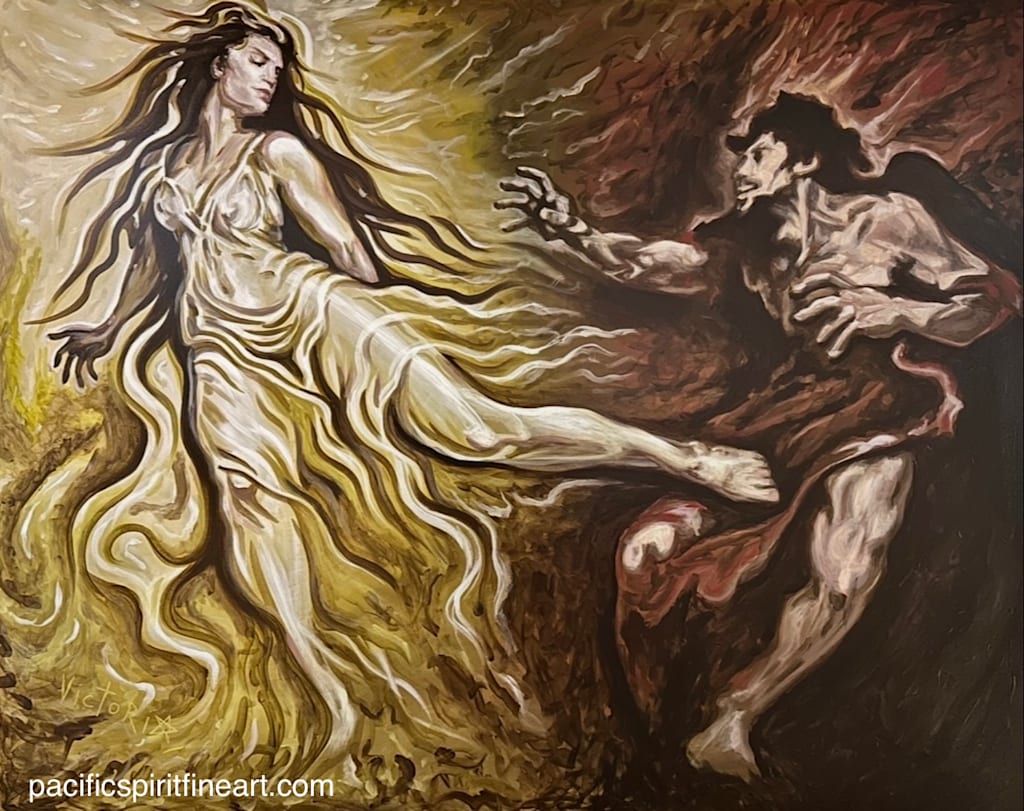
There is a version of forgiveness that has been handed to the wounded like a commandment to return to the scene of the crime.
Go back.
Speak to him.
Hear him out.
Understand his childhood.
Give him another chance.
Forgive seventy times seven.
And when the wolf comes dressed as a wounded lamb, the injured are sometimes told that Christian love requires them to open the gate again.
But Matthew 18 does not teach this.
Matthew 18 is far more dangerous, more compassionate, and more intelligent than that.
It begins with the vulnerable.
Jesus places a child in the midst of his disciples and makes the smallest, the least powerful, the easily overlooked, central to the Kingdom. He warns against causing such a little one to stumble, using the terrifying image of a millstone around the neck. He speaks of the shepherd who leaves the ninety-nine to seek the one who has wandered. He teaches what to do when someone sins against you. He speaks of boundaries, witnesses, separation, accountability, forgiveness, and mercy. And then Peter asks the question wounded people have asked for two thousand years:
How many times?
Seven?
Jesus answers: not seven, but seventy times seven.
The passage is not a command to remain available to an abuser.
It is a command against becoming one.
There is a difference.
The Serpent and the Dove
Jesus knew the world contained wolves.
He did not tell his disciples that wolves were imaginary. He did not say that every wolf was merely a wounded sheep waiting for enough compassion. He said plainly that he was sending his followers out among wolves.
And then he gave them a peculiar instruction:
Be wise as serpents and innocent as doves.
This is a remarkable sentence.
The Christian is not instructed to become a wolf.
Nor is she instructed to become stupid.
She is told to retain innocence without surrendering discernment.
This distinction matters enormously in an age when psychology has given us language for forms of human behaviour that earlier generations could see but could not always name: narcissistic personality disorder, antisocial personality disorder, psychopathic traits, manipulative and exploitative behaviour, coercive control, predatory sexual behaviour, and other patterns in which one human being repeatedly treats another as an object rather than a person.
These categories must not be thrown around as casual diagnoses. Narcissism is not synonymous with evil, psychopathy is not synonymous with violent crime, and a difficult or selfish person is not automatically a predator. The American Psychiatric Association distinguishes narcissistic personality disorder from ordinary narcissistic traits and describes NPD as involving persistent grandiosity, need for admiration, impaired empathy, entitlement, and exploitation of others.
Psychopathy, likewise, is a specific personality construct rather than simply another word for “bad person,” and most people with psychopathic traits are not violent criminals.
But the existence of complexity does not erase danger.
A person does not need a psychiatric diagnosis before their behaviour becomes unsafe.
A pattern is enough.
Repeated lying.
Deliberate exploitation.
Predation upon vulnerability.
Boundary testing.
Financial exploitation.
Sexual exploitation.
Intimidation.
Coercion.
Violence.
Retaliation when confronted.
Manufactured victimhood when held accountable.
These are behaviours.
And behaviours have consequences.
The Mask of the Wounded Child
One of the great confusions surrounding forgiveness is the human capacity to confuse explanation with absolution.
Perhaps the predator was wounded.
Perhaps he was abused.
Perhaps he was neglected.
Perhaps he has a terrible childhood.
Perhaps he suffers.
Perhaps he genuinely experiences himself as the victim.
All of these things can be true.
And none of them make the victim responsible for becoming his refuge.
A person can be wounded and dangerous.
A person can suffer and still cause suffering.
A person can have a broken inner child and still deliberately break someone else’s life.
Compassion does not require blindness.
Jesus never said, Believe every mask.
He said, in effect, Look at the fruit.
And Matthew 18 contains something that is often skipped when the conversation becomes sentimental: a process of confrontation and accountability.
If someone sins against you, Jesus says to address the matter. If they refuse to listen, bring witnesses. If they still refuse, the matter becomes communal. And if they refuse even then, there comes a point of separation: “let them be to you as a Gentile and a tax collector.”
Whatever one’s precise theological interpretation of that final phrase, the passage plainly does not say that forgiveness requires unlimited access.
There is a boundary.
There is a consequence.
There is a point at which the relationship changes.
Forgiveness and reconciliation are not identical things.
Forgiveness does not mean trust.
Forgiveness does not mean forgetting.
Forgiveness does not mean giving someone another opportunity to harm you.
Forgiveness does not mean surrendering evidence.
Forgiveness does not mean abandoning legitimate restitution.
Forgiveness does not mean refusing to tell the truth.
And forgiveness certainly does not mean standing still while someone loads another stone into the sling.
The Little Ones
This is where Matthew 18 becomes profoundly relevant to the modern world.
The vulnerable matter to God.
Children matter.
Women matter.
The elderly matter.
The economically dependent matter.
People recovering from addiction matter.
People with disabilities matter.
People isolated from family matter.
People without money, social power, physical strength, legal knowledge, or institutional connections matter.
The person who has less power is not less valuable.
And when a society is arranged so that the powerful can repeatedly exploit the vulnerable, calling upon the vulnerable to become endlessly forgiving can become another form of abandonment.
Modern Canadian statistics do not make the problem imaginary. In 2023, police-reported intimate-partner violence victims aged fifteen and older were 78% women; the rate for women and girls was nearly four times that for men and boys. Between 2019 and 2023, women accounted for 73% of intimate-partner homicide victims.
These numbers do not mean every man is dangerous.
They mean danger is not distributed randomly.
And pretending otherwise does not make society more compassionate.
It makes vulnerable people less prepared.
Historically and materially, women have often entered relationships with less physical power, less economic independence, and greater biological vulnerability through pregnancy and caregiving. Children are smaller and dependent. Predators understand vulnerability because predators exploit asymmetry.
The wolf does not need the sheep to be stupid.
The wolf needs the sheep to believe that recognizing the wolf is unchristian.
That is the trap.
What, Then, Does “Seventy Times Seven” Mean?
It cannot mean that the victim must count the blows.
It cannot mean:
I forgive you, therefore you may continue.
It cannot mean:
I forgive you, therefore you owe me nothing.
It cannot mean:
I forgive you, therefore I will stop telling the truth.
It cannot mean:
I forgive you, therefore I will put my children back within your reach.
It cannot mean:
I forgive you, therefore I must destroy myself trying to save you.
The parable that follows Peter’s question is about the enormous mercy of God and the refusal to withhold mercy from others. But mercy is not the same as enabling destruction.
The Kingdom of God does not require the wounded to become collateral damage.
There is another way to understand the mathematics.
Seventy times seven is not a prison sentence.
It is freedom from arithmetic.
It is the refusal to keep a ledger of vengeance inside one’s own heart.
It says:
I will not allow what you did to become the ruler of what I become.
That is forgiveness.
And that is very different from surrender.
The Debt
This is where the parable becomes almost unbearably profound.
What if the debt owed to you is real?
What if something genuinely was taken?
What if there was actual theft, actual violence, actual betrayal, actual exploitation?
Does forgiveness mean pretending the debt never existed?
No.
The Kingdom does not require a person to call theft generosity.
Truth remains true.
A debt can be legitimate.
A crime can be real.
A boundary can be necessary.
A court can be necessary.
A record can be necessary.
A witness can be necessary.
And still the heart can eventually release its demand that the perpetrator’s punishment be the source of one’s peace.
That is the strange alchemy of forgiveness.
The debt may remain a matter of earthly accountability while ceasing to be the master of the soul.
This is why forgiveness can become an act of sovereignty.
Not:
You did nothing wrong.
But:
You no longer own my inner world.
Not:
I trust you.
But:
I refuse to become you.
Not:
There should be no consequences.
But:
I will not spend my entire life chained to the consequences of what you did.
The distinction is everything.
The Criminal Protection Maze
Modern justice systems are human institutions. They can protect people, restore rights, punish wrongdoing, fail victims, correct themselves, and fail again. They are not identical to the Kingdom of God.
For a victim, the machinery of law can sometimes become another wilderness: forms, fees, hearings, delays, evidentiary burdens, procedural rules, appeals, negotiations, uncertainty, and years spent proving something that was lived in a single devastating moment.
And there is a terrible temptation hidden inside that machinery.
Just one more form.
One more hearing.
One more lawyer.
One more application.
One more year.
One more attempt to make the world admit what happened.
Sometimes that pursuit is necessary.
Sometimes justice can be obtained.
Sometimes a debt can be recovered.
But sometimes the pursuit itself begins consuming the life it was supposed to restore.
This is where the teaching becomes radical.
There comes a moment when the soul must ask:
Am I pursuing justice—or am I still chasing the wolf?
There is a difference between pursuing a lawful remedy and allowing the perpetrator to occupy the entire landscape of one’s consciousness.
Jesus repeatedly calls the eye back toward the Kingdom.
Do not become fascinated by the machinery of evil.
Do not stare so long into darkness that darkness becomes your horizon.
Do not become so obsessed with defeating the enemy that you forget who you are.
The Kingdom is elsewhere.
Pluck Out the Eye
Matthew 18 uses another violent image: if your hand or foot causes you to stumble, cut it off; if your eye causes you to stumble, tear it out.
Jesus is not giving us a literal surgical program.
He is speaking in the language of radical severance.
Remove what repeatedly leads you into destruction.
Stop feeding what destroys you.
Stop looking where you should not look.
Stop following what leads you away from life.
There are relationships that must be severed.
There are doors that must remain closed.
There are conversations that should never happen again.
There are people whose inner mythology you do not need to understand.
There are battles you do not need to win.
And there are eyes you must stop turning toward the spectacle.
Because sometimes the final victory over the predator is not watching him fall.
It is no longer watching him at all.
The Serpents Underfoot
Then comes the astonishing counter-image.
Jesus tells his disciples that he has given them authority to tread upon serpents and scorpions and over the power of the enemy.
The serpent is not to be worshipped.
It is not to be negotiated with indefinitely.
It is not to be invited into the nursery because perhaps it has had a difficult childhood.
It is recognized.
It is survived.
It is placed beneath the feet.
And then Jesus immediately warns them not to make their triumph over evil the center of their joy. Their deeper joy is that they belong to Heaven.
There it is.
The whole teaching.
Do not become obsessed with the serpent.
Put it beneath your feet.
Then look up.
The Resurrection of Forgiveness
Perhaps this is why the deepest meaning of Christ’s resurrection cannot be separated from forgiveness.
Not cheap forgiveness.
Not the forgiveness demanded by frightened institutions.
Not the forgiveness that asks the wounded to erase reality.
The resurrection is the possibility that what was murdered in us can live again.
Hope.
Dignity.
Trust in God.
Beauty.
Creativity.
Love.
The capacity to walk forward without carrying the corpse of yesterday everywhere we go.
Imagine Mary Magdalene standing before the aftermath of the crucifixion.
Imagine the horror.
The betrayal.
The blood.
The body.
The impossible contradiction between what she believed and what she could see.
And then imagine resurrection not merely as an event occurring outside her, but as something that begins to occur within her.
The love that did not die.
The truth that did not die.
The spirit that did not die.
The forgiveness that did not die.
Perhaps this is one meaning of resurrection consciousness:
The thing the world tried to kill in you rises.
Not as revenge.
As freedom.
That is a different kind of power.
What Is My Sin?
Perhaps the hardest question for the wounded person of faith is this:
What have I done that requires me to forgive someone who deliberately harmed me?
The answer cannot be that the victim and the perpetrator are morally interchangeable.
They are not.
Forgiveness is not a cosmic equation in which every injury must be balanced against an equal injury committed by the injured person.
Christian mercy begins with the recognition that every human being stands in need of grace.
But grace does not require false equivalence.
The person who was robbed does not become the thief because she seeks restitution.
The person who was assaulted does not become the aggressor because she tells the truth.
The person who leaves an abusive relationship does not become cruel because she closes the door.
The person who reports a crime does not become unforgiving merely because she refuses to conceal it.
And the person who walks away from a predator is not abandoning God.
She may be walking directly toward Him.
Let Them Go
There are people who live in hell while still walking around on earth.
They may possess money.
Beauty.
Status.
Charm.
Influence.
Sexual power.
Professional success.
A convincing smile.
A carefully constructed reputation.
And still be internally ruled by hunger, domination, envy, entitlement, fear, emptiness, and the endless need to extract something from someone else.
That is not freedom.
It is bondage wearing a crown.
So perhaps pity becomes possible.
Not because evil is harmless.
But because evil is tragic.
We can say:
I do not hate you.
I do not need to destroy you.
I do not need to become you.
I do not need to carry you.
I will not give you access to me.
I will not participate in your delusion.
I will not lie about what happened.
I will not abandon the vulnerable to protect your reputation.
And I will not follow you into hell.
That is forgiveness with a spine.
The Crone at the Gate
The mature soul eventually learns that compassion has a gate.
The gate has hinges.
The gate can open.
The gate can close.
And the person standing at the gate is allowed to possess discernment.
She can forgive the wolf without inviting it into the flock.
She can pity the wolf without becoming its prey.
She can pray for the wolf without feeding it her children.
She can release hatred without releasing boundaries.
She can surrender vengeance without surrendering truth.
She can leave justice to God without abandoning every earthly avenue of accountability.
She can stop fighting without declaring the fight imaginary.
And she can walk away without needing the enemy to understand why.
This is not weakness.
This is the wisdom of the serpent joined to the innocence of the dove.
Matthew 18 does not tell the vulnerable to become endlessly available to those who harm them.
It tells us to protect the little ones.
To seek the lost.
To confront wrongdoing.
To establish witnesses.
To recognize when relationship has broken beyond repair.
To forgive without limit.
And to refuse the spiritual poison of vengeance.
Jesus does not ask the sheep to become wolves.
He asks the sheep to wake up.
To see.
To know.
To discern.
To forgive.
And then, when necessary, to walk away.
The Kingdom of Heaven is not found in winning every earthly battle.
Sometimes the Kingdom begins the moment you stop chasing the battle.
Sometimes the miracle is not that the debt is collected.
Sometimes the miracle is that the debt no longer owns you.
Sometimes the resurrection is not the enemy falling.
It is you rising.
And perhaps that is the final mystery of forgiveness:
You do not forgive because what happened was small.
You forgive because your life is larger.
You do not forgive because evil deserves your trust.
You forgive because your soul deserves its freedom.
You do not forgive because the wolf was harmless.
You forgive because you finally understand that you were never meant to live inside its den.
So let the serpent remain beneath your feet.
Let the scorpion keep its sting.
Let the wolf walk its own road.
Do not follow.
Do not become.
Do not return to the cage to prove that you are free.
Turn your face toward the Kingdom.
Keep your hands clean.
Keep your eyes open.
Keep the little ones safe.
Tell the truth.
Forgive.
And go.
Because there is a place beyond the battlefield where the Crone stands beneath the open sky, no longer carrying the enemy on her back.
And there—
at last—
she is free.
The Last Shall Be First
Rest in the LORD, and wait patiently for him: fret not thyself because of him who prospereth in his way, because of the man who bringeth wicked devices to pass.
Cease from anger, and forsake wrath: fret not thyself in any wise to do evil.
For evildoers shall be cut off: but those that wait upon the LORD, they shall inherit the earth.
But the meek shall inherit the earth; and shall delight themselves in the abundance of peace.
— Psalm 37:7–11
And so the sword can be put down.
Not because the battle was imaginary.
Not because the wound was small.
Not because the debt was never owed.
But because there is a greater Kingdom.
There comes a moment when the soul must stop chasing the enemy into the wilderness and turn its face toward God.
Let them keep their kingdom.
Let them keep their masks, their games, their battles, their hunger for power.
You do not have to live there anymore.
The last shall be first.
The meek shall inherit the earth.
And perhaps forgiveness is the moment we finally understand that we do not have to conquer hell to leave it.
We can simply stop walking toward it.
Turn around.
Put down the sword.
Follow Christ.
And go home.
About the Creator
THE HONED CRONE
Sacred survivor, mythic storyteller, and prophet of the risen feminine. I turn grief, rage, and trauma into art, ritual, and words that ignite courage, truth, and divine power in others. Linktr.ee/TakeTheExit
Enjoyed the story? Support the Creator.
Subscribe for free to receive all their stories in your feed.
Comments
There are no comments for this story
Be the first to respond and start the conversation.