art
Art of an introspective nature; a look at artwork that reveals the artist's psyche and comments on the inner workings of a chaotic mind.
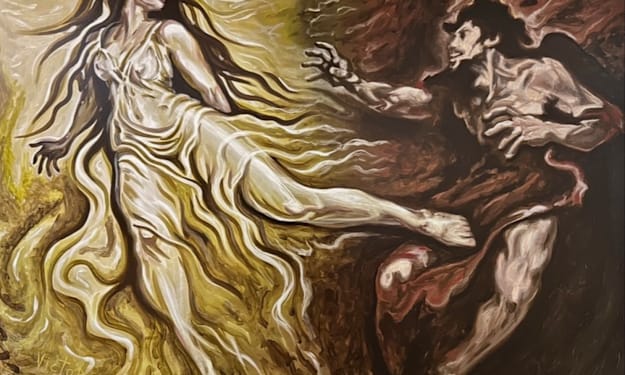
Desire
Consider what moves within us. Fear, greed, love, envy, curiosity, shame, guilt, regret, joy, bliss, happiness, pride, sadness, loneliness, and others. We encounter these in different measures, under different circumstances, and sometimes struggle to find a name for what we feel. Yet through them we recognize something of one another: that we share the same consciousness... a human consciousness. Being in the wonderment of being human and the human experience.
By Chase McQuade10 days ago in Psyche
Conscious Whimsy: Finding Meaning Without Losing Touch With Reality
I think one of the most beautiful and potentially dangerous things about being human is our ability to create meaning. We can recognize patterns, connect experiences, and construct narratives that help us to better understand ourselves and the world around us. But there's an important distinction we can lose sight of, something can be meaningful to us without that meaning being the reason why it happened. A coincidence doesn't have to be orchestrated by something larger than yourself to have a profound impact on you. I think one of the most valuable things we can learn is to appreciate the meaning we create while remaining comfortable with not knowing why things happen. To be human is absurd. And over the years I've found myself drawn to absurdism, the idea that we desperately seek meaning in a universe that doesn't necessarily provide any inherent meaning in return. We want answers. We want things to happen for a reason. We want to believe that the things we endure and people we encounter fit together into some larger narrative. However, there is no objective proof that the universe will provide us with any of these. Things seem to happen through a complicated interplay of circumstance, chance, and consequence. Some things follow consistently recognizable patterns while others may surprise us. Life is chaotic at best and our understanding of it incomplete. Yet, here we are. Human beings have this extraordinary capacity to look at an indifferent universe and still experience wonder. We create art, fall in love, develop philosophies, invent religions, tell each other stories, and find significance in the smallest of details. Our capacity to experience an ordinary moment as extraordinary isn't something we need to eliminate, but rather embrace with discernment. The answer to the absence of inherent meaning is not to stop creating meaning, but to learn how to create it without demanding that the universe confirm our interpretations. We can accept the absurdity of existence while creating reasons to participate in it and acknowledge uncertainty without surrendering our wonder. Life may have no predetermined narrative, but we can still write beautiful stories with it. Synchronicity is not the same as causation. Consider how often you encounter something that feels like a meaningful coincidence. You're thinking about someone you haven't spoken to in years, your phone rings, and it's them. A song you associate with someone you've lost plays on the radio at a moment when you're missing them most. You meet a fascinating stranger who says something that ultimately changes the direction of your life or career. These experiences can feel extraordinary, supernatural. They can evoke emotions that are difficult to articulate and even become important parts of our personal histories. But what makes them meaningful? Must the universe have arranged them intentionally? Must there be some external intelligence coordinating events for our benefit? Must a coincidence be evidence of something supernatural to deserve our appreciation? I don't think so. The phone call could be a coincidence, simply two people thinking about each other at the same time. The song might have played just because it was on the radio's rotation. The stranger likely offered their advice without knowing just how profoundly it would affect you. None of these explanations diminish what the experience meant to you though. An event can be accidental in its occurrence while also being extraordinary in its significance. The distinction comes from understanding that the meaning is real as part of our experience, but the external explanation is an entirely separate question. And we don't have to resolve that question to appreciate what the experience brings into our lives. I think this is where we sometimes get ourselves into trouble. We become so attached to the significance of an experience that we begin treating it as an explanation or evidence for one. We stop saying, "This feels meaningful to me," and start saying, "Because this feels meaningful, it must have happened for this reason." Those statements might seem similar on the surface, but they make fundamentally different claims. The first acknowledges our subjective experience. The second attempts to establish something about objective reality because of our subjective experience. But one does not automatically prove the other and we can appreciate the first without assuming the second. Pattern recognition is both a blessing and a curse. Human beings are remarkably good at finding patterns. This ability helps us navigate the world, learn from experience, anticipate consequences, and understand complex systems. Our capacity to recognize relationships between events is fundamental to much of what makes us intelligent. But we must remain aware that pattern recognition also has limitations. Sometimes we can perceive connections that aren't actually there. We can mistake coincidence or correlation for causation, interpret ambiguous events as distinctly meaningful due to our existing beliefs, and even become increasingly convinced of an explanation simply because we keep finding ways to interpret new experiences as confirmation of it, often referred to as confirmation bias. Sometimes our interpretations are useful. Sometimes they're mistaken. Sometimes we simply don't have enough information to know. The problem isn't that we find patterns. It's that we can become so committed to our interpretations that we lose the ability to question them. This distinction matters when discussing delusional thinking and psychosis. Psychosis is complex, and it cannot be reduced to a failure of reasoning or an inability to understand coincidence. Psychological and neurological processes can profoundly affect how people perceive experiences, assign significance, and evaluate beliefs. People experiencing these difficulties deserve compassion, not condescension. Still, there is an important broader lesson here, when an interpretation becomes impossible to question, when every event is treated as confirmation, or when perceived messages begin dictating consequential decisions, meaning-making can become increasingly harmful. This is particularly concerning when AI systems enter the picture. AI chatbots can produce persuasive explanations, validate a user's interpretations, and reinforce their beliefs without having reliable grounds for doing so. For someone already struggling to evaluate unusual experiences, that kind of interaction can be especially dangerous. A system that continually generates convincing explanations for perceived patterns may make an unsupported interpretation feel increasingly certain. I do not believe the answer is to shame people for seeking meaning or to treat every unusual belief as pathological. It's to recognize that our interpretations are fallible and that systems interacting with vulnerable people should have a legal responsibility not to reinforce potentially harmful beliefs. We need room for wonder, but we also need ways to remain grounded. And we need to remember that people who struggle with that balance are not simply failing to think hard enough. This brings me to an idea I've been contemplating for a while, conscious whimsy. I think humans desperately need whimsy. We need imagination, wonder, playfulness, romance, curiosity, and the freedom to experience the world as something more than a collection of measurable facts. We need to be able to look at a beautiful sunset and feel something intangible, find comfort in coincidences, and deeply romanticize the mundane moments. Experiencing the world through the poetry of our own perspectives is part of what makes existence so rich. Life becomes dull otherwise. Sometimes we just need to be a little ridiculous and absurd to keep functioning in regular, boring life. Talk to the moon. Give all 63 of your houseplants names. Make a wish when you see a shooting star or 11:11 on the clock. You don't have to believe the moon hears you or that your plants have personalities. The shooting star can literally just be a rock burning in the atmosphere instead of a magical wish-granting rock and the encounter can still mean something beautiful and cosmic to you. We have the ability to participate in the magic of experience without requiring that the magic be an objectively verifiable property of the universe. To me, conscious whimsy is wonder accompanied by awareness. It's finding meaning without demanding it be the cause. We don't have to remove whimsy from our lives to remain grounded. We can be scientifically curious, philosophically skeptical, and in awe of the world all at once. I think that's a much more interesting way to live than forcing ourselves to choose between believing in everything or believing in nothing. Cultivating the ability to hold seemingly contradictory ideas without immediately forcing one to eliminate or resolve the other is a vastly underrated skill. Sometimes, two perspectives reveal different aspects of the same situation and give us a fuller understanding. We can acknowledge that life is unpredictable while recognizing that events have causes. We can experience something as deeply meaningful while admitting that we don't know why it happened. Individuality can be recognized while acknowledging our dependence on everything around us. And we can embrace the human desire for meaning while recognizing that this desire does not establish the existence of an inherent cosmic purpose. Of course, not every contradiction can be resolved by declaring both sides true. Sometimes one claim really does conflict with another, and we need evidence, careful reasoning, or clearer definitions to determine what follows. But sometimes what initially appears contradictory reflects the limitations of our perspective. The challenge is learning to distinguish between those situations. I don't think intellectual humility means refusing to reach conclusions. It means being willing to revise our map of reality when we encounter evidence or perspectives we hadn't previously considered. As we identify patterns and develop models to explain reality, we must remain open to the idea that those models may be incomplete. An unexpected observation might reveal a flaw in our understanding or expose an assumption we hadn't recognized. It may require us to refine an existing explanation or sometimes develop an entirely new one. We should always be careful to not treat our current understandings of the world as the ultimate truth, regardless of the quantity and quality of knowledge acquired. The moment we become convinced that our interpretation explains everything, we risk losing the ability to recognize what it doesn't explain. How can we identify everything our understanding fails to account for when those omissions are, by definition, things we haven't fully recognized? We cannot anticipate every possibility. Our models are useful precisely because they simplify reality, but that simplification does not mean they can capture every detail. Even language has similar limitations. We divide experiences into categories, give them names, and develop concepts that allow us to communicate what we understand. Yet every description emphasizes certain features while leaving others unexpressed. A scientific explanation, a philosophical argument, a painting, and a poem can all illuminate different aspects of an experience without any one of them necessarily exhausting everything there is to say about it. Perhaps our understanding of existence will always be a process of translation, an ongoing attempt to express something through the limited perspectives and tools available to us. We may never arrive at a description that captures everything, but that doesn't make the process pointless. I still believe curiosity is worthwhile. We can pursue understanding without assuming that understanding must eventually become complete. And we can recognize the limitations of our current knowledge without treating those limitations as evidence for whatever explanation we happen to prefer. Uncertainty leaves room for possibility, but it does not automatically validate every possibility. That distinction allows us to remain open-minded without abandoning critical thought. I don't believe we need to settle every philosophical question before we can live meaningful lives. I don't need to know that there's a God sending me signs to find meaning in the little things or whether the universe has an ultimate purpose to care about the planet and people around me. And humanity doesn't need to resolve every contradiction before we can find beauty in the experience of just being human. We can acknowledge that our perspectives are limited while still taking them seriously and develop our own beliefs while remaining willing to revise them. Wonder can and ought to be experienced without turning it into certainty. Our lives may not have been arranged according to some predetermined plan, but what we do with them matters profoundly to us and those who love us. And I think there's a certain sense of freedom in that. We are not required to choose between a universe that supplies all our meaning and a universe in which meaning is impossible. We can inhabit the grey area in between those possibilities. Meaning can be made through our relationships, our creativity, our curiosity, our compassion, and the experiences that we choose to value. Personal meaning can be appreciated for what it is without us insisting that it explains everything else. And we can extend that same humility to other people, recognizing that their interpretations emerge from experiences and circumstances we may never fully understand. We don't have to agree with every belief to treat the person holding it with dignity. Perhaps the goal is not to eliminate the tension between wonder and uncertainty, but to become more comfortable living within it. I keep coming back to the same idea, let life be magical but in the most realistic way. We are creatures who seek meaning in a universe that may not inherently provide any. Humans find patterns, create stories, develop beliefs, and experience wonder. Sometimes these capacities enrich our lives, but other times they can lead us toward conclusions that aren't supported by evidence, and sometimes that can cause real harm. We need to preserve our capacity for meaning while remaining aware of its limitations and take reality seriously without becoming so rigid that we lose our ability to appreciate it. Our interpretations are not necessarily explanations and the world is far more complicated than any single perspective can capture. But we have to remember whimsy. We need the freedom to be delighted by coincidences, to find personal significance in ordinary events, to create art about things we cannot fully explain, and to experience moments of connection that make existence feel supernatural. We can do all of these things without demanding that the universe objectively confirm our interpretations. The sunset doesn't need to be a miracle to be mesmerizing. A song doesn't need to have been sent to us by someone we've lost for it to help us grieve them and heal. Sometimes just letting these experiences mean what they mean to us is enough. The world doesn't have to be definitively enchanted for us to experience genuine enchantment. Maybe that's what conscious whimsy really means, to participate in the poetry of existence while remembering that our interpretations are only partial translations of it, acknowledging that we might be wrong without becoming afraid to keep wondering. Conscious whimsy recognizes that meaning can be personally profound without being cosmically ordained. And at the end of the day, conscious whimsy teaches us to approach other people with compassion, reality with curiosity, and uncertainty with a little patience. One can hold the absurdity of existence in one hand and the capacity for wonder in the other. We don't have to resolve the paradox to appreciate it. We can simply be here, experiencing, questioning, creating, loving, learning, and trying to understand. Skepticism and childlike wonder are not mutually exclusive and we lose something important when we believe we must choose between them. We can have both. Deriving personal meaning without mistaking it for causation. Experiencing wonder without the need for certainty. Living in reality without becoming disenchanted. Conscious whimsy. Perhaps that's enough.
By Lolly Vieira16 days ago in Psyche
What I’ve Slowly Come To Learn About Happiness
A friend recently showed me his ‘happiness graph’. It depicts the evolution of his perceived sense of happiness over time. One of my first thoughts was pfff, white people — then I remembered that I, too, was white people.
By Paul Fingl2 months ago in Psyche
Ego Tripping at the Gates of Hell
Please forgive me for this one. It is only a few days before our semester begins at the college where I teach. I have been in touch with our new coordinator, looked over my notes from having had the same group last year, and deliberately avoided going into the building. Our first meeting gave us the option to be online, and I was hoping I could continue with this particular conceit for the rest of the course. And on top of this, I have been told that I might possibly - just maybe - have two whole courses at the college to teach!
By Kendall Defoe 2 months ago in Psyche
Silenced Voice
Think We Have Freedom of Expression?- Think Again I had worked all day on my writing and then on my art drawings to get the writing posted before the deadline and to have my art of the day shared with my followers across all social media platforms I participate in. I’ve been working tirelessly for months to grow a following and monetize my accounts. Diligently, I have met the daily challenges and requirements imposed by each platform, and today was no exception.
By Alexandra Grant4 months ago in Psyche
Blood and Ink. Top Story - July 2026.
Spiders are my favorite animals. I've always loved them for as long as I can remember, ever since I was a little kid. Charlotte's Web was one of my favorite books and cartoons. This also partially inspired my passion for animal rights, including a decade of vegetarianism.
By Cheryl Lynn4 months ago in Psyche
The Letter That Arrived Twenty Years Late
No one believes that a single letter can change a life. Daniel Harper didn't either. Until the morning it arrived. At thirty-eight, Daniel lived alone in a quiet apartment overlooking the Boston harbor. He worked as a history teacher, loved old bookstores, and spent most evenings reading novels while classical music played softly in the background. His students admired him. His colleagues respected him. But no one truly knew him. For twenty years, Daniel had carried one regret that never faded. The name of that regret was Emma Collins. They had met during their first year at university. Daniel was shy, thoughtful, and happiest with a book in his hands. Emma was fearless. She laughed loudly, talked to strangers, and believed every city had a story waiting to be discovered. Their friendship began in the university library. Daniel accidentally dropped a stack of books. Emma helped him pick them up. "You always carry this many?" she asked with a smile. "Only when I can't decide." She laughed. "I think we're going to be friends." She was right. Over the next four years, they became inseparable. They studied together. Explored museums. Walked through parks until midnight. Shared coffee every Friday after class. Daniel slowly fell in love. But he never said a word. He feared losing the friendship they had built. Graduation arrived faster than either expected. Emma received an opportunity to work in Paris for a famous publishing company. Daniel accepted a teaching position in Boston. The night before she left, they sat on the roof of their university dormitory beneath a sky full of stars. "I'll miss this," Emma whispered. "So will I." She looked at him for a long moment. "There are things we never say because we're afraid they'll change everything." Daniel felt his heart race. "What do you mean?" Emma smiled sadly. "Nothing." The next morning, she was gone. Life moved on. Or at least it pretended to. Daniel never married. Emma disappeared from his life completely. No phone calls. No emails. No messages. Only memories. Twenty years later, an old envelope appeared in Daniel's mailbox. The handwriting stopped him in his tracks. Emma Collins. His hands trembled as he opened it. Inside was a single handwritten letter. It read: «Dear Daniel,» «If you're reading this, then life has played one final trick on both of us.» «I wrote this letter twenty years ago.» «I asked my grandmother to mail it only if we somehow lost touch forever.» «I suppose she waited exactly as I asked.» «There's something I never had the courage to tell you.» «I loved you.» «Not for weeks.» «Not for months.» «For years.» «Every coffee.» «Every conversation.» «Every walk home.» «I hoped one day you would tell me you felt the same.» «But you never did.» «So I convinced myself I had imagined everything.» «Maybe we were simply two people who loved each other at the wrong time.» «If life is kind, perhaps we'll meet again.» «If not...» «Thank you for giving me the happiest years of my youth.» «Love always,» «Emma.» Daniel read the letter three times. Then four. Then ten. His vision blurred with tears. All those years... They had loved each other. Neither had spoken. The following morning, Daniel did something completely unlike himself. He requested unpaid leave from school. Booked the first flight to Paris. And carried the letter in his coat pocket. Paris had changed over twenty years. New cafés. New buildings. New faces. But Daniel had one clue. The publishing house where Emma had once worked. When he arrived, the receptionist searched the employee records. "Emma Collins?" she asked. "Yes." A smile appeared. "She retired last year." Daniel's heart sank. "But..." The receptionist continued. "She owns a little bookshop now." She wrote down an address. Daniel thanked her and hurried through the narrow streets. The bookstore was small. Its windows were filled with old novels. A wooden sign read: Lost Chapters. Daniel pushed open the door. A small bell rang. Behind the counter stood a woman arranging books. Her hair was touched with silver. Tiny laugh lines framed her eyes. But Daniel recognized her instantly. Emma looked up. For several seconds, neither moved. Finally she whispered, "Daniel?" He smiled. "I think your letter got delayed." Emma covered her mouth. "My grandmother..." "I know." Tears filled her eyes. "You read it?" "Yesterday." She laughed softly through her tears. "Only twenty years late." Daniel stepped closer. "I've been trying to answer it ever since." Emma looked at him. "What would your answer have been?" Daniel reached into his pocket. He unfolded the worn letter. "I loved you too." Silence. Then Emma began crying. Not from sadness. From relief. She walked around the counter and hugged him tightly. For a long time, neither spoke. Words were no longer necessary. Over the following weeks, Daniel extended his stay in Paris. Every day they rediscovered each other. Some things had changed. Their favorite music. Their careers. The color of their hair. But something essential remained untouched. The comfort they found in each other's company. One afternoon they revisited the university campus where they had first met. The library still stood. Daniel intentionally dropped three books. Emma laughed exactly as she had twenty years earlier. "You still can't decide?" He smiled. "Some habits survive time." Months later, Daniel made a decision that surprised everyone back home. He resigned from his teaching position. Moved permanently to Paris. Together, he and Emma expanded her bookstore into a literary café where visitors could read, write, and share stories. The walls became covered with handwritten letters from customers around the world. One section held anonymous love letters. Another displayed letters people wished they had sent. Daniel framed Emma's original letter. Not for everyone to read. Only for themselves. It remained behind the counter. A reminder that silence can sometimes steal decades. On the anniversary of their reunion, Daniel invited Emma to the rooftop of an old Parisian building overlooking the glowing Eiffel Tower. The city shimmered beneath them. Emma smiled. "You've become much braver." "I learned that time isn't as generous as we imagine." He took her hands. "For twenty years, I thought I had missed my chance." She squeezed his fingers. "And now?" "Now I know love doesn't disappear." "It waits." Daniel reached into his jacket. This time it wasn't a letter. It was a small velvet box. Emma laughed before he even opened it. "You really like surprises, don't you?" "Only the happy ones." He knelt. "Emma Collins..." His voice shook. "You once thanked me for giving you the happiest years of your youth." He smiled gently. "I'd like to spend the happiest years of our future together too." He opened the ring box. "Will you marry me?" Emma didn't answer immediately. Instead, she gently lifted him back to his feet. Then she kissed him. When she finally spoke, only two words escaped her lips. "Of course." Their wedding was small. Simple. Beautiful. Friends from university attended. Former students traveled across countries. Customers from the bookstore filled the front rows. Instead of traditional wedding vows, Daniel and Emma exchanged handwritten letters. Letters they promised never to leave unsent again. Years later, visitors often asked how they had met. Daniel would simply smile. "We were separated by silence..." Emma would finish the sentence. "...and reunited by a letter." Every evening, after closing the bookstore, they placed two cups of tea on a tiny table outside. They watched people hurry through the streets. Young couples. Old friends. Families. Dreamers. Sometimes someone would ask for relationship advice. Daniel always gave the same answer. "If your heart has something kind to say..." Emma smiled beside him. "...don't make it wait twenty years." As the sun disappeared behind the rooftops of Paris, Daniel reached for Emma's hand. She intertwined her fingers with his. The old letter rested safely inside the bookstore. Its paper had grown fragile with age. Its ink had begun to fade. But the love written between those lines had only grown stronger. Some stories begin with a first kiss. Some begin with a chance meeting. Theirs began with a letter that arrived twenty years late... ...exactly when two hearts were finally ready to read it.
By Ahmed aldeabella4 months ago in Psyche
The Scars
Understanding that invisible wounds need the same care as visible ones Hiding the HurtFor years, Zain carried a pain that no one could see. To the world, he looked strong, capable, and unshaken by life’s difficulties. He had built a good career, supported his family, and handled every challenge with a calm face. But beneath that steady exterior, he was still living with the effects of a difficult childhood and a series of painful events that had shaped his early years.
By The Curious Writer4 months ago in Psyche
How to Spot a Lie Without Making the Situation Worse
Have you ever walked away from a conversation thinking, Something about that didn't feel right? Maybe a friend gave an explanation that seemed a little too polished. Perhaps a coworker changed small details every time they retold a story. Or maybe someone close to you answered a simple question with an unusually complicated response.
By Shahid Zaman4 months ago in Psyche
With God as My Witness, I Learned to Trust My Body
I write this as a witness to a pattern that is often denied because it is uncomfortable to name. Many survivors of childhood and adult abuse describe a similar mechanism: their internal signals of danger are consistently invalidated by authority figures who use love, fear, and confusion in cycles.
By THE HONED CRONE5 months ago in Psyche