
Xiang Zuo Says Protein Powder Aged His Kidney to 70. The Full Story Is Messier.
Painkillers, hard training, and a shake mixed too thick all played a role. The test most gym-goers skip matters more than the scoop.
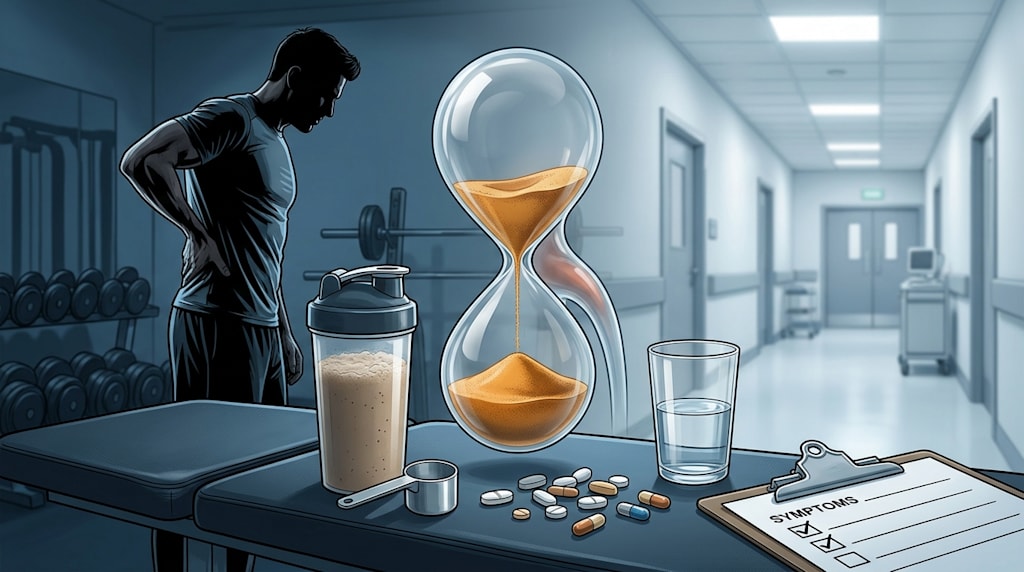
When Xiang Zuo said “70 years old” on The Big Brother’s Little Assistant, he moved his hand as if describing a number. He was talking about his kidney.
It was not the first time. In 2019, during a premarital health check with Guo Biting, a doctor told him his kidney function matched that of a 70-year-old. He blamed painkillers. He had practiced martial arts since childhood. Broken hands, broken knees, three shoulder dislocations, two-thirds of a meniscus removed. Painkillers kept him going. Seven years later, the same phrase returned with a new cause: protein powder.
Both things happened. Put them together and the simple story breaks. If painkillers caused the damage, protein powder did not. If protein powder caused it, painkillers did not. Or both did, along with something else.
Zhang Xijun, deputy director of nephrology at Nanjing Jiangbei Hospital, told reporters that multiple factors stacked together and damaged the kidney. Those factors included long-term painkiller abuse, high-intensity training, and excessive protein intake. Xiang Zuo added one detail. He used to mix his protein powder very thick.
Thickness does not change total protein grams. One scoop in 200 milliliters of water and one scoop in 50 milliliters deliver the same protein. But thick mixing often means a large dose in a short time. If water intake is low, the kidneys face a harder job concentrating nitrogen waste. It is not the main cause. It is a catalyst.
His kidney later recovered. Zhang Xijun said recovery depends on how long the damage lasts. If kidney damage is caught early and treated, it can improve. If it lasts more than three months, it may become chronic kidney disease. At that point, most cases are irreversible. Xiang Zuo caught it and treated it. That does not mean everyone will.
The kidney is a silent organ. Two kidneys need only about half their nephrons to handle daily metabolism. If some glomeruli fail, the remaining ones work overtime. Creatinine and urea can stay in range. The body can feel fine. By the time symptoms appear, kidney function is often badly reduced. That is why many people with chronic kidney disease are diagnosed late.
So the real question is not whether protein powder is safe in general. It is whether your kidneys are safe right now.
The debate over high-protein diets and kidney health has run for years. The short version: for people with normal kidney function, current evidence does not show that a high-protein diet directly causes kidney damage. For people who already have chronic kidney disease, too much protein clearly speeds up progression.
In 2018, Devries and colleagues published a systematic review and meta-analysis in The Journal of Nutrition. They pooled 28 randomized controlled trials with 1,358 adults without kidney disease. The high-protein group averaged about 1.81 grams per kilogram of body weight per day. The control group averaged about 0.93 grams. After the intervention, the high-protein group had a slightly higher glomerular filtration rate. When researchers compared changes before and after, the two groups did not differ in a statistically meaningful way.
A 2025 dose-response meta-analysis in BMC Nutrition looked at 10 prospective cohort studies. It covered 218,741 participants and 10,794 chronic kidney disease events. Higher animal protein intake was linked to lower CKD risk. Higher plant protein intake was also linked to lower risk. Total protein intake showed no clear link to CKD risk.
A UK Biobank study followed about 177,000 people for a median of 12 years. Protein from dairy and fish was linked to lower CKD risk.
Taken together, these studies suggest one thing. More protein does not automatically mean kidney damage.
But other evidence exists. A 2025 study in the Journal of the American Society of Nephrology found that among U.S. adults, higher protein intake was modestly linked to lower eGFR, especially in people who already had CKD. The KDIGO 2024 guideline recommends that adults with CKD stages 3 to 5 keep protein intake around 0.6 to 0.8 grams per kilogram per day. Chinese guidelines recommend 0.8 grams per kilogram per day for CKD stages 3 to 5. Patients at risk of progression should avoid high-protein diets above 1.3 grams per kilogram per day.
The mechanism is easy to picture. When protein intake rises, the kidneys adjust blood flow. Glomerular filtration rate can jump 20% to 30% in the short term. This is called glomerular hyperfiltration. Think of a sewage plant. It handles normal flow with room to spare. If a huge volume arrives, it runs at full power. Short bursts are not a problem. Running overloaded every day raises wear and tear.
But the body is not a machine. The kidney is made of cells that can repair. If damage stays within repair limits, permanent injury should not occur. The controversy is whether long-term hyperfiltration pushes past that limit.
The current answer leans toward no for healthy people and yes for people with kidney disease.
The problem is that many people do not know which group they are in. Early chronic kidney disease has few specific symptoms. Many standard health checks do not include urine microalbumin. They check serum creatinine and urinalysis. Serum creatinine is not sensitive. More than half of kidney function can be gone before creatinine rises. Early disease is easily missed.
If you fall into any of these groups, you are at high risk for CKD: diabetes, high blood pressure, high uric acid or gout, obesity, metabolic syndrome, family history of chronic kidney disease, long-term use of painkillers, history of aristolochic acid Chinese medicine, age over 60, or a history of nephritis, urinary tract infection, proteinuria, or hematuria. Every year, your health check should include three tests: urinalysis, urine albumin-to-creatinine ratio, and serum creatinine plus estimated glomerular filtration rate. These three cost about two hundred yuan together. Not much more than a tub of protein powder.
If you are not in those groups and your kidney function is normal, protein powder can be part of your diet. How you use it matters.
The International Society of Sports Nutrition says most healthy adults who train regularly need about 1.4 to 2.0 grams of protein per kilogram of body weight per day to support muscle growth and training adaptation. Strength athletes can go up to 1.6 to 2.2 grams per kilogram per day.
Take a 75-kilogram lifter. At 1.6 grams per kilogram, the daily target is 120 grams of protein. That number does not come from nowhere. Breakfast: two eggs, 12 grams. Lunch: one chicken breast, 30 grams. Dinner: one fish, 25 grams. One glass of milk, 8 grams. That adds up to 75 grams. The remaining 45 grams is the protein powder allowance. This is the allowance within the total daily intake. It is not an extra reward after three meals.
In 2018, Morton and colleagues published a meta-analysis in the British Journal of Sports Medicine. They pooled 49 studies and 1,863 participants. Protein supplementation helped strength trainers gain muscle and strength. But when total daily protein reached about 1.6 grams per kilogram of body weight, extra intake produced smaller returns. Eating more does not make muscle grow faster.
Protein powder is a supplement, not a necessity. It fits people who travel, who cannot eat right after training, who have a clear gap in daily protein, or who have weaker digestion. Meat, fish, milk, and soy foods also bring iron, calcium, B vitamins, and fiber. Long-term use of protein powder to replace whole foods can lead to micronutrient gaps and low fiber.
When you mix, follow the label. Most products suggest 30 to 40 grams of powder with about 250 milliliters of water. Do not mix it thick to chase an effect. Drink enough water through the day. High protein metabolism creates more nitrogen waste. Water helps the kidneys dilute and remove it.
If you also take creatine, other amino acid supplements, or long-term painkillers, your kidneys handle those too. Stacking supplements raises the load. Zhang Xijun warned that people with impaired liver or kidney function must talk to a doctor before using creatine or protein powder. Blind supplementation increases organ burden.
Back to Xiang Zuo. His kidney damage came from several forces: years of hard training, painkiller abuse, and excessive protein. Blaming protein powder alone does not match the medical facts. It also hides the risks that deserve more attention. Painkiller abuse, underlying disease management, and regular testing matter far more than the question “Can I drink protein powder?” That question is easy. The real one is harder.
When Xiang Zuo told the story, his tone was like someone talking about the past. The story ended. His kidney recovered. The question remains. A silent organ can still speak. Most people do not listen until it stops.
Urinalysis. Urine albumin-to-creatinine ratio. Serum creatinine plus eGFR. These three tests are how you listen.
About the Creator
Jin
Writer of reamstories
https://reamstories.com/jin
Enjoyed the story? Support the Creator.
Subscribe for free to receive all their stories in your feed. You could also become a paid subscriber, letting them know you appreciate their work.
Comments
There are no comments for this story
Be the first to respond and start the conversation.