
Two Scars, One Body: What My C-Section Taught Me About Why Wounds Heal Differently
I had surgery as a child and again as a mother. The difference between the two scars shows where healing gets stuck, and what modern recovery does to unstuck it.
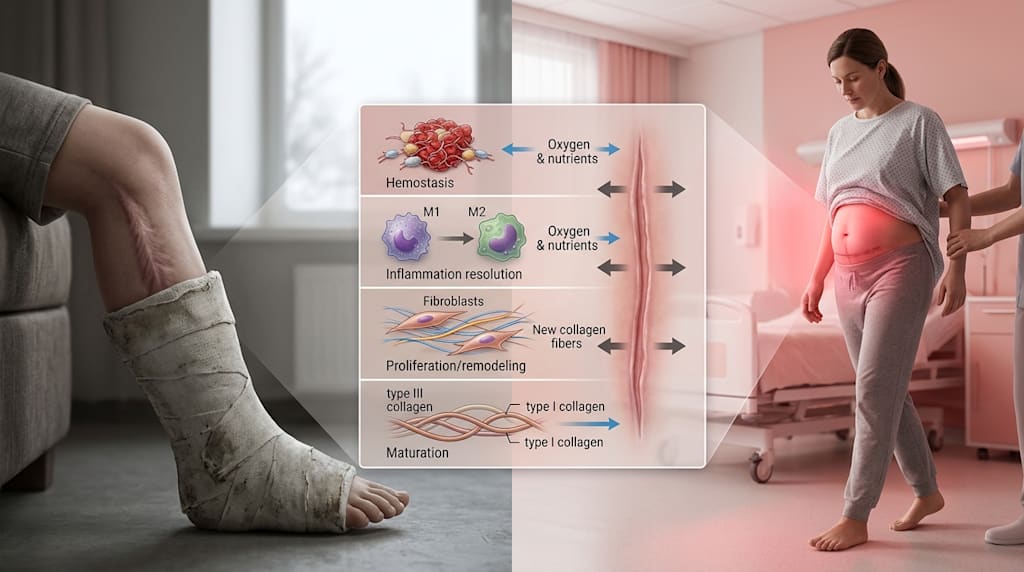
I have had three surgeries. Wounds get my attention.
As a child, I had orthopedic surgery for polio. I spent a month in bed afterward. My leg hung in a cast. The muscles shrank, the joints stiffened, and the wound leaked and stayed red and swollen for weeks. The scar grew wide, thick, and raised. It felt hard under my fingers and itched on rainy days. The itch felt like a small fire that never went out.
Years later, I had a C-section. The day after surgery, the catheter came out and I walked to the toilet. I had red light, infrared light, and short-wave ultraviolet therapy. The doctor told me to walk a little. I felt pain, soreness, and pulling. The recovery still moved at a different speed. By discharge, I could walk slowly on my own. The C-section scar stayed thin and soft. Its color matched the skin around it. I had to look for it to feel it.
Same body. Same repair system. Two very different scars. Where does healing get stuck?
Healing runs in four stages
A wound does not just grow skin back. It goes through four stages. They overlap, but each stage has work to finish.
Bleeding. Blood vessels tighten. Platelets form a clot and stop the leak. They also release growth factors, including PDGF and TGF-beta. Those factors tell repair cells to move in.
Inflammation. Neutrophils and macrophages arrive. They clear dead tissue and kill bacteria. This stage is useful. It becomes a problem when it runs too long. A wound that stays inflamed slides away from repair.
New tissue. Fibroblasts move into the wound and make collagen. New blood vessels grow. Granulation tissue fills the gap. Epidermal cells crawl across the surface. This stage uses a lot of energy and needs oxygen and nutrients.
Remodeling. Collagen cross-links and reorganizes. Softer type III collagen gives way to stronger type I collagen. The scar flattens and becomes more flexible.
A small cut on the lower leg that lingers for months has usually stalled in inflammation or new-tissue growth. Chronic wounds in clinics stall in the same places.
The problem is the environment
Chronic wound reviews list four common reasons a wound stops healing: low oxygen in the tissue, bacteria that form a biofilm, repeated cycles of poor blood flow followed by restored flow, and cells that respond poorly because of age or disease. The short version: cells want to work. They lack oxygen and food, bacteria keep bothering them, and the local conditions keep changing. After a while, they slow down.
The lower leg shows this clearly. Poor veins or narrowed arteries leave the tissue short of blood and full of fluid. Oxygen and glucose cannot get in. Waste cannot get out. Fibroblasts make collagen more slowly. Epidermal cells crawl slowly. New vessels fail to grow. The surface looks unclosed. Underneath, the wound sits in a wet, low-oxygen, low-grade inflamed patch.
Infection and biofilm add another block. Bacteria build a film over the wound. The film slows epithelial crawling and keeps inflammation going. If inflammation does not settle, macrophages stay in attack mode. They do not switch to repair mode. The healing program stays in stage two.
A wound on the face has rich blood flow. A wound on the front of the shin has poor blood flow, high skin tension, and constant movement. The same size means little. Age, nutrition, blood sugar, immune status, smoking, and pressure all change the timeline.
Two scars show when inflammation leaves
My childhood scar and my C-section scar show two endings.
A normal scar comes from ordinary healing. Inflammation ends on time. Macrophages switch from the attack-heavy M1 type to the repair-heavy M2 type. They release anti-inflammatory signals such as IL-10 and tell fibroblasts to stop. TGF-beta signaling falls. Fibroblasts die off in an orderly way. Collagen lines up, mostly type I. The scar ends flat, flexible, and close to skin color. My C-section scar followed that path.
A raised scar comes from healing that never settled. My month in bed left poor circulation, a leaking wound, slow clearing of redness and swelling, and possibly a low-grade infection. Those conditions kept inflammation alive. Macrophages stayed in M1 and kept sending TGF-beta. Fibroblasts kept working overtime and poured out a disordered matrix, mostly type III collagen. Type III collagen starts soft. Constant inflammation and pulling make it cross-link too much. The scar rises, hardens, and itches. The hard feel comes from tangled collagen. The itch comes from inflamed nerve endings.
M2 macrophages are often called repair cells. In raised scars, M2-like macrophages can drive fibrosis by releasing too much TGF-beta1. The problem is timing and balance. Inflammation should arrive when needed and leave when the work is done.
Pulling changes the scar
A vertical cut and a horizontal cut heal under different forces. Daily movement pulls on a vertical wound. That repeated pull tells fibroblasts to stay active and keep making collagen. Biomechanical studies have measured higher stress on vertical scars than on horizontal ones. After my childhood surgery, the cast took weight off the leg, but it also shrank the muscles and changed how the skin pulled back. The wound felt pulls from uneven directions. For the wound, that was not rest. It was a different kind of stress.
A scar does not simply appear. Cut direction, skin tension, and movement after surgery all shape it.
Light therapy removes blocks and supplies energy
The therapy after my C-section helped because it targeted specific blocks.
Short-wave ultraviolet light kills bacteria on the skin surface. It lowers the bacterial load, helps prevent biofilm, and gives inflammation a chance to settle. Once inflammation settles, macrophages can switch to M2. UV also affects local immune signals. Its first job is cleanup.
Red light at 600 to 700 nm reaches about 5 to 10 mm into the skin. It hits the superficial dermis. Mitochondria absorb it through cytochrome c oxidase and make more ATP. ATP powers fibroblast collagen production and epidermal cell migration. Red light gives those cells energy.
Infrared light at 780 to 1100 nm reaches deeper. Heat opens blood vessels and improves local flow. More oxygen, glucose, and protein reach the wound. Waste and inflammatory fluid leave. Better flow reduces oxygen shortage and helps cells return to work.
The three worked together. UV controlled bacteria and inflammation. Red light supported cell work. Infrared light improved blood supply. Therapy did not replace repair. It loosened the stuck parts. Light therapy has rules and limits. Not every wound should get it. A doctor should decide.
Walking after surgery helps more than clot prevention
After my C-section, the doctor told me to get up and walk to the toilet. That order sounded like clot prevention. It did more. Muscle contractions push venous blood back toward the heart. That action reduces swelling and speeds exchange between blood and tissue. It attacks one cause of chronic wounds: poor flow and low oxygen.
A month in bed costs more than weak muscles and stiff joints. Circulation slows. Fluid builds up. Oxygen and nutrients arrive more slowly. Fibroblasts work poorly. New vessels fail to grow. Granulation tissue fills slowly. Epidermal cells crawl slowly. The wound closes when time forces it. The result can be long-lasting low-grade inflammation and too much scar tissue.
Modern recovery does not ask people to move through pain without limits. It asks them to break the bed rest, poor flow, slow healing, less movement cycle early and within safe limits. Movement and rest both matter. The dose matters.
Conclusion
Why does a wound of the same size heal in days for one person and drag on for another?
The size is not the main answer. Fast healing with a good scar usually means four things happened. Inflammation was controlled and ended. Macrophages switched from cleanup to repair. Fibroblasts had enough energy and blood flow, did their work, and stopped on time. Mechanical pull stayed within a range the wound could handle.
I went from a month of bed rest to a modern recovery plan that cleared blocks, supplied energy, and managed mechanical load. My body showed me what changes when those parts get attention. Wound healing is not a waiting game. It is a process with points where help matters. Once you know where it sticks, you know where to push.
About the Creator
Jin
Writer of reamstories
https://reamstories.com/jin
Enjoyed the story? Support the Creator.
Subscribe for free to receive all their stories in your feed. You could also become a paid subscriber, letting them know you appreciate their work.
Comments
There are no comments for this story
Be the first to respond and start the conversation.