
The “Western Food” China Invented: Iron Plates, Borscht, and Spicy Soy Sauce
How steak, fried eggs, and black pepper sauce became a Chinese childhood memory, and why authenticity was never the point.
The Iron Plate, Borscht, and Spicy Soy Sauce: A Century of Chinese Western Food
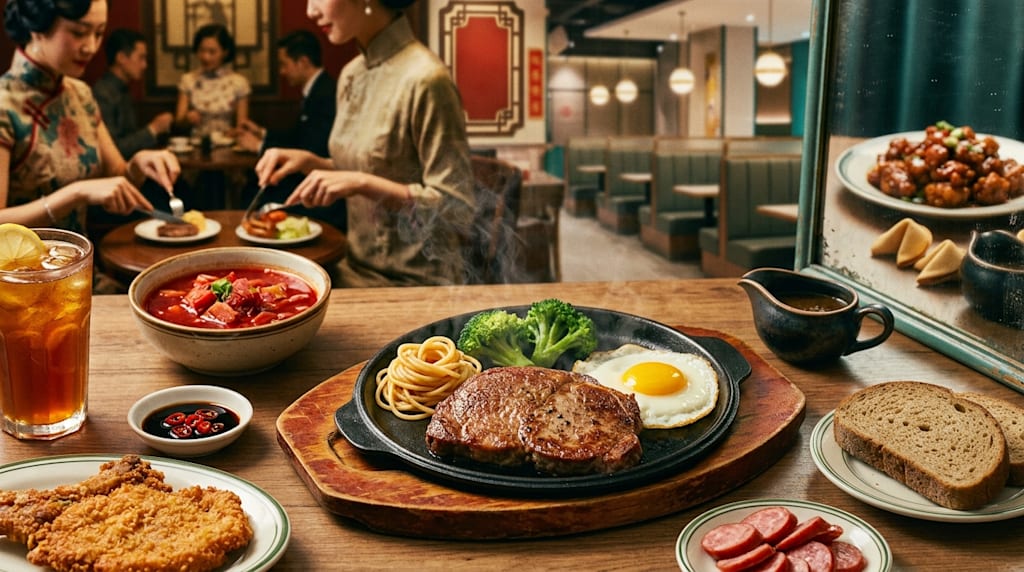
On a wooden tray sits a black iron plate, still sizzling. Beside the steak lies a fried egg, its yolk half-set, its edges crisp. A small knot of spaghetti, a few florets of broccoli, two slices of raw carrot. The server brings it over, asks "How done?", and before you can answer, black pepper sauce has already been poured on. The sauce bursts on the hot iron, white smoke rises, the sound is like rain.
This is the "Western food" many Chinese grew up eating. It is not in the Michelin Guide, not at diplomatic banquets, not even in most food bloggers' topics. But it exists on every city's commercial street, on the fourth floor of every mall, in the alley beside every university. It is called "Chinese Western food," or "soy-sauce Western food," or "Shanghai-style Western food," or it has no name. It is just "that steak place."
Fancai Restaurants: The First Chinese Imagination of Western Food
At the end of the Qing dynasty and the beginning of the Republic, the first Western restaurants opened by Chinese appeared around Simalu in Shanghai. They were called fancai guan, foreign cuisine restaurants. Eating fancai was respectable. Gentlemen in long gowns used knives and forks, drank borscht, cut fried pork chops. But authentic French food was too expensive. Steak was bloody. Cheese stank. Red wine was sour. Local cooks began to improve things. Steak had to be well done. Sauces had to be thick. Flavors had to be sweet and salty. Ingredients had to come from the local market.
Shanghai borscht is the Shanghai version of Russian red cabbage soup. Red beets were unavailable, so Maling tomato paste was used instead. Cabbage, beef, red sausage, and potatoes simmered until thick, sour, and sweet. Fried pork chop used local pork, coated in breadcrumbs, served with a dish of spicy soy sauce. That sauce was the Shanghai variant of English Worcestershire sauce, sour with a little heat, cutting the grease. The baked clams at Red House Western Restaurant came about because French snails were out of stock. The chef used clams instead. Even French President Pompidou praised them.
Tianjin Kiessling, Harbin Huamei, Guangzhou Taiping Guan, Hong Kong Taiping Guan: all products of the same logic. The form of Western food was kept. The content was swapped out.
Four Schools: Soy Sauce, Tomato Paste, and Red Sausage
Hong Kong-style Western food is also called soy-sauce Western food. Hong Kong cha chaan tengs are its main battlefield. Soy-sauce steak, Swiss wings, baked pork chop rice, iced lemon tea. The so-called Swiss sauce is not from Switzerland. It is sweet soy sauce, said to come from a Cantonese mishearing of "sweet." A plate of rice topped with a fried pork chop, a spoonful of soy sauce, a few stalks of choy sum. Fast, cheap, pretty, right.
Shanghai-style Western food is the Shanghai person's dignity and sweetness. Red House, Deda, Swan. Borscht, fried pork chop, baked clams, garlic bread. Shanghai-style Western food does not pursue authenticity. It pursues what Shanghai people think is delicious.
Tianjin and Northeast Russian-style Western food carries the nostalgia of White Russian emigres. Tianjin Kiessling, Harbin Huamei, Churin Company. Pot-braised beef, borscht, big Russian bread, red sausage, Su Bo soup. In the early 20th century, White Russian nobles poured into Harbin, Tianjin, and Shanghai. They opened restaurants, baked bread, stuffed sausages. Their Russian-style Western food, after localization, became the taste memory of northern cities.
Taiwanese steak is the cheap Western food of night markets. Sizzling plate steak, sizzling plate noodles, fried egg, mushroom sauce, black pepper sauce. Cheap, lively, filling. Later it spread to the mainland and became the prototype for Houcaller and Luyinge in many cities.
General Tso's Chicken and Soy-Sauce Steak: Two Sides of a Mirror
American Chinese food and Chinese Western food are two sides of a mirror of culinary localization.
American Chinese food was invented by Chinese immigrants for the American market: chop suey, General Tso's chicken, fortune cookies, sweet-and-sour chicken, broccoli beef. It uses Chinese woks and ingredients to make what Americans like: sweet, sour, fried, boneless, large portions. People from the original region mock it as not authentic. It still blooms across America.
Chinese Western food was improved by local Chinese cooks for the local market: soy-sauce steak, borscht, fried pork chop, baked clams, Swiss wings, sizzling plate steak. It uses Western knives and forks, iron plates, set-meal forms to make what Chinese people like: cooked, hot, rich, sweet, salty, savory. Authentic Western food fundamentalists look down on it. It has lived in Chinese cities for over a century.
What they share: both were born at the edge of cultural contact. Both serve ordinary people's tastes. Both are belittled by authenticity narratives. Both have survived. The difference: American Chinese food is an economic strategy of a diasporic group, an invention for survival in a foreign land. Chinese Western food is cultural imitation and re-creation in modernization, the result of Chinese people pulling the world closer to their own dinner tables.
How to Place the Knife and Fork, How to Say Eight-Tenths Done
Many people feel a trace of insecurity when eating Chinese Western food. They wonder whether it counts as Western food, how to place the knife and fork, which hand holds which, how to tear bread, why steak only comes in three-, five-, and seven-tenths doneness, how to say eight-tenths, and what to wear so they don't lose face.
This anxiety shows that in China, Western food has been cultural capital as well as food. It once represented civilization, class, taste. Eating Western food, you ate a meal, and you also ate status. Thus, in sizzling steak restaurants a strange contrast appears: on one side, a cheap steak sizzling; on the other, people agonizing over court etiquette.
But food culture is never static. Tomatoes, chili peppers, potatoes, corn: all foreign crops, now the soul of Chinese food. Sichuan cuisine without chili is unimaginable. Shanghai cuisine without tomato paste is incomplete. After Western food entered China, being improved, translated, and renamed is also the normal state of cultural flow. Authenticity is fluid, not carved in stone.
Saizeriya, Durian Pizza, and New Chinese Western Food
Today, Chinese Western food is still evolving.
Old brands remain: Shanghai Red House, Deda, Tianjin Kiessling, Harbin Huamei, Hong Kong cha chaan tengs, Guangzhou Taiping Guan. They sell nostalgia and city memory.
Chain brands are expanding: Houcaller, Luyinge, Saizeriya, Pizza Hut. Saizeriya is a Japanese brand doing Japanese-style Italian food. In China it has become synonymous with cheap Western food. After Pizza Hut entered China, it launched durian pizza and crayfish pizza.
A new generation of chefs is creating new Chinese Western food: using Sichuan pepper, fermented bean curd, yellow wine, soy sauce, and dried tangerine peel to make Western food, putting local ingredients into French and Italian frameworks. This is not old-style sizzling steak. It is the continuation of the same logic: turning Western food into Chinese people's own expression.
Chinese Western Food in Various Situations
On a date, it is the black pepper sauce and fried egg in a sizzling steak restaurant, the youthful memory of awkwardly cutting steak and pretending to understand doneness.
At a family dinner, it is borscht and fried pork chop in a Shanghai home, the old Western restaurant you only go to during holidays, what parents call getting a taste of the exotic.
In student days, it is Saizeriya's free refills, the poor student's pasta, pizza, and drink bar.
For a worker's lunch, it is a cha chaan teng rice plate, soy-sauce chicken wings, iced lemon tea, and a quickly solved meal.
When traveling, it is Harbin's red sausage and big Russian bread, Tianjin Kiessling's pot-braised beef, Hong Kong cha chaan teng's baked pork chop rice.
When feeling nostalgic, it is the dim light, red carpet, white tablecloth of an old Western restaurant, the server pushing a cart and asking if you want salad.
In these scenes, the Western food is not very authentic. It is very real.
The Iron Plate Is Still Sizzling
The iron plate is still sizzling. The borscht is still steaming. The spicy soy sauce is still beside the fried pork chop. Globalization was never a one-way street. America has American Chinese food. China has Chinese Western food. Both are wildflowers that grew after cultural collision. They are not noble. They are tenacious and have their own fragrance.
The server brings another iron plate and asks, "How done?"
You say, "Seven-tenths."
Actually, three-, five-, and seven-tenths are all the same. But the question itself matters more than the answer.
About the Creator
Jin
Writer of reamstories
https://reamstories.com/jin
Enjoyed the story? Support the Creator.
Subscribe for free to receive all their stories in your feed. You could also become a paid subscriber, letting them know you appreciate their work.
Comments
There are no comments for this story
Be the first to respond and start the conversation.