
The Great Scallion Confusion: Finally, a Guide to Every Onion, Chive, Leek, and Shallot
What da-cong, xiao-cong, jing-cong, and all their relatives actually are, how to tell them apart, and how to cook with them without losing your mind.
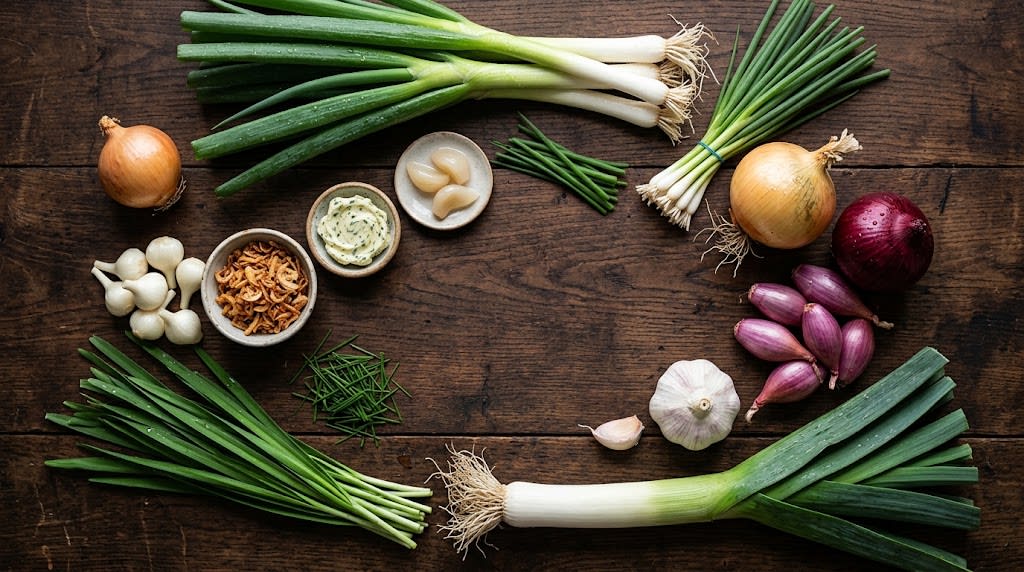
Allium family guide: da-cong, xiao-cong, onion, chive, leek, shallot, and scallion
The allium family is confusing. One word can name a genus, a species, and a whole shelf of vegetables. The correspondences below cover the common names, scientific names, leaf forms, and edible parts. The rest of this article explains why those correspondences look this way.
Da-cong, also called jing-cong, is Allium fistulosum var. giganteum. Its English names include Welsh onion and scallion. The leaves are hollow cylinders. The edible part is the scallion white, a false stem. Xiao-cong, also called fen-cong or qing-cong, is Allium fistulosum var. caespitosum. Its English names include spring onion and bunching onion. The leaves are hollow cylinders. The edible part is mainly the leaves. The original species, cong, is Allium fistulosum. Its English names include Welsh onion and scallion. The leaves are hollow cylinders. People eat the leaves and the false stem.
Yang-cong is Allium cepa, or onion. The leaves are hollow cylinders. The edible part is the bulb, which is spherical and solitary. Hong-cong-tou, also called huo-cong, is Allium cepa var. aggregatum, or shallot. The leaves are hollow cylinders. The edible part is the bulb, which is clustered and elongated-ovoid. Hu-cong is Allium ascalonicum or Allium cepa Aggregatum Group, also called shallot or ascalonic onion. The leaves are hollow cylinders. The edible part is the bulb. Jiao-tou, also called xie, is Allium chinense, or Chinese onion or Kiangsi scallion. The leaves are hollow cylinders with ridges. The edible part is the bulb.
Jiu-cai is Allium tuberosum, or Chinese chive or garlic chive. The leaves are flat and solid. People eat the leaves and the flower scapes. Da-suan is Allium sativum, or garlic. The leaves are flat and solid. The edible part is the bulb, which divides into cloves. Xia-yi-cong, also called xi-xiang-cong, is Allium schoenoprasum, or chive. The leaves are very thin hollow cylinders. People eat the leaves. Jiu-cong is Allium ampeloprasum Porrum Group, or leek. The leaves are flat and solid. People eat the false stem and the leaves.
The list hides several traps. Da-cong and xiao-cong are the same species, not two separate species. Hong-cong-tou is a variety of onion. Leek belongs to jiu-cong, a different plant from da-cong. Chive refers to xia-yi-cong, not to xiao-cong or jiu-cai. Garlic chive refers to jiu-cai, not to chive. Scallion is a general term rather than a single species.
The botanical identity card
The genus name is Allium. In Latin, the word refers to both onion and garlic. Older classification systems placed Allium in Liliaceae. After APG III, it moved to Amaryllidaceae. The former Alliaceae became a subfamily. Onions, garlic, chives, and leeks now sit in the same large family as lycoris, narcissus, and amaryllis.
Plants in Allium share several features. They contain sulfur compounds. When cut, those compounds irritate the eyes and nose. Leaves grow from the base. Leaf shape falls into two groups: hollow cylindrical, as in onion and chive, or flat and solid, as in garlic chive, garlic, and leek. Flowers grow in umbels with a spathe. Underground parts can be bulbs, rhizomes, or false stems.
People grow several Allium species for food. These include Allium fistulosum, Allium cepa, Allium sativum, Allium tuberosum, Allium schoenoprasum, Allium chinense, and Allium ampeloprasum. Within Allium fistulosum, farmers selected da-cong and fen-cong. Within Allium cepa, they selected hong-cong-tou and huo-cong. That is where the naming confusion starts. One species, selected in different places for different uses, became different forms.
The direct cong family
The original species Allium fistulosum came from western China and Siberia. People domesticated it from wild onions in China. The species epithet fistulosum means "hollow." It describes the hollow cylindrical leaves. English names include Welsh onion, scallion, spring onion, and bunching onion. "Welsh" here does not mean Wales. It comes from an old English sense of "foreign," because the plant originated in China.
In ancient China, cong was one of the five vegetables: kui, huo, xie, jiu, cong. The Book of Rites says: "For minced meat, use scallion in spring and mustard in autumn. For fat, use scallion. For grease, use xie." The Qimin Yaoshu from the Northern Wei has a chapter on planting scallions. Wang Zhen's Agricultural Book from the Yuan Dynasty records detailed methods for growing da-cong.
Da-cong is the variety selected for a thick scallion white. Its scientific name is Allium fistulosum var. giganteum. The plant is tall. The white stalk is long and thick. Leaves are hollow cylinders. The flavor is strong. Northern China grows most of it: Shandong, Hebei, Henan, Shaanxi. Zhangqiu da-cong in Shandong is the most famous. People describe it as tall, large, crisp, white, and sweet. The white stalk is long and straight. It is not too pungent even when eaten raw.
Jing-cong is the Beijing name for da-cong. Peking duck scallion shreds, Jingjiang shredded pork, and scallion-burst lamb all use da-cong. In northern Chinese cooking, da-cong is not only a seasoning. It is an ingredient. Scallion-burst lamb, scallion-burst beef, scallion-braised sea cucumber, da-cong dipped in sauce, and pancakes rolled with da-cong all put it at the center.
Xiao-cong and fen-cong are the other direction. Their scientific name is Allium fistulosum var. caespitosum. They are smaller than da-cong. The white stalk is short. Leaves are slender. Roots tiller into clumps. The flavor is milder than da-cong.
The word "xiao-cong" means different things in different places. In the north, it can mean young da-cong. In the south, it often means fen-cong. Some people call the leaves of xia-yi-cong or huo-cong "xiao-cong." Wild "xiao-cong" dug in the countryside may be young leaves of jiao-tou or hu-cong. "Xiang-cong" is also a general term. In many southern places, fen-cong is called xiang-cong. Some call xia-yi-cong xiang-cong. Others call the leaves of huo-cong xiang-cong. It describes a flavor more than a botanical category.
The onion family
Onion is Allium cepa. Its English name is onion. The edible part is the enlarged underground bulb. It originated in Central Asia and later spread worldwide. People bred hundreds of varieties. By color, there are yellow, white, and red onions. By taste, there are sweet and pungent onions.
The pungency comes from sulfur compounds. When you cut an onion, cells break. Sulfur compounds release. They irritate the eyes and cause tears. Heat changes the compounds. They evaporate or transform. Sugars release. The onion becomes sweet. In Western cooking, onion is a base for soups, sauces, and stews. French onion soup, onion sautéed liver, and onion sauce all depend on it. A sprouted onion is still edible. Remove the sprout and root. It can still be cooked, though the flavor drops.
Hong-cong-tou, also called huo-cong, is Allium cepa var. aggregatum. Its English name is shallot. The scientific name shows it is a variety of onion. The differences are easy to see. An onion bulb is solitary, spherical, and large. A hong-cong-tou bulb is clustered, elongated-ovoid, and small. Its skin is purplish-red. The aroma is stronger. The sweetness is more concentrated. It has a hint of garlic. The texture is fine. It works well in sauces and fried shallots.
In Taiwanese snacks, hong-cong-tou is the soul. Braised pork rice, blanched vegetables, and fried shallots all depend on it. The method is simple. Slice hong-cong-tou. Fry it slowly in lard until crisp. Store it in the oil. Frying cuts the pungency. It leaves a rich scallion-garlic aroma. In Western cooking, shallot goes into red wine sauce, vinaigrette, and soup bases.
If you plant hong-cong-tou in the ground, the leaves it grows are "xiao-xiang-cong." So in some southern places, what people call xiao-cong may be the leaves of hong-cong-tou.
Hu-cong has the traditional scientific name Allium ascalonicum. The epithet comes from Ashkelon in western Palestine. It originated in Central Asia. It reached China in the Tang Dynasty as a diplomatic gift. Southern China grows more of it, especially Guangzhou. The base has an enlarged white bulb. The upper leaves look like xiao-cong. Modern classification often places shallot in the Allium cepa Aggregatum Group. Hu-cong, hong-cong-tou, huo-cong, and shallot are close relatives. Different papers cross-reference them.
Jiao-tou is Allium chinense. Its English names include Chinese onion and Kiangsi scallion. The ancient name is "xie," one of the five vegetables. The Book of Rites says: "For grease, use xie." The bulb is elongated-ovoid, like a small garlic head. Cut it open and you see concentric rings. It is white, crisp, and sweet, with garlic aroma. Leaves look like xiao-cong and also like garlic sprouts. They are slender, hollow, and ridged.
The Yangtze River basin and the south grow jiao-tou. Southerners stir-fry it with cured meat. They pickle it with salt, vinegar, and chili. Hunan pickled jiao-tou and Yunnan jiao-tou with cured meat are local famous dishes. Japanese cooks also use jiao-tou. They call it rakkyo. They make sweet-and-sour pickles and tempura.
Garlic chives and garlic
Jiu-cai is Allium tuberosum. English names include Chinese chive and garlic chive. The leaves are flat and solid. Scallion leaves are hollow cylinders. That is the quickest way to tell them apart. Jiu-cai has a unique chive aroma from sulfur compounds. People eat the leaves. They also eat the flower scapes, called jiu-tai, and the flowers, called jiu-cai-hua. Grown in darkness, jiu-cai becomes jiu-huang. It is more tender and less pungent.
Jiu-cai has a high place in Chinese cooking. Jiu-cai boxes, jiu-cai scrambled eggs, jiu-cai pork dumplings, grilled jiu-cai, and jiu-cai flower sauce are all common. In English, jiu-cai is called garlic chive because it has garlic aroma and looks like chive. It is not chive. Chive is xia-yi-cong, Allium schoenoprasum. Its leaves are extremely thin and its flavor is mild. Garlic chive is jiu-cai, Allium tuberosum. Its leaves are flat and its flavor is strong.
Da-suan is Allium sativum. Its English name is garlic. The bulb has several cloves. The flavor is very strong. It originated in Central and Western Asia. It reached China early. Garlic sprouts are the young plants. Garlic scapes are the flower stalks. Garlic yellow is the dark-grown seedling. Garlic head is the mature bulb.
Garlic appears in many dishes. Chinese cooking uses minced garlic, garlic slices, Laba garlic, sweet pickled garlic, and black garlic. Western cooking uses garlic in pasta, garlic bread, and aioli. Garlic leaves are flat and solid, like jiu-cai. Garlic bulbs divide into cloves. Jiu-cai bulbs are not obvious. Garlic sprouts and leek leaves can look alike. Garlic sprouts taste of garlic. Leek tastes mild.
Western scallions
Chive is Allium schoenoprasum. Chinese names include xia-yi-cong, xi-xiang-cong, bei-cong, and fa-cong. The leaves are extremely thin and hollow. The flavor is mild. It is the only Allium species spread across Eurasia and North America. In China, it grows wild only in Xinjiang and nearby areas. Western cooks chop it and sprinkle it on soups, salads, potatoes, and eggs. They mix it with butter to make chive butter. It is also a common ornamental plant with pink-purple spherical flowers. Chive is not xiao-cong, not jiu-cai, and not hong-cong-tou. It has the thinnest leaves and the mildest flavor.
Garlic chive is jiu-cai, Allium tuberosum. The leaves are flat and solid. They have garlic aroma. The English name means "garlic-flavored chive," but the leaves are wider than chive and the flavor is stronger. Chinese cooking uses it for jiu-cai boxes and dumplings. Japanese and Korean cooking also use it. Korean chive pancakes and Japanese chive scrambled eggs are common.
Leek is Allium ampeloprasum Porrum Group, or Allium porrum. It belongs to jiu-cong, a different plant from da-cong. The leaves are flat and solid, like jiu-cai. The leaf sheaths wrap into a thick false stem, like the white stalk of da-cong. The flavor is milder and sweeter than da-cong. It originated in Switzerland and nearby areas. It is an important European vegetable. French potato-leek soup, Welsh leek soup, and Scottish leek chicken soup all use it. It works well in stews. It adds sweetness and scallion aroma. Many people first see leek abroad, think it is da-cong, buy it to stir-fry with lamb, and find the flavor completely different.
Shallot is hong-cong-tou or huo-cong, Allium cepa var. aggregatum, or Allium cepa Aggregatum Group. It is a variety of onion. The bulbs are clustered and purplish-red. The aroma is strong. French cooking uses it for red wine sauce and vinaigrette. Southeast Asian and Taiwanese cooking use it for fried shallots and braised pork rice.
Scallion is a general term rather than a single species. It usually refers to young plants of Allium fistulosum, to xiao-cong or fen-cong Allium fistulosum var. caespitosum, and sometimes to young onion Allium cepa. In American English, scallion and green onion are often mixed. They mean slender scallions with unswollen white bases. In British English, spring onion is more common. Welsh onion more specifically refers to Allium fistulosum.
Why names are messy
Four reasons explain the mess. First, people have grown these plants for a long time and selected them heavily. The same species became different forms in different regions. Da-cong, xiao-cong, and fen-cong all descend from Allium fistulosum. Second, there are many hybrids and varieties. Onion, hong-cong-tou, and hu-cong are closely related. Scientific names keep changing. Third, common names differ by region. Northern xiao-cong, southern xiao-cong, Taiwanese hong-cong-tou, and Cantonese hu-cong may be different species. Fourth, Chinese and English names do not line up. Chinese "cong" can refer to many species. English onion, scallion, spring onion, Welsh onion, and bunching onion also overlap.
You cannot identify scallions by name alone. Look at the form. Hollow cylindrical leaves point to cong, da-cong, xiao-cong, or onion. Flat solid leaves point to jiu-cai, garlic, or leek. Extremely thin hollow leaves point to chive. A solitary spherical bulb is onion. Clustered elongated-ovoid bulbs are hong-cong-tou, huo-cong, or jiao-tou. A divided bulb is garlic. A thick false stem is da-cong or leek.
In the kitchen
Chinese cooking uses da-cong for scallion-burst lamb, scallion-burst beef, Jingjiang shredded pork, Peking duck scallion shreds, da-cong dipped in sauce, and pancakes rolled with da-cong. Xiao-cong and fen-cong go into xiao-cong with tofu, scallion oil noodles, scallion oil chicken, xiao-cong scrambled eggs, and xiao-cong pan-fried tofu. Onion goes into onion stir-fried pork, onion scrambled eggs, onion soup, and onion rings. Hong-cong-tou becomes fried shallots, braised pork rice, blanched vegetables, and steamed chicken. Jiao-tou is stir-fried with cured meat, pickled, or pickled with chili. Jiu-cai goes into jiu-cai boxes, jiu-cai dumplings, jiu-cai scrambled eggs, grilled jiu-cai, and jiu-cai flower sauce. Garlic goes into garlic dishes, garlic paste with white meat, Laba garlic, sweet pickled garlic, and garlic spare ribs.
Western cooking uses onion for French onion soup, onion sauce, and stew bases. Shallot goes into red wine sauce, vinaigrette, caramelized shallots, and roast chicken side dishes. Leek goes into potato-leek soup, leek stewed chicken, and leek gratin. Chive goes into chive butter, potato salad, and soup garnish. Garlic chive goes into Asian dishes, jiu-cai dumplings, and jiu-cai pancakes. Scallion goes into American cornbread, salads, fried rice, and ramen garnish. Garlic goes into garlic bread, aioli, and pasta.
Japanese cooking uses da-cong for ramen, sukiyaki, scallion yakitori, and duck hot pot. Jiao-tou is called rakkyo. It is pickled or made into tempura. Korean cooking uses scallion pancakes, chive pancakes, and garlic for kimchi and barbecue.
Final answer
Da-cong, xiao-cong, jing-cong, xiang-cong, onion, hong-cong-tou, jiu-cai, and garlic all belong to the genus Allium in Amaryllidaceae. They share ancestors and similar sulfur metabolism. Human selection split them into different edible parts. Regional languages gave them messy common names. Chinese and Western exchange gave them overlapping English names.
The simplest correspondences are these. Da-cong is Allium fistulosum var. giganteum. Jing-cong is da-cong. Xiao-cong and fen-cong are Allium fistulosum var. caespitosum. But "xiao-cong" may also mean young cong, xia-yi-cong, or huo-cong leaves. Xiang-cong is a general term and may mean fen-cong, xia-yi-cong, or huo-cong leaves. Onion is Allium cepa. Hong-cong-tou and huo-cong are Allium cepa var. aggregatum, or shallot. Jiu-cai is Allium tuberosum, or garlic chive. Garlic is Allium sativum. Chive is Allium schoenoprasum, or xia-yi-cong. Garlic chive is Allium tuberosum, or jiu-cai. Leek is Allium ampeloprasum Porrum Group, or jiu-cong. Shallot is Allium cepa Aggregatum Group, or hong-cong-tou. Scallion usually means Allium fistulosum or young Allium cepa, a general term for xiao-cong or young scallions.
Next time someone asks which scallion you are, you can say it depends on whether they mean Allium fistulosum, Allium cepa, or Allium tuberosum.
About the Creator
Jin
Writer of reamstories
https://reamstories.com/jin
Enjoyed the story? Support the Creator.
Subscribe for free to receive all their stories in your feed. You could also become a paid subscriber, letting them know you appreciate their work.
Comments
There are no comments for this story
Be the first to respond and start the conversation.