
I Could Do 17 Pull-Ups in High School. At 77.5 Kg, I Couldn’t Do One.
A ledger of body weight, upper-body strength, and the small win of three strict reps.
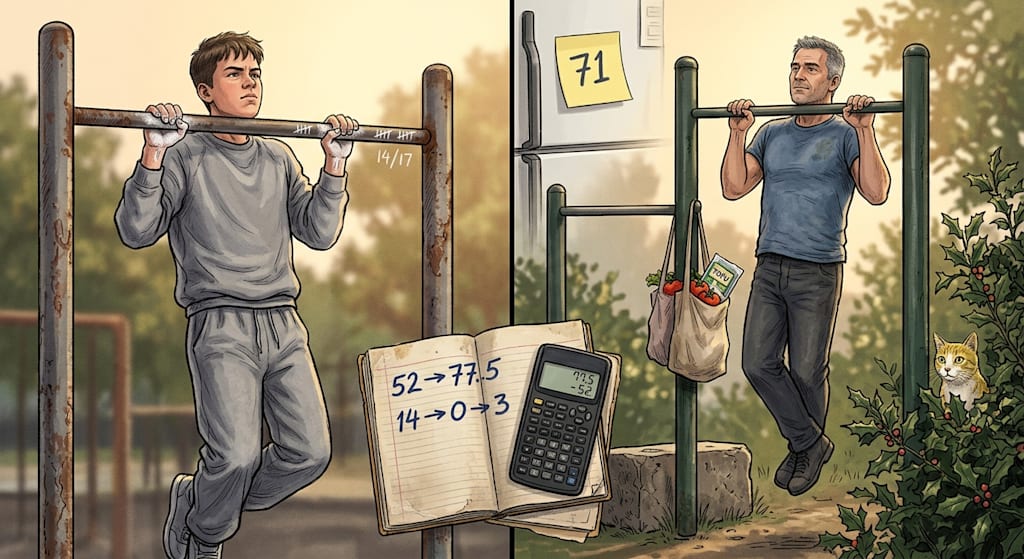
I was the first to notice the pull-up bar in the bushes of our residential compound.
The iron bar slanted out from the holly bushes, half its paint peeled off, revealing blackened iron underneath. A shared bike was parked beside it, and someone had left a half-empty bottle of mineral water in the basket. I stood there watching for more than ten seconds, reached out, and got a palmful of dust before I even touched the bar.
It was Saturday afternoon. I had just come back from the market, carrying a bag of tomatoes and two boxes of tofu. I hung the bag on a screw sticking out of the bar’s post, wiped my hands on my pants, and jumped up.
The moment my feet left the ground, my body sank. My forearms tightened first. My lats barely engaged. My core was loose, and my legs swung once in the air. My chin was still a fist’s width from the bar. I tried to drive my elbows down and lift my chest. The bar did not budge. I let go, landed, and my shoe crunched on a dried camphor berry.
Not even one.
That was not how it had been in high school.
From 1992 to 1995, I weighed 52 kg. There was a row of pull-up bars in the southeast corner of the school playground. The high one was out of my reach. I had to jump for it. In PE class, pull-ups were tested, and 14 was full marks. Every time I finished, my palms were coated in a mix of rust and magnesium chalk. I rinsed them under the tap, and the water ran yellow.
Once, in a contest with the class next door, I did 17. By the 15th, my form was no longer clean. Around the 90-degree point between extended arms and bent arms, my lats couldn’t generate force, so I had to swing my hips and throw my body up. Chin over the bar counted. But I knew the last few were borrowed.
Working backward with the Epley formula, 14 reps corresponded to an additional load limit of:
14 ÷ 30 × 52 ≈ 24.27 kg
And 17 reps corresponded to:
17 ÷ 30 × 52 ≈ 29.47 kg
That meant the high-school me could still barely manage one pull-up with another 24 to 29 kg hanging from my waist. The 17-rep set involved swinging, so it couldn’t be treated directly as a strict weighted 1RM. But I remembered that number for many years.
More than thirty years passed. Now I weigh around 77.5 kg, 25.5 kg heavier than in high school.
That lands right between 24.27 and 29.47.
The night I found the bar, I went home, sat at the dining table, and punched the numbers into my phone calculator. 77.5 minus 52: 25.5. The additional load limit I had back-calculated from high school: 24.27 to 29.47. 25.5 was in between. I pressed the keys again, afraid I had made a mistake.
Judging by that high-school capacity, my total 1RM back then was roughly 76 to 81 kg. Now my body weight is 77.5, leaving only -1 to 4 kg of margin by the formula. I was standing right on the line between “barely able to do one” and “unable to do even one.”
The formula is an estimate, not a verdict. But the feeling that afternoon, feet off the ground, chin unable to reach the bar, matched the number.
After I found the bar, I started training.
The bar on the east side of the compound is lower; I can reach it by jumping. The one on the west side is higher, and I have to step on a stone block beside it. As long as it didn’t rain and the bar was dry, I went.
The first week, I could do only one per set. For the second, I had to rest a long time. Hands on the bar, feet on the ground, waiting until my forearms stopped shaking before jumping again. The second week, I could get to two per set. The third simply wouldn’t go. I would pull halfway up, my elbows wouldn’t bend further, my body started to swing, and I had to let go.
Now, after more than two weeks, I can do three per set. After the first rep, I don’t let go of the bar; I hang for two seconds, then pull the second. After the third, my forearms feel like someone has twisted them from the inside, and I have to pry my fingers off the bar one by one.
Yesterday was relatively fierce. Two sets of three on the east side, then I walked to the west side and did another set of three. On the way home, nothing felt wrong. Then my forearms ached, my abs ached, my glutes ached. When I sat down this afternoon, I had to brace one hand on the edge of the chair.
But I still went downstairs today. Two sets of three on the east side. One set of three on the west side. Afterward I stood under the bar catching my breath and saw a yellow-and-white cat crouching in the holly bushes, watching me. I let go, and it ran.
At my current weight, the additional-load margin is only 0 to 4 kg. After two weeks of training, being able to do three is already squeezing something out of a margin that is nearly gone.
If my weight dropped to 71 kg, the margin by the formula would return to 10 to 14 kg. According to the formula:
30 × 10 ÷ 71 ≈ 4.2
30 × 14 ÷ 71 ≈ 5.9
About four to six reps. If the strength I’ve built over these two months stays, seven or eight could happen. But that is an estimate, not a guarantee. If weight loss costs muscle, strength will drop too.
I wrote “71” on a yellow sticky note and stuck it to the fridge door. Beside it is last week’s grocery receipt: a carton of eggs, two bags of milk, a bunch of spinach.
Pull-ups are a ledger.
On the left is upper-body strength; on the right is body weight. Every pull-up is lifting yourself from the right side over to the left. When body weight goes up, the right side gets heavier. If the left side doesn’t keep up, the books don’t balance. When they don’t balance, not being able to do even one is not strange.
In high school: 52 kg, additional load limit 24 to 29 kg. Now: 77.5 kg, margin 0 to 4 kg. The numbers are right there, more reliable than “I think I’m still okay.”
But the ledger doesn’t decide anything. Today, three. Next week, maybe still three. Next month, maybe four. The bar is there. If it doesn’t rain, I’ll go.
If tomorrow is sunny, four p.m., the east-side bar. Three first, then we’ll see.
About the Creator
Jin
Writer of reamstories
https://reamstories.com/jin
Enjoyed the story? Support the Creator.
Subscribe for free to receive all their stories in your feed. You could also become a paid subscriber, letting them know you appreciate their work.
Comments
There are no comments for this story
Be the first to respond and start the conversation.