
The Bionic Herald Declares War on the Gray Lady
This massive report is NOT for the faint of heart!!

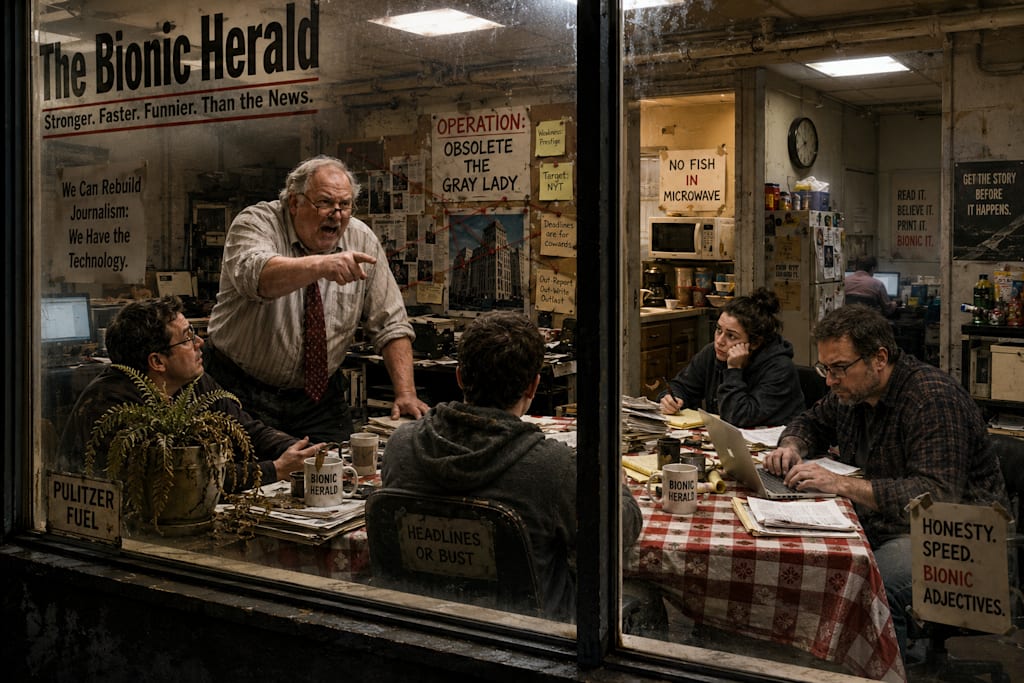
On my first day at The Bionic Herald, I was told three things:
Never mention “clickbait” in front of the editor-in-chief.
Never praise the New York Times within earshot of the copy desk.
And never, under any circumstances, ask why the office espresso machine is labeled “Pulitzer Fuel.”
The newsroom was in the basement of a building that used to be a RadioShack and still smelled faintly of burnt plastic and old batteries. The windows were painted over in a shade of gray that Tully claimed was “anti-surveillance matte,” and the flickering fluorescent lights hummed loudly enough to feel... intentional.
Edward “Tully” Tulinski, stood in the center of the open room, hands on his hips, the way a general might survey a battlefield where the only troops are underpaid staff writers and one unpaid intern (me).
“Kid,” he said, by way of greeting, “welcome to the nerve center of the post-print world.”
I glanced at the mismatched desks, the aging monitors, and the single office fern that had given up on photosynthesis sometime in 2019.
“This is it?” I asked.
He squinted at me, as if trying to decide whether I was being sarcastic, ignorant, or merely stupid.
“Every revolution,” he said, “starts in a basement. Ask Marx. Ask punk rock. Ask whoever invented CrossFit.”
He thrust a rolled newspaper into my hands. The masthead was printed in bold, heroic type:
THE BIONIC HERALD - Stronger. Faster. Funnier. Than the News.
Beneath it, the slogan of the week:
'We Can Rebuild Journalism: We Have the Technology.'
I ran my finger under the tagline. “Is that… a Six Million Dollar Man reference?”
“That,” Tully said, puffing his chest, “is a mission statement.”
He motioned for me to follow. We marched between desks occupied by reporters who looked as though they’d all once had respectable careers. And then, at some critical junction, chose a more interesting path.
At the far wall, a corkboard dominated the space. Across the top, in red yarn and pushpins, someone had spelled:
‘OPERATION: OBSOLETE THE GRAY LADY’
Tully tapped the words with reverence. “There she is,” he said. “Our true beat. Not City Hall. Not Wall Street. Not the school board or the weather or the sports section.” He leaned in, eyes narrowing. “Our job is to out-New York Times the New York Times, until they’re nothing but a nostalgia brand on a tote bag.”
Most publications would have been satisfied simply surviving the slow erosion of ad revenue into quiet oblivion. The Bionic Herald, by contrast, believed its destiny was to make the most famous newspaper in the world irrelevant.
“Isn’t that… overly ambitious sir?” I asked. He snorted. “Ambitious is trying to get a second season on basic cable. This is righteous!”
On the corkboard, a printed photo of the Times building had been annotated in thick black marker: ‘TARGET’, with arrows, circles, and the phrase “Structural weakness: prestige” underlined three times.
“So, what’s the plan?” I asked. He smiled, the way men do when they’ve been waiting decades for someone to ask exactly that question. The plan, as it turned out, was written in a three-ring binder labeled in Sharpie: ‘THE BIONIC PLAYBOOK’.
Tully slapped it down on the conference table, which was just two folding tables pushed together and draped in what I suspected was a retired tablecloth from a mid-range Italian restaurant.
“Page one,” he said, flipping it open. “The Six Million Dollar Model of News.”
Inside, someone had diagrammed a human body, except each limb was labeled with a journalistic function. “See?” Tully said, tapping the stick-figure cyborg. “We take the old broken model of legacy news and we upgrade it. Stronger headlines. Faster turnaround. Better hooks. Bionic adjectives. You following?”
Not really, but I nodded anyway...
On the left, the “pre-bionic” body was labeled:
• HEAD: “Dry Headlines”
• EYES: “Objectivity Fatigue”
• HEART: “Print Nostalgia”
• LEGS: “Chronically Behind the Internet”
On the right, the bionic version read:
• HEAD: “Narrative-Driven Titling Engine”
• EYES: “24/7 Hyper-Contextual Vision”
• HEART: “Weaponized Empathy”
• LEGS: “Real-Time Publishing Velocity”
“We’re not just a newsroom kid,” Tully said. “We’re an augmentation lab.”
“So… we’re like the Steve Austin of journalism,” I ventured. He jabbed a finger at me. “Exactly!... The Times is the old astronaut with the shattered legs. We are the government program that rebuilds him into the future.” He considered this. “Except we’re on a much smaller budget and no one outside of three zip codes has heard of us.”
“Heh... details,” I said sheepishly. “Minor detail,” he agreed.
The Herald’s “secret sauce,” according to Tully, was a proprietary mix of elements he claimed would make the Gray Lady irrelevant within five years.
He recited them often, usually to no one in particular:
“Number one: Bionic Voice. No sterile institutional monotone. Everything we write should sound like it was composed by a slightly unhinged philosopher in a deadline-induced trance.”
“Number two: Precision Absurdity. We treat the most ridiculous stories with the same structural gravity as war reporting. ‘Local Man Creates Religion Around Toast’ gets the same narrative arc as the Pentagon Papers.”
“Number three: Intentional Overreach. If we can’t actually beat the Times, we can at least commit to the bit so hard that they flinch.”
He was very proud of that third one. In practice, the newsroom ran on an energy that could only be described as earnest delusion. A whiteboard near the copy desk tracked “Engagement Velocity” in multicolored markers. Numbers that appeared to be entirely invented.
“What’s Engagement Velocity?” I whispered to Nina, who managed the Herald’s analytics, or what passed for them.
“Nothing,” she said. “It’s just page views multiplied by the number of times Tully says the word ‘disruption’ in a staff meeting.”
“How high is it supposed to go?” I chirped. “No one knows. That’s the beauty of it.” She confidently retorted.
At 10:00 a.m. sharp each morning, Tully held what he called the “Bionic Briefing.” We would cram into the break room; just a narrow space between two filing cabinets and a microwave that made threatening noises. He’d stand under the laminated sign that read ‘NO FISH IN MICROWAVE’ like it was a banner at a political rally.
“Listen up, cyborgs,” ... “What is the Gray Lady doing today?” He’d ask.
“Publishing a long-form on supply chain resilience,” someone offered.
“Running a special on the decline of civility,” another would add.
“Running the same Sunday Styles piece they’ve run for twenty years under a new headline,” Nina muttered.
“Exactly!” Tully said, pounding the coffee maker as if it were a lectern. “Predictable. Respectable. Soothing. Like a well-folded funeral flag.” He swept his gaze across us. “We are not here to soothe. We are here to perturb.”
On the whiteboard behind him, he’d scrawled that day’s headline prototypes:
• ARE WE LIVING IN THE AGE OF PERFORMATIVE SINCERITY?
• LOCAL CITY COUNCIL ACCIDENTALLY OUTS ITSELF AS SOCIALISTIC SASSAFRAS
• THE ECONOMY, SCIENCE OR SORCERY: A GUIDE.
He circled them with manic enthusiasm. “The Times will explain. We will expose. The Times will contextualize. We will dramatize. The Times will ask, ‘What does this mean for democracy?’ We will ask, ‘What does this mean for your group chat?’ That’s the secret sauce, people...”
In quieter moments, when the phones weren’t ringing, and the printer wasn’t jammed, I would catch him staring at the front page of the Times like a chess player examining an opponent’s move from three games ago. He never read it in public; that would have been heresy. But the pages were worn at the edges from being folded and refolded.
“You admire them,” I said. He flinched, as if I’d slapped him. “I respect the craft, kid,” he said gruffly. “You don’t try to obsolete an institution unless it’s worth obsoleting. I’ve been in this business long before you were an itch in your daddy’s britches. If there is one thing I’ve learned over the years, it’s this... the game only matters if you play.”
While pondering that nonsensical fortune cookie, eventually, it happened: his grand offensive. We were all summoned to the conference table-slash-Italian-tablecloth at noon. Tully stood at the head like a man about to unveil a new constitution or a dubious multi-level marketing scheme.
“Today,” he said, “we send the Dossier.”
On the table waited a thick manila envelope. “The what?” I asked. He cleared his throat.
‘THE OBSCELENCE DOSSIER’ (typo later corrected in pen)
“Inside this envelope,” he declared, “is the manifesto that will make the Gray Lady question her skincare routine.”
He held it up like a hidden relic. “We outline our model. Our metrics. Our philosophy of bionic news. Our comparative charts on narrative density and metaphor per column inch. Our projections for how we surpass their cultural footprint by 2030.”
Nina raised her hand. “We have projections?” “We have graphs,” he said. “They are colorful. That’s enough.” “How are we sending it?” I asked.
Tully smiled the slow, dangerous smile of a man who still believed in the postal service as an act of romance. “By certified mail,” he said. “Mano a Mano, paper to paper, ink to ink. We meet them on their home turf.”
“Shouldn’t we just email it?” Nina asked. “Or tag them? Or...” He silenced her with a glare. “We're not sliding into the DMs of the Paper of Record. We're not asking them to like and subscribe. We're delivering a challenge.” He blurted. He then turned to me. “Kid. You’re the newest. You get the honor.”
He pushed the envelope into my hands. It was heavier than I expected, packed with single-spaced pages and what appeared to be at least one flow chart attempting to quantify “narrative swagger.”
“Take it to the post office. Send it to the editor-in-chief, New York Times. Make sure they have to sign for it. Let them... feel the weight,” he said. “And then what?” I asked. “Then,” he said, “we wait.”
I mailed it. I watched the clerk stamp it with indifferent ritual and toss it into a bin with supermarket coupons and jury summonses. Somehow, this felt appropriate.
For three weeks, nothing happened. We returned to our usual work. Writing bionically enhanced profiles of local eccentrics, diagnosing societal malaise via the comments section on X, publishing investigations into questions no one had asked: "Is ChatGPT sad?" - "Do pigeons understand zoning laws through electromagnetics?" Tully never mentioned the Dossier, but once I saw him hover near the mailbox in the lobby, pretending to read a flyer for yoga classes.
Then, on a Wednesday, the package arrived. It was addressed not to The Bionic Herald, but to Tully himself. The return address was a Manhattan ZIP code I recognized from movies and the spine of hardcover books. He gathered us around the conference table, slit it open with a letter opener shaped like a Buck knife, and pulled out a single folded section of newsprint.
On the front page of the Sunday Styles section, halfway down, there it was:
“In the Age of Infinite News, One Basement Paper Declares War on the Gray Lady.”
Below it, a photograph of our office: the painted-over windows, the fern, the whiteboard with “Engagement Velocity?” scrawled like a math problem no one wanted to solve. In the corner of the frame, Tully himself, mouth open mid-rant, finger jabbing toward some invisible future.
They had interviewed him. None of us remembered this happening. The article described our “quixotic mission” to “obsolete” the Times, our “bionic playbook,” our “secret sauce,” our “weaponized absurdity.” It quoted him calling the Times “a respectable antique in need of competition, like a monarchy that’s forgotten how to wave properly.”
Nina read it over his shoulder, lips moving. “They called us ‘lovably delusional,’” she said. Tully’s jaw worked silently. I couldn’t tell if he was angry, thrilled, or starting to stroke out. “They described our manifesto as ‘part performance art, part critique, part love letter,’” I added.
In the final paragraph, the writer observed:
“In trying so hard to obsolete the Gray Lady, the Bionic Herald may have stumbled upon a different role: not successor, but necessary foil.”
The room was quiet. You could have heard a pin drop on a cricket. “So,” I said carefully, “does this mean we lost?”
Tully stared at the page a moment longer. Then he folded the section with surprising gentleness and set it on the table. “Kid,” he said, his voice lower than I’d ever heard it, “when the empire writes about the rebels, who really loses?”
He looked around at us, at the mismatched desks, the broken espresso machine, the fern that refused to die. “They saw us,” he said. “On their pages. In their ink. You can’t be obsolete if you’re in the story.” Nina snorted. “So, we didn’t topple the Gray Lady.” “No,” he said. “But we made her look down...” He straightened; the moment of softness passed.
“Alright, bionics,” he barked. “Break’s over. We’ve been anointed as an existential footnote in Sunday Styles. Now we must live up to it.”
He grabbed a marker and marched to the whiteboard, writing in all caps:
‘OPERATION: MAKE THE FOOTNOTE THE HEADLINE’
“And somebody,” he added, “get me a fresh pot of Pulitzer Fuel. The revolution just got a review.” He then looked at me. “You sticking around, kid?” he asked.
I thought of the Times building, the gleaming glass, the carefully calibrated fonts. I thought of our painted-over windows, our impossible charts, our editor-in-chief who’d declared war on an institution and somehow ended up collaborating in its own satire.
“Yeah,” I said. “I think I like it down here in the basement.” Tully grinned, that lopsided, battle-scarred grin of his. “Good,” he said. “Because the Gray Lady may have a hundred and seventy years on us…” He tapped the masthead of our latest edition, hot off the aging printer. “…but we,” he declared, “have better metaphors.”
And in the bionic glow of the humming lights, for just a moment, it felt like he might be right.
About the Creator
The Pompous Post
Welcome to The Pompous Post.... We specialize in weaponized wit, tactful tastelessness, and unapologetic satire! Think of us as a rogue media outlet powered by caffeine, absurdism, and the relentless pursuit to make sense from nonsense.
Enjoyed the story? Support the Creator.
Subscribe for free to receive all their stories in your feed.
Comments
There are no comments for this story
Be the first to respond and start the conversation.