
It Was Free, So Naturally It's Worth $40,000
Another Thursday Montage

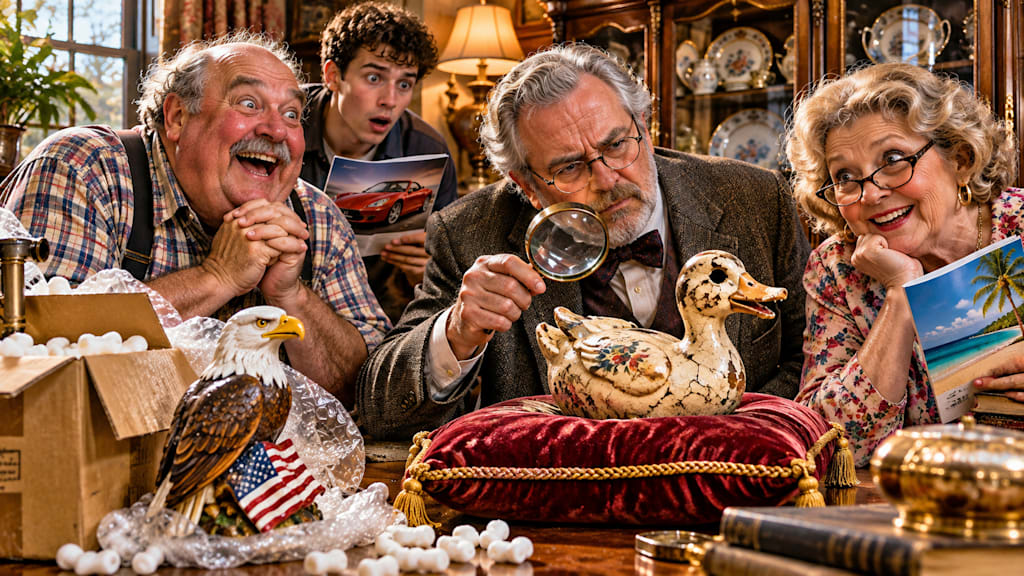
Two financial principles apparently govern the American household.
The first is that anything advertised as FREE must be acquired immediately, regardless of whether we need it, want it, or can even identify what it does. The second is that anything we’ve owned for more than twenty years automatically becomes a priceless antique.
Somewhere between these two principles lies a garage filled with plastic commemorative eagles, promotional beer mugs, chipped ceramic ducks, discontinued beer koozies, and a gentleman named Frank who believes he’s sitting on approximately $600,000 worth of collectibles.
Frank has never consulted an appraiser. Frank has never researched the market. But Frank once watched an episode of Antiques Roadshow in which somebody sold a vase for $40,000. And that’s all the financial education Frank requires.
Part One: FREE! (Except for Everything That Costs Money)
I have a question... When did the word FREE stop meaning FREE? Because when I was growing up, free meant somebody handed you something and you didn’t give them any money. Free Samples at a Safeway or Costco, for instance. Simple transaction. No paperwork. No credit card. No twelve-page terms-and-conditions agreement. You got the thing, you left, and everybody went about their business.
But apparently, sometime around the invention of the internet, the advertising industry gathered in a conference room and decided this arrangement was unacceptable.
“Gentlemen, we’re giving away too much free stuff.” “Then stop giving it away.”
“No, no. We need to keep calling it free. That's the hook! We just need to charge people for receiving it.”
And thus was born one of the greatest linguistic, gymnastic achievements in modern commerce.
FREE! JUST PAY SHIPPING AND HANDLING!
Oh, wonderful! A commemorative ceramic eagle! Completely free! All I have to do is pay $13.95 for shipping and handling. Now, the eagle itself appears to weigh approximately the same as a Ritz cracker.
It’s made of some mysterious substance that looks like ceramic but feels suspiciously like a recycled armrest. Its left eye points toward Washington, D.C. Its right eye appears to be monitoring weather conditions over Nebraska. And it was almost certainly manufactured for less money than you’d find beneath the cushions of a reasonably maintained sofa.
But somehow, transporting this magnificent bird to my house costs $13.95.
THIRTEEN DOLLARS AND NINETY-FIVE CENTS! Is it being delivered by helicopter? Does the eagle require its own seat on a commercial airline? Is a professional falconer accompanying it to ensure its emotional well-being during transit?
And what exactly is HANDLING? Shipping, I understand... You put something in a box. You move the box. Eventually, somebody throws the box onto my porch from approximately forty feet away, where you can usually hear some glass breaking.
But handling? What does that involve? Is there a dedicated employee named Reginald whose entire job is to lovingly cradle my ceramic eagle while whispering words of encouragement?
“Steady now, little fellow. Your forever home awaits.”
Perhaps there’s a specialized handling department of men in white gloves. Soft classical music accompanies them in the background of a climate-controlled room.
“Johnson, the eagle has landed! Lol, you see what I did there?" "Uhhh yeah, I got it..." (rolling eyes) “Excellent. Initiate the handling procedure.”
And then somebody picks it up, moves it six inches to the left, and charges me eleven dollars. Meanwhile, the shipping company actually doing the work gets $2.95.
The Free Stuff Reflex
But here’s the truly embarrassing part: we all fall for it! Not because we’re stupid. Because the word FREE apparently activates a primitive section of the human brain normally reserved for spotting predators and locating barbecue.
You could be walking through a shopping mall, perfectly content with your life, when somebody announces: “FREE PROMOTIONAL KEYCHAINS!”
Suddenly, you’re moving at a speed you haven’t achieved since high school. You don’t even need a keychain. You already own seventeen and use none of them. Three of them are attached to keys that no longer open anything. But this one is FREE! And therefore, it must be yours.
People will drive thirty miles to claim a complimentary refrigerator magnet advertising a dentist they’ve never visited. They’ll stand in line for forty-five minutes to receive a free tote bag that begins disintegrating the moment somebody places a banana inside it. They’ll sign up for a newsletter, provide their email address, disclose their birthday, and surrender enough personal information to apply for a mortgage. All for a promotional ballpoint pen that has a light AND a small screwdriver bit inside. But it was FREE!
And here’s the phrase that really sends us over the edge.
LIMIT ONE PER HOUSEHOLD. Oh, NOW you’ve done it... You weren’t even interested in the item until somebody suggested you couldn’t have two. Suddenly, you’re calling relatives in neighboring states.
“Linda, I need your address.”
“Why?”
“Don’t ask questions. There’s a situation involving collectibles.”
“Frank, what have you done?”
“NOTHING ILLEGAL... YET.”
By the end of the afternoon, you’ve spent $55.80 in shipping fees to acquire four objects with a combined manufacturing cost of approximately forty-seven cents. And you feel like you’ve beaten the system. Meanwhile, the system is buying a vacation home in the Bahamas.
Part Two: Grandma’s Ceramic Duck Is Going to Pay Off the Mortgage
Now let’s fast-forward thirty years. Remember that ridiculous commemorative eagle? The one you paid $13.95 to receive for free? Well, it’s still around. Because, of course it is!
Nobody has ever successfully thrown away a promotional collectible. These things are like cockroaches; they can survive anything.
Recessions.
Divorces.
Three presidential administrations.
A kitchen renovation.
The Great Basement Flood of 2009.
You could demolish the house with a wrecking ball, and when the dust settled, that ceramic eagle would be sitting on the rubble, staring in two different directions.
It's now vintage and more importantly, it’s an heirloom. Nobody knows how this transformation happened. One day it was worthless promotional junk. The next, Uncle Frank was telling everybody it belonged in a museum.
“YOU KNOW WHAT YOU’VE GOT THERE?”
“A ceramic eagle?”
“NO! A COLLECTOR’S ITEM!”
“Frank, it came free with a subscription to Popular Mechanics.”
“EXACTLY! YOU CAN’T GET THOSE ANYMORE!”
Well, Frank, you also can’t get a 1987 tuna salad sandwich anymore. That doesn’t make it valuable. But Frank has been watching antiques programs. And this is dangerous. Because somewhere on television, a perfectly ordinary-looking vase just sold for $40,000.
Now Frank believes every object manufactured before 1995 is a retirement account. He’s been examining the bottoms of dishes at the local Goodwill and Salvation Army. Inspecting chipped figurines and squinting at faded manufacturer labels.
He recently spent twenty minutes studying an old ashtray because somebody told him it might be Baccarat crystal. It was from a Holiday Inn, in 1982, and somebody had scratched “DAVE WAS HERE” into the bottom.
Frank remains optimistic. “THAT COULD BE THE ARTIST’S SIGNATURE!”
The Family Appraisal
Eventually, the family agrees to have Grandma’s prized ceramic duck evaluated. This duck has occupied a place of honor in the family china cabinet for approximately forty years. It is an extraordinary object. Its beak is chipped. One eye is missing. The paint is peeling. And somebody apparently attempted to repair its tail using a substance normally reserved for sealing bathroom tiles.
Nevertheless, Aunt Linda is convinced it’s worth a fortune.
“Grandma always said that duck was special.”
“Linda, Grandma also said margarine was healthier than butter and that the television could hear us.”
“THAT’S NOT THE POINT!”
The entire family assembles around the dining room table. Frank has brought a magnifying glass. Linda has brought a calculator. Their nephew has already begun researching sports cars. Somebody has printed out listings for beachfront condominiums. The appraiser arrives.
A distinguished gentleman with silver hair and the expression of someone who has spent thirty years explaining to people that their priceless possessions are actually decorative garbage.
He carefully examines the duck. Turns it over. Studies the bottom. Adjusts his glasses. The room falls silent. “Ah,” he says. Frank leans forward. Linda grips the edge of the table. “Yes,” the appraiser continues. “I recognize this particular piece.” Aunt Linda gasps. “YOU DO?” “Certainly. These were promotional items distributed at participating gas stations during the early 1980s.”
Silence... “Gas stations?” Frank asks. “Yes. Customers received one with a qualifying fuel purchase over 10 dollars.” Linda looks confused. “But it’s an antique!... It's VINTAGE!" “Well, it’s certainly old enough to have some age.” “AND RARE?” “Not especially, no... Approximately six million were produced.”
Frank swallows. “Six million?” “Yes.” A long pause. “Well,” Frank says, “that would explain why it’s so difficult to find one in good condition.” THE MAN CANNOT BE DEFEATED.
The appraiser continues. “Unfortunately, the missing eye, damaged beak, and extensive repairs significantly affect its value.” Linda closes her eyes. “How much?” The appraiser considers for another moment. “In its present condition? Perhaps seventy-five cents.”
Nobody speaks. Somewhere in the distance, a dog barks. Aunt Linda slowly folds her Caribbean cruise brochure and chucks it toward the recycling bin. Their nephew quietly closes the sports car website. Frank stares at the duck.
“Seventy-five cents?” “Possibly a dollar if you find someone who collects them.” Frank brightens. “SO THERE’S A MARKET!” “Frank,” Linda whispers, “please.”
But he’s already reaching for the magnifying glass again. “WHAT ABOUT THE EAGLE?”
Oh, dear Lord. Here we go again. Frank produces the commemorative eagle. The appraiser studies it. The crooked eyes. The faded paint. The tiny American flag glued to one wing.
He turns it over. A small label sits on the bottom reads: MADE IN TAIWAN. Frank smiles triumphantly. “INTERNATIONAL!” The appraiser sighs. “Sir, this was a mass-produced promotional item.” “BUT IT’S A LIMITED EDITION!” “Limited to what?” “ONE PER HOUSEHOLD!”
The appraiser removes his glasses. “That isn’t quite the same thing.” Frank is undeterred. “I paid $13.95 for this back in 1994!” “Was that the purchase price?” “No! IT WAS FREE!” The appraiser looks up. “Then why did you pay $13.95?” “SHIPPING AND HANDLING!”
A terrible silence fills the room. The appraiser examines the eagle one final time. “Well, I’m afraid its current resale value is approximately two dollars.” Frank blinks. “Two dollars?” “Yes.” “BUT I PAID THIRTEEN NINETY-FIVE!” “Then I’m afraid you overpaid.”
Frank slowly sits down. For the first time in his adult life, the man appears to be questioning his financial judgment. Linda places a comforting hand on his shoulder. “It’s okay, Frank.” He looks up. “Maybe you’re right...”
It's a Kodak moment... A family united by disappointment. Then Frank reaches into his pocket. “WAIT A MINUTE.”
Oh, no...no, please no.
“WHAT ABOUT THIS COMMEMORATIVE PRESIDENTIAL KEYCHAIN?”
The True Value of Absolutely Nothing
And there you have it. The magnificent cycle of American consumer economics. First, we pay money to receive something that’s supposedly free. Then we store it for thirty years. Then we convince ourselves it’s worth a fortune. Then we pay somebody else to explain that it’s worthless. It’s an entire financial ecosystem built around objects nobody actually wanted in the first place.
And the companies selling these things understand us perfectly. They know that FREE gets our attention. They know that LIMITED EDITION makes us nervous. They know that COLLECTIBLE makes us imagine our grandchildren discovering a fortune in the attic.
Meanwhile, the object itself sits in a cardboard box, worth about the same as a slightly bruised potato. But don’t worry. Uncle Frank has a plan. He’s going to keep the eagle another twenty years. Because by then, it’ll be even older. And older means more valuable. Right? RIGHT?!
Unfortunately, Frank has just discovered a website offering a completely free commemorative porcelain bald eagle. Gold-trimmed. Individually numbered. Certificate of authenticity included. LIMIT ONE PER HOUSEHOLD. Just pay $19.95 in shipping and handling. Frank is reaching for his credit card. Linda is reaching for the blood pressure medication.
And somewhere in a warehouse, a gentleman named Reginald is preparing to move a plastic bird six inches to the left.
BUSINESS IS BOOMING!!
About the Creator
The Pompous Post
Welcome to The Pompous Post.... We specialize in weaponized wit, tactful tastelessness, and unapologetic satire! Think of us as a rogue media outlet powered by caffeine, absurdism, and the relentless pursuit to make sense from nonsense.
Enjoyed the story? Support the Creator.
Subscribe for free to receive all their stories in your feed.
Comments
There are no comments for this story
Be the first to respond and start the conversation.