
IDIOMS VS. IDIOTS: The Phrases That Make No Sense and the People Who Said Them Anyway
A Pompous Post™ Exclusive Investigation

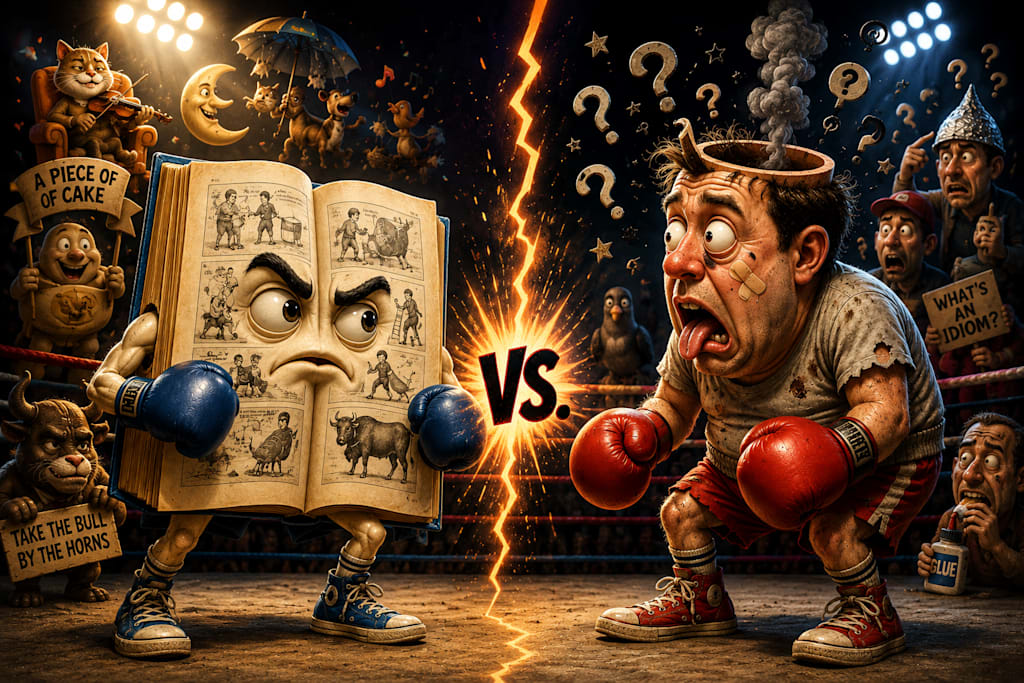
For centuries, humanity has traded in the sacred art of saying one thing and meaning another. These strange, sticky phrases, known as idioms, have infested every corner of our speech. They make us sound wise, even when we’re just repeating something our grandmother said after hitting her thumb with a hammer.
But where did they come from? Who invented them? And, more importantly… why?
After months of exhaustive research, gallons of coffee, and at least one minor séance with the ghost of Shakespeare, The Pompous Post can now reveal the scandalous, completely unverifiable origins of history’s most beloved idioms.
Buckle up, dear reader, it’s about to get linguistically stupid!
🐦 “A Bird in the Hand Is Worth Two in the Bush.”
Translation: Settle for less. It’s safer. You’ll never achieve greatness anyway, but you also won’t get pooped on. Pretty straightforward…
This phrase dates back to 1537, when English falconer Reginald Featherton lost two partridges in a shrub and declared, “Fine! One bird’s enough! I’m going home!” His rival, Sir Edmund Bushly, allegedly coined the comeback: “You should’ve stayed out of my hedges.”
The phrase caught on immediately among cowards, real estate agents, and anyone who’s ever given up halfway through an IKEA project.
🪣 “Don’t Cry Over Spilled Milk.”
Translation: Be emotionally repressed.
First uttered in 1662 by a peasant named Agnes Puddlebottom, who spilled her only jug of milk and sobbed uncontrollably. Her husband, normally a man of great empathy, said: “Stop crying over spilled milk!”… Moments later, he slipped in it. Be careful what you wish for, you may just get it. (Whoa! That’s another one right there…)
Today, the phrase is used to shame anyone who dares to have feelings. Just like the related saying, “big boys don’t cry”. Which we NOW know, forgot the afore-mentioned “over spilled milk” on the end. Proving that human emotional progress peaked somewhere between the cow and the mop.
🪓 “Bite the Bullet.”
Translation: Embrace pain and pretend it’s character development.
Originating in the 19th century, this saying came from battlefield surgeries where soldiers literally bit down on bullets during operations. The tradition continues metaphorically today whenever someone decides to attend a family reunion or assemble furniture without instructions.
Fun fact: dentists still recommend biting the bullet as a coping mechanism. But only if you can pay out of pocket.
🧂 “Take It with a Grain of Salt.”
Translation: “Don’t believe everything you hear… especially from your Uncle Larry.”
This ancient Roman phrase began as medical advice: a grain of salt was thought to cure poisoning. Sadly, that’s not true, but it does explain why so many ancient Romans had high blood pressure and gout.
The modern interpretation evolved in the 18th century when gossip became an Olympic sport. Historians believe the first use in polite society came from a woman named Prudence Hallows, who whispered, “I heard Lady Kensington’s husband eloped with a horse breeder, but do take it with a grain of salt.”
🐴 “Don’t Look a Gift Horse in the Mouth.”
Translation: Stop inspecting free things, you ungrateful mule.
In medieval Europe, horses were the primary form of both transportation and passive-aggressive gift-giving. Checking a horse’s teeth was how you estimated its age. And looking a gift horse in the mouth, was the 14th-century equivalent of scanning a free couch for horrid cushions. Just take it and deal with it… So what if you get a spring in your rectum? It’s not that bad if it’s FREE!(probably not true)
To this day, the phrase lives on in offices everywhere. Whenever someone complains about the toppings on free pizza, or protesting because someone ate the last Bear Claw.
🪑 “Pulling Someone’s Leg.”
Translation: Harmless deception, unless you’re from 1750.
London’s pickpockets once specialized in tripping their victims by yanking their legs before robbing them blind. Over time, the phrase evolved from assault to humor, a natural linguistic shift historians call “British Optimism.”
Modern equivalent: gaslighting, but with better manners or another idiom, “just joshing ya”. (Not one person could explain to us who Josh was, and what he had to do with this phrase)
🐖 “When Pigs Fly”
Translation: Never gonna happen, but please continue lying to yourself.
In 14th-century Scotland, a group of drunken farmers allegedly attempted to catapult pigs skyward in a bet to impress the local clergy. They failed spectacularly but succeeded in inventing the world’s first “agricultural air show.”
The idiom stuck, and now it’s used by parents everywhere when their kids promise to clean their rooms.
🐸 “It’s Raining Cats and Dogs”
Translation: It’s raining, and everyone’s confused.
In the 1600s, English houses had thatched roofs. Warm, cozy, and irresistible to stray animals. When heavy rain hit, the unfortunate creatures would slide off and land in the street. A man named Hubert Slopshire reportedly shouted, “It’s raining cats and dogs!” shortly before being hit by a falling Scotty. (We, too love the irony)
And just like that, linguistic history was made…
🧱 “Hit the Nail on the Head.”
Translation: Congrats, you finally said something intelligent.
This originated with medieval carpenters who, after decades of missing nails and fingers, found the act of accuracy so miraculous that they turned it into philosophy. One builder, Geoff Hammerston, struck his thumb so hard that he inadvertently coined five new swear words and sparked a minor religious movement.
🥔 “Hot Potato.”
Translation: A problem you want to pass to someone else before it burns your bollocks, or your reputation.
In 19th-century England, this was a literal parlor game. Participants tossed scalding baked potatoes to one another while shouting “Bloody Hell!” to warn of imminent injury. The game was discontinued after one enthusiastic round led to the Great Potato Fire of Nottingham in 1823.
The saying now applies to everything from political scandals to office group projects.
🍞 “The Best Thing Since Sliced Bread.”
Translation: “Mildly convenient, but let’s totally overreact.”
Coined in 1928 when inventor Otto Rohwedder introduced pre-sliced bread, this idiom represents humanity’s inability to manage expectations. People called it “revolutionary.” They were right. Nothing since; not the internet nor space travel, has inspired quite the same awe.
The phrase is now used to describe anything slightly better than average, such as air fryers and sleeping in.
🧽 “Clean as a Whistle.”
Translation: Suspiciously clean. Possibly cursed.
Originally a reference to surgical instruments in the 18th century, the phrase later evolved into general hygiene advice for people who hadn’t yet discovered soap.
Today, it’s most often used sarcastically, especially when describing the trunk of your car, your child’s face, or any government document that has been redacted.
🧠 “The Whole Nine Yards.”
Translation: Go all out - or at least pretend to.
No one agrees on what this means. Some say it referred to the length of World War II ammunition belts. Others claim it was a phrase from Scottish textile mills. But newly uncovered Pompous Post records show that it actually came from a tailor named Reginald Yarnsworth. He ran out of fabric mid-project and told his client, “You’re getting the whole nine yards. That’s all I’ve got.”
🧈 “Butter Someone Up.”
Translation: The ancient art of flattery, cholesterol edition.
Rooted in an old Indian custom where people threw balls of butter at idols to seek favor, this practice evolved into verbal flattery once doctors got involved.
To this day, the phrase remains common in workplaces where compliments are free and promotions are not.
🧑⚖️ Closing Remarks: The Idiom Epidemic
Language experts agree… idioms persist because they sound profound, while allowing us to avoid saying anything specific. They give conversations texture, history, and plausible deniability. In short, they make us sound smart without requiring proof.
So the next time someone tells you “don’t cry over spilled milk,” remember Agnes Puddlebottom. The woman who did cry and gave us all a life lesson in dairy-based humility.
🏛️ THE IDIOMS HALL OF FAME
(Located somewhere between logic and lunacy.)
Visitors enter through velvet curtains and are immediately greeted by a weary docent who sighs, “Don’t ask me what any of this means.”
🐝 Exhibit #1: “The Bee’s Knees”
Meaning something excellent or delightful, this idiom buzzed into popularity in the 1920s. Historians believe it was coined by a tipsy entomologist who admired insect anatomy a little too much. Bees themselves have declined to comment. Not to mention the most obvious fact, they don’t actually have any knees.
🐱 Exhibit #2: “The Cat’s Pajamas”
Born in the Jazz Age when everything was nonsense and alcohol, this phrase suggested someone stylish or impressive. It is believed to have originated at a party where someone actually tried to put pajamas on a cat. The cat survived and the human got his just desserts.(Ha! Another one)
🧰 Exhibit #3: “The Whole Kit and Caboodle”
A phrase so whimsical that it defies logic. “Kit” refers to tools or belongings. “Caboodle” means “group,” “bundle,” or “probably made up.” Together, they mean “everything.” Scientists estimate the combined weight of a full kit and caboodle to be roughly two llamas.
🧀 Exhibit #4: “The Big Cheese”
Originating in colonial India, where “chiz” meant “thing,” the phrase evolved into “cheese” through the British art of confident mispronunciation. It now refers to someone important… or, in modern times, anyone with a LinkedIn Premium account.
🦆 Exhibit #5: “Like Water off a Duck’s Back”
A phrase symbolizing calm resilience, inspired by ducks who appear unbothered by anything, including geese, hunters, and the meaninglessness of existence.
At the far end of the Hall, a rope cordons off a plaque reading:
“Reserved for Future Inductee: ‘Hold Your Horses.’
Nominated 27 times, still awaiting explanation.”
A janitor named Earl pushes his mop by and mutters,
“Been cleaning this place for years. Still don’t know what ‘kick the bucket’ means. But I have tripped over one.”
🫡 The Final Word
Idioms endure because they make the human condition sound poetic instead of absurd. They turn mistakes into metaphors, nonsense into nuance, and history into a never-ending game of linguistic telephone.
So go forth, dear reader… butter someone up, bite the bullet, and if you must, cry over the milk. Just remember: behind every wise-sounding phrase stands a long line of confused idiots… and we wouldn’t have it any other way.
📰 THE POMPOUS POST™
“Where meaning comes to die and grammar goes to drink.”
About the Creator
The Pompous Post
Welcome to The Pompous Post.... We specialize in weaponized wit, tactful tastelessness, and unapologetic satire! Think of us as a rogue media outlet powered by caffeine, absurdism, and the relentless pursuit to make sense from nonsense.
Enjoyed the story? Support the Creator.
Subscribe for free to receive all their stories in your feed.
Comments
There are no comments for this story
Be the first to respond and start the conversation.