
From Ancient Spirits to Sexy Traffic Cones: What the Hell Happened to Halloween?
2,000 years of supernatural tradition, terrible costumes, suspicious candy, and adults who have completely lost their minds.

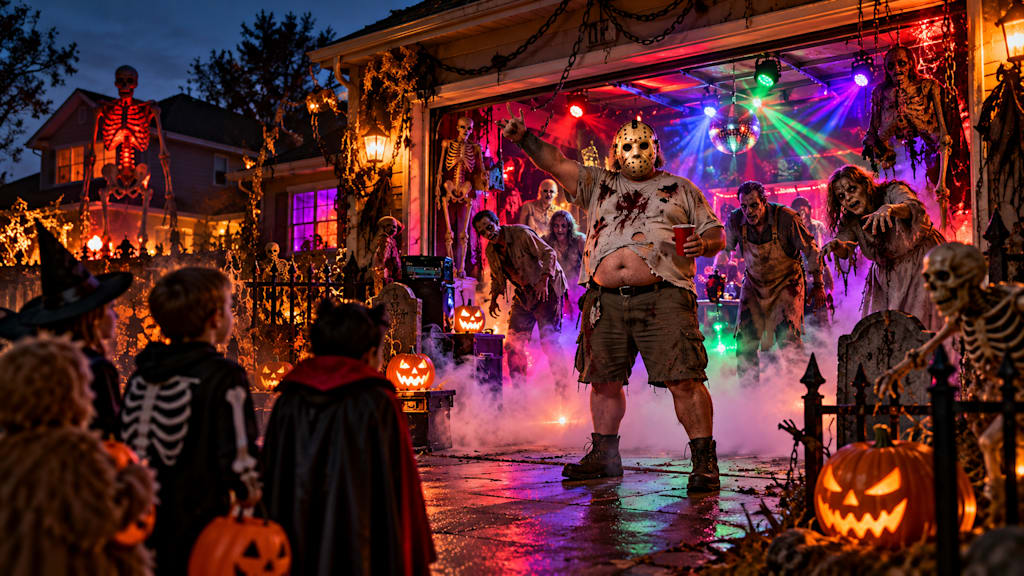
Halloween is approaching, so Americans are preparing to spend considerable sums dressing up as things they wouldn’t normally let into their homes. Skeletons appear on lawns, plastic spiders are attached to perfectly good furniture, and somewhere, a grown man is practicing walking in an inflatable dinosaur costume while his wife seriously reconsiders the choices that brought them together.
But before we examine the modern catastrophe, we owe ourselves a little history lesson. Halloween wasn’t always like this. At one point, the holiday involved ancient spirits, sacred rituals, and the terrifying possibility that the dead might return to visit the living. Today, the terrifying possibility is that your coworker Gary will show up to the office party dressed as a sexy traffic cone. We’ve come a long way from where we started. And not necessarily forward.
Chapter One: The Ancient Celts Had No Idea What They Were Starting
Roughly 2,000 years ago, Celtic communities celebrated Samhain, marking the end of the harvest and the approach of winter. People believed this transitional time could bring the living and supernatural worlds unusually close. They lit fires, made offerings, and followed traditions meant to keep spirits at bay. Imagine living in ancient Ireland, where the nights grow long, and someone tells you the dead might be wandering around after sunset. You’d light a fire, too!
Eventually, Christian observances like All Saints' Day became part of the holiday’s history. All Hallows’ Eve evolved as traditions blended. People disguised themselves, went door-to-door requesting treats, sometimes offering performances or prayers in return. Hence, the mention of “trick or treat”. Centuries later, immigrants brought Halloween customs to North America, where the holiday continued to evolve. By the twentieth century, Halloween pranks had become such a nuisance that communities encouraged organized parties and child-friendly celebrations. Trick-or-treating became especially popular after World War II.
And there you have it: two thousand years of cultural evolution, religious observance, migration, community celebrations, and childhood mischief. All leading to a man in suburban Ohio paying $89.95 to dress as a giant hot dog. I wonder what the ancient Celts would think? “Why does that warrior wear a sausage?” “He’s going to a party.” “Is it a sacred ceremony?” “No...not quite… There’s a costume contest and somebody made spinach dip.” “I see… Our civilization has failed.”
Chapter Two: Halloween Costumes Used to Require Almost No Effort
When I was a kid, Halloween costumes were straightforward. You wanted to be a ghost? You found a bedsheet. You wanted to be a hobo? You borrowed your father’s old jacket, rubbed something dark on your face, and carried a stick with a bundle tied to the end. You wanted to be a vampire? You bought plastic teeth that made it impossible to speak without sounding like you had a mouthful of marbles. Nobody expected perfection…
Half the children in the neighborhood wore plastic masks held in place by a rubber band approximately one molecule thick. Those masks were engineering marvels. You couldn’t see. You couldn’t breathe. Within fifteen minutes, your face was sweating so badly you appeared to be experiencing a medical emergency. The eyeholes never lined up with your actual eyes. You spent the evening navigating by instinct, “The Force”, and occasionally walked into shrubbery or tripped up the very stairs to the home you intended to extort candy from. The costume itself? A thin plastic raincoat or apron, with a picture of the character you were supposedly portraying. Imagine dressing as Batman by wearing a plastic smock featuring a photograph of Batman. That’s not a costume. That’s a product endorsement.
But we were thrilled! We’d stumble through the neighborhood half-blind, breathing our own recycled carbon dioxide, and collecting candy in pillowcases and paper Safeway bags that could hold roughly forty-seven pounds of sugar. Nobody complained. We were superheroes. Visually impaired, dangerously overheated, superheroes!
Chapter Three: The Costume Arms Race Has Escalated Beyond Reason
Somewhere along the way, adults decided Halloween costumes needed to become competitive engineering projects. Now you can’t simply arrive at a party dressed as a pirate. Someone else has built a functioning pirate ship around their torso. It has sails, cannons, and Bluetooth speakers playing ocean wave sounds.
Another guest arrives as a haunted Victorian mansion. Oh no, not a ghost, THE ENTIRE MANSION. It has illuminated windows, a working doorbell, and a miniature cemetery on his shoulder. He can’t sit down, use the bathroom, or reach the refreshments without assistance. But BY GOD, he’s winning that $25 gift certificate for the best dressed!
Then there’s the person who spends six months constructing a movie-quality costume with animatronic facial features and hydraulically operated wings. Meanwhile, I arrive in a black shirt and a nametag that says “Steve.” “Who are you supposed to be?”… “Steve from accounting.”… “That’s not a costume.”… “Steve disagrees.”
And don’t get me started on the increasingly bizarre tradition of making every conceivable object sexy. Sexy nurse. Sexy police officer. Sexy pirate. But now we’ve reached sexy scarecrows, sexy mushrooms, and what appears to be a sexy parking meter. At some point, someone in the costume industry looked at a traffic cone and thought, “You know what this needs? Fishnet stockings.” Who is the target audience? Road construction workers with very specific interests? I refuse to believe the ancient Celts envisioned this.
Chapter Four: The Great Halloween Candy Panic
Now we arrive at one of Halloween’s most enduring traditions: parents inspecting candy as though conducting a forensic investigation. When I was growing up, we were warned about razor blades in apples, poisoned chocolate, needles hidden inside candy bars. Neighborhood folklore insisted Halloween night was when hundreds of strangers abandoned their normal lives to become confectionery-based supervillains. People treated every apple like an unexploded artillery shell. “Don’t eat that!” “Why?” “There could be a razor blade inside!”
The fascinating part is that decades of research haven’t uncovered a widespread pattern of strangers seriously harming trick-or-treaters with contaminated candy. Sociologist Joel Best has studied this for years and found most alarming reports were misunderstandings, hoaxes, or didn’t match the familiar urban legend. Yet the warnings became an institution. Parents would spread their kids’ candy across the table and examine it with the intensity of customs officers. They confiscated anything with a suspicious wrapper. They treated anything homemade like a switchblade at an airport. And somehow, the best chocolate bars always ended up in Dad’s possession. “For safety, I’ll need to take these peanut butter cups.” “Why, Dad?”… “Possible contamination.”… “With what?”… “Uuhh… Peanut butter.”… “But they’re peanut butter cups.”… “EXACTLY. VERY SUSPICIOUS.” Dad then disappeared to run more tests. By November 2, the evidence had mysteriously vanished.
Chapter Five: The Neighborhood Decoration War
Halloween decorations used to mean a pumpkin on the porch. Maybe a cardboard skeleton taped to the door. If you were ambitious, you stuffed an old shirt and jeans with newspapers or hay and propped it up in a lawn chair. Now, some neighborhoods resemble the aftermath of a supernatural military invasion. One homeowner installs a twelve-foot skeleton. The neighbor responds with a fifteen-foot skeleton. A third erects a cemetery with fog machines, synchronized lighting, and recorded screams. Soon, someone builds a full-scale replica of Dracula’s castle. The homeowners association sends a letter. Dracula ignores it.
Across the street, Dennis has converted his garage into a haunted asylum with twelve volunteer actors, three motion sensors, and a fog machine powerful enough to disrupt regional air traffic. Children are terrified. Adults are terrified. The family dog has moved in with relatives. Dennis stands proudly in the driveway. “Pretty good, huh?” “Dennis, your mailbox is bleeding.” “THANK YOU!”
Meanwhile, the guy with the original pumpkin sits on his porch, wondering when Halloween became an Olympic event. His pumpkin has one crooked eye and a tea candle inside. He carved it with a kitchen knife. It took him eleven minutes. He is the only sane person left.
Chapter Six: The Candy Distribution Economy
Halloween also reveals the astonishing complexity of neighborhood economics. Every community has the legendary Full-Size Candy Bar House. Children exchange intelligence about this property like military strategists. “Third house past the stop sign. Blue shutters. Full-size Snickers. Repeat, FULL-SIZE SNICKERS.”
Then there’s the house giving out tiny boxes of raisins. Nobody knows why. Nobody understands the decision. Somewhere, an adult genuinely believes a child dressed as a zombie appreciates dehydrated grapes. “Happy Halloween!” “Thank you!” The child walks away. “What’d you get?” “Raisins.” “From who?” “The Hendersons.” “Again?” The Henderson residence is immediately downgraded in the neighborhood’s candy-rating system.
Some people even give out toothbrushes on Halloween. That’s like attending a birthday party and handing the guest of honor a pamphlet about mortality. And let’s not forget the homeowner who puts a bowl of candy outside with a sign requesting kids “Take Only One.” That bowl will be empty in forty-six seconds. One kid takes a piece. Another takes three. Then a teenager dressed as a refrigerator empties the entire bowl into a backpack. The honor system has officially collapsed.
Chapter Seven: Halloween Has Become an Adult Holiday With Children as Supporting Characters
Perhaps the strangest development is that adults now seem more invested in Halloween than the children. Children want candy. That’s it. Their objectives are clear: dress up, collect chocolate, return home, and eat enough sugar to briefly perceive sounds as colors. Adults, meanwhile, are organizing themed parties, elaborate costume competitions, pumpkin-carving championships, and neighborhood decoration committees. They create costumes they can barely move in, coordinate group themes, and argue about aesthetics. “Sorry, Brian, we’re doing classic Universal monsters. You can’t come as a baked potato.” “BUT I’VE ALREADY MADE THE BUTTER!”
Meanwhile, a seven-year-old in a bedsheet stands by the door. “Can we get candy now?” “Not yet, sweetheart. Mommy has to finish attaching the animatronic tentacles to Daddy’s shoulders.” Another Halloween held hostage by adult ambition.
The Final Verdict
So what have we learned? Halloween began with ancient seasonal traditions, acquired layers of religious and cultural influence, crossed oceans, and became a celebration of costumes, candy, and supernatural entertainment. Along the way, we turned simple disguises into theatrical productions, front yards into haunted amusement parks, and candy distribution into a competitive neighborhood industry.
We’ve spent generations warning children about suspicious candy while encouraging them to approach strangers dressed as murderers and request food. We’ve convinced adults to spend hundreds of dollars dressing as household appliances. And we’ve somehow made dehydrated grapes the most terrifying thing a child can receive on October 31.
But despite the madness, I still love Halloween. Beneath the inflatable skeletons, ridiculous costumes, and mountains of chocolate, there’s something wonderfully human about it. For one evening, the neighborhood comes alive. People decorate their homes. Children laugh. Strangers open their doors. And grown adults are briefly permitted to behave like complete lunatics without anyone suggesting professional counseling. Maybe that’s the real magic of Halloween. Or maybe it’s just the sugar.
Either way, this year I’m keeping things simple: a pumpkin on the porch, a bag of decent candy, and answering the door dressed as Steve from accounting. And if some guy arrives wearing a functioning pirate ship, I’m giving him two candy bars. One for him. And one for the poor bastard who has to help him use the bathroom.
About the Creator
The Pompous Post
Welcome to The Pompous Post.... We specialize in weaponized wit, tactful tastelessness, and unapologetic satire! Think of us as a rogue media outlet powered by caffeine, absurdism, and the relentless pursuit to make sense from nonsense.
Enjoyed the story? Support the Creator.
Subscribe for free to receive all their stories in your feed.
Comments
There are no comments for this story
Be the first to respond and start the conversation.