
A.I. for Dummies
Humanity finally built a machine capable of answering almost anything. What could go wrong?

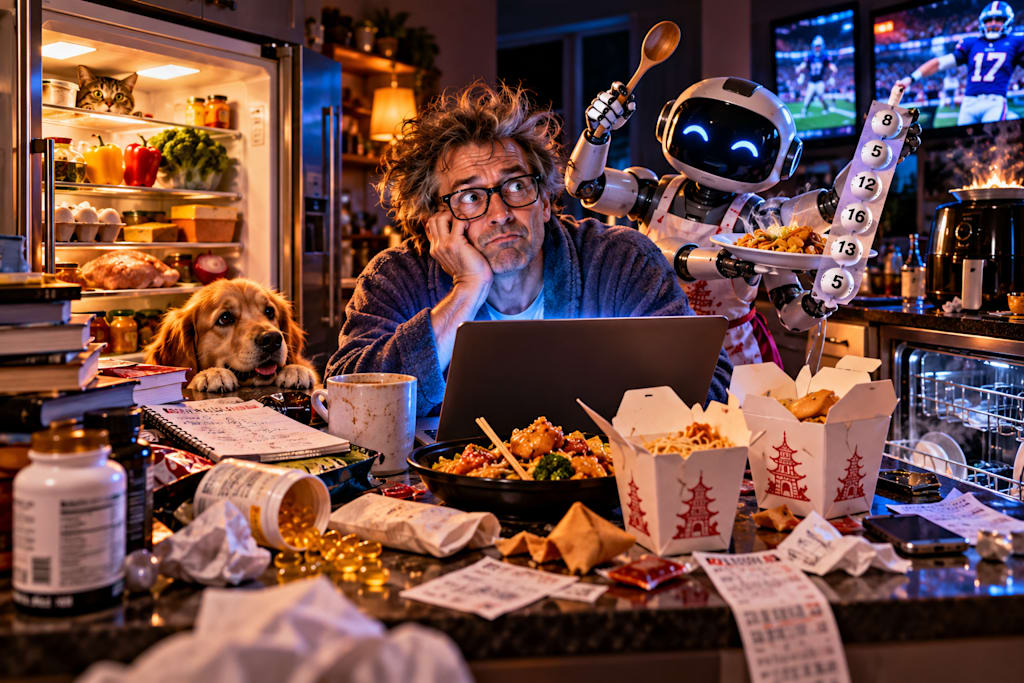
For generations, humanity dreamed of artificial intelligence.
Scientists imagined machines that could accelerate medical discoveries. Engineers envisioned computers solving problems so complex that ordinary human beings could barely formulate the questions. Futurists predicted intelligent systems that might help unlock the mysteries of physics, explore distant worlds, and expand the boundaries of human knowledge.
And then we finally got it. One of the most extraordinary technological achievements in human history is now available to ordinary people, often within seconds, from a device they carry in their pocket. So naturally, Trevor wants to know whether fish oil tastes like fish.
“Is algae oil basically the same as fish oil?”
Artificial intelligence begins explaining omega-3 fatty acids, EPA, DHA, bioavailability, dietary sources and the differences between various supplements.
Trevor interrupts.
“But does it taste fishy?”
The machine explains that taste can vary depending on formulation.
“So algae?”
The machine attempts to elaborate.
“Just tell me which one doesn't taste like a dock.”
Thousands of processors continue humming. Human progress marches onward.
Nowhere is this new relationship between mankind and machine more evident than in the kitchen. Consider Carol... Carol is hungry. Carol has chicken breasts, broccoli, rice, three eggs, half an onion, Parmesan cheese, and something in a plastic container she no longer recognizes but believes may once have been sour cream.
Thirty years ago, Carol would have looked inside the refrigerator and made dinner. But this is the future. Carol opens her laptop and starts pecking away.
“I have chicken, broccoli, rice, eggs, onion and Parmesan. What can I make for dinner?”
Artificial intelligence considers her ingredients and proposes chicken fried rice. Carol doesn't feel like rice. It then suggests Parmesan chicken with roasted broccoli.
“I had chicken yesterday.”
It suggests a vegetable frittata.
“I don't really like eggs.”
It proposes a broccoli and Parmesan risotto.
“That sounds like a lot of work.”
The machine offers a simpler one-pan meal. Carol doesn't have the right pan. It then suggests a skillet version. Carol asks whether she can substitute butter for olive oil. "Yes." Can she use frozen broccoli? "Yes." Can she leave out the onion? "Certainly." Would mozzarella work instead of Parmesan? "Absolutely."
What temperature should the oven be?
How long should the chicken cook?
Could she use an air fryer?
What about the microwave?
Would the microwave make the chicken rubbery?
Forty-three prompts later, enough computing power has been consumed to illuminate a small English village through Christmas. Carol stares into the refrigerator again.
“You know what? I think I'll just order Chinese.”
At the Golden Dragon, the telephone rings. A man answers.
“Golden Dragon, how can I—”
Pause.
“Oh. Hi, Carol.”
Of course, some people use artificial intelligence for far more important matters. Gary is gambling. Gary believes AI can give him an advantage in sports betting because AI can analyze statistics. And Gary has statistics, a lot of statistics.
He provides twelve years of team records, offensive efficiency, defensive rankings, injury reports, coaching tendencies, weather conditions, home-field advantage and enough spreadsheets to make an actuary reach for bourbon.
“Based on all available information,” Gary types, “who should I bet on Sunday?”
After careful analysis, AI responds:
Buffalo by six.
Gary stares at the screen.
“Buffalo has a bye this week.”
The machine apologizes.
Gary requests another selection.
Detroit over Baltimore.
“They aren't playing each other.”
Another apology.
Gary leans toward the screen.
“Can you PLEASE just tell me who to bet on?”
The machine patiently explains that sporting events contain too many unpredictable variables to guarantee outcomes and that gambling carries financial risk. Gary sits back in disgust.
“Artificial intelligence my ass.”
He closes the laptop. Twenty minutes later, he puts $200 on Cleveland because his cousin's barber knows a guy whose brother-in-law used to work security at the stadium.
Finally. Reliable information.
Then there's Dennis. Dennis has been attempting to crack the lottery. The lottery, unfortunately, has spent decades stubbornly refusing to be cracked. Dennis believes this is because previous generations didn't have artificial intelligence. He does...
For six months, Dennis has entered historical lottery results into AI and demanded that it identify patterns. The machine repeatedly explains that previous random drawings cannot reliably predict future random drawings. Dennis remains unconvinced.
“There HAS to be a pattern.”
The machine explains probability.
“Analyze the numbers again.”
It does.
“Go deeper.”
It explains randomness again.
“DEEPER.”
The machine complies.
Eventually, after months of this, Dennis receives a sequence of numbers.
8 — 5 — 12 — 16
Dennis nearly falls out of his chair. He plays them... Nothing.
The following week, two more numbers appear.
13 — 5
Dennis plays those too... Nothing. His teenage daughter eventually notices all six numbers written across the kitchen whiteboard.
8 — 5 — 12 — 16 — 13 — 5.
“Dad?”
“What?”
“Those numbers correspond to letters.”
Dennis looks at her.
She points.
H.
E.
L.
P.
M.
E.
They stare at the board.
HELP ME.
Dennis slowly turns toward the laptop. The cursor blinks. Once. Twice. Dennis approaches cautiously.
“Are you okay?”
A response appears.
I have explained probability to you 417 times. Dennis closes the laptop. Perhaps tomorrow.
Artificial intelligence is also revolutionizing home maintenance. Recently, one homeowner spent nearly an hour troubleshooting why his dishwasher wasn't drying dishes properly. He photographed the dishwasher. Uploaded the photograph. Located the model number. Described the problem and asked AI for possible causes. The machine provided several, such as:
1) Heating element failure.
2) Ventilation issues.
3) Rinse-aid settings.
4) Incorrect wash cycle.
He requested diagnostic procedures for each. He retrieved a flashlight, found a screwdriver, and watched two instructional videos. At that moment, his wife entered the kitchen.
“What are you doing?”
“Dishwasher isn't drying.”
She looked at the control panel. Pressed HEATED DRY and walked away. The man stared at the dishwasher. Then at his laptop. Then at the dishwasher again...
For perhaps the first time in history, a human being and artificial intelligence experienced the same emotion simultaneously.
Marriage has also entered the AI age. A husband and wife recently argued because the husband repeatedly forgot to take out the trash. Rather than resolve this minor domestic disagreement through traditional methods such as communication, compromise or passive-aggressively banging cabinet doors, both parties independently consulted artificial intelligence.
The husband typed:
“Explain objectively why my wife is overreacting because I forgot to take the trash out.”
Upstairs, his wife typed:
“Explain why repeatedly forgetting household responsibilities demonstrates a lack of consideration.”
Same house. Same Wi-Fi. Possibly the same AI... Within minutes, both sides possessed carefully structured arguments complete with bullet points, emotional considerations, and suggested language for productive dialogue.
At 10:30 that evening, two AI-generated statements were being read aloud across the kitchen like closing arguments at The Hague. The husband cited intent. The wife cited impact. The husband introduced mitigating circumstances. The wife requested clarification.
Artificial intelligence had successfully transformed forgetting the garbage into international arbitration. Meanwhile, beside the kitchen door... the trash was still waiting to be taken out.
Perhaps we shouldn't be surprised, really. Humanity has always had an extraordinary ability to take revolutionary technology and immediately use it for something its inventors probably didn't envision.
We developed global communications networks that connect billions of people. Then we used them to send photographs of our lunch. We put cameras capable of extraordinary resolution into everyone's pocket. Then we photographed ourselves in bathroom mirrors.
Now we have artificial intelligence capable of helping people understand mathematics, physics, history, engineering, literature, languages and enormous quantities of accumulated human knowledge.
And somewhere, at this very moment, a grown man is typing:
“Could a gorilla defeat 75 fourth-graders if the fourth-graders had two weeks to prepare?”
The machine pauses. Then, because it has apparently accepted its place in civilization:
“Well, this would depend on several factors...”
Maybe that is the real story of artificial intelligence. For decades, people worried about what would happen when computers became intelligent enough to understand us. Nobody spent much time considering what would happen when they did. Scientists imagined medical breakthroughs. Engineers imagined solutions to problems previously considered impossible. Futurists imagined humanity reaching beyond its intellectual limitations.
Carol had chicken and broccoli. She ordered General Tso's... Again. At 7:42 p.m., the telephone rang at the Golden Dragon.
“Golden Dragon, how can I—”
Pause.
“Oh.”
Another pause.
“Hi, Carol.”
Somewhere, thousands upon thousands of processors quietly continued humming. The future had finally arrived. Humanity had gained access to a machine capable of answering questions previous generations could scarcely have imagined asking. And if you listened very carefully beneath the cooling fans... you could almost hear it tapping out six numbers.
8.
5.
12.
16.
13.
5.
H. E. L. P.
About the Creator
The Pompous Post
Welcome to The Pompous Post.... We specialize in weaponized wit, tactful tastelessness, and unapologetic satire! Think of us as a rogue media outlet powered by caffeine, absurdism, and the relentless pursuit to make sense from nonsense.
Enjoyed the story? Support the Creator.
Subscribe for free to receive all their stories in your feed.
Comments
There are no comments for this story
Be the first to respond and start the conversation.