
Valuation Over $12M Before I Open a Dating App
One founder. One cold burrito. One email from his lead investor asking if he has “bandwidth to spare.” And a sticky note that may be keeping him alive — or keeping him alone.
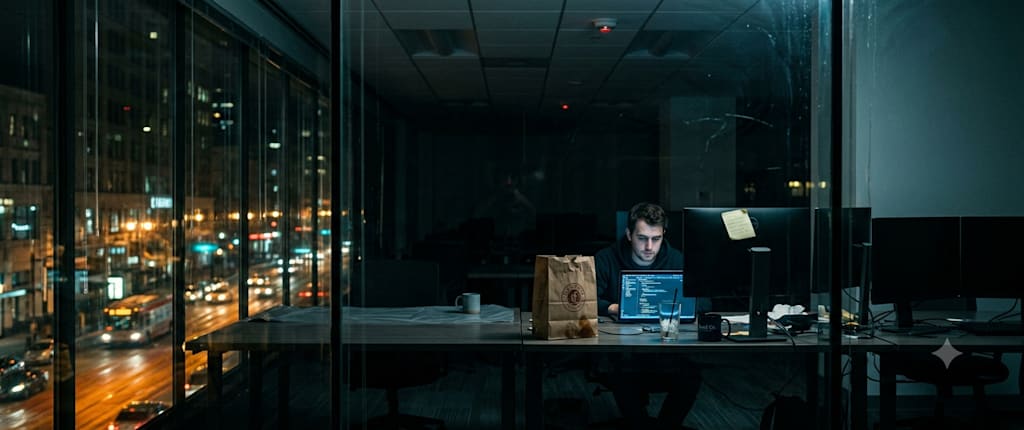
James's desk sat against the window side of the open-plan office, looking out over the rolling rooftops of San Francisco's Financial District and the gray-blue evening sky. Three monitors crowded his desk, but only the center one was lit; the other two sat dark. Along the left monitor's edge, four sticky notes were lined up—two blue ones covered in technical notes, one pink with next week's investor meeting agenda, and a yellow one at the bottom, half-pinned under a coffee mug, revealing only a single blurry character that looked like "val." The mug was a company-branded giveaway, stamped with "SaaS Co." in faded lettering, with about a third of its contents still inside. James couldn't remember when he'd last drunk from it, or whether it had been hot or cold, but he remembered brewing a packet of instant coffee in it at 9:30 that morning. It was the only calorie he'd consumed all day.
In front of him sat an unopened Chipotle bag, the delivery sticker still intact, a dark grease stain already bleeding through the bottom and leaving a ring-shaped mark on the desk. He didn't need to open it to know what was inside: the white paper bowl, the black plastic lid, the handwritten label that read "Chicken, White Rice, Black Beans, Corn, Sour Cream, No Spice." He ordered the same thing every Wednesday and Friday. The "reorder" button in the app had eliminated the need to make a decision. The delivery had arrived at 6:40. Two hours had passed. The bag was cold to the touch now; the chicken had probably started to congeal into a slick layer of white fat. He wasn't hungry. He didn't plan to eat it. But the bag remained on the corner of his desk like an open task, neither completed nor dismissed.
His phone lit up. Messages from the group chat with his roommates came through one after another. He didn't look at them right away—his thumb was still moving across the trackpad, pulling the copy on slide 34 back to the version from half an hour ago, then redoing the change, then undoing it again. He did this three times before he stopped and picked up the phone.
The first message came from Ethan. Ethan had spent three years at Google and jumped at the start of the year to a startup doing AI infrastructure. The message read: "Friend of mine's putting together a thing this Friday. Couple of girls want to meet people in tech. You in? My friend says her roommate is a Stanford MBA, and there are two VC analysts coming. Small group, maybe eight total—perfect size. If you guys don't come it's just me and a table of girls." He appended a crying-laughing emoji.
James's fingers had already found the keyboard, but before he could type a single word, the second message arrived. Peter—the group's designated gamer, working DevOps at Salesforce—sent a very short message: "Diablo new season just dropped." Beneath it was a screenshot: a character named "PeterTheBarbarian," Level 47, decked out in gleaming gold legendary gear, with a small line of text in the corner reading "Online: 4h ago." That meant Peter had logged in around 3 PM and was still on. James stared at the screenshot for two seconds. He found himself thinking: a man who spends four hours on a Friday night leveling a character named "PeterTheBarbarian" instead of meeting a Stanford MBA—was that a clear-eyed choice, or was it avoidance? Then he realized he was in the same group chat, and he didn't know the answer for himself any better than he knew it for Peter.
The third message came from Alex, James's college roommate, who'd been laid off the previous fall and hadn't looked for another job since. He'd been holed up in his apartment, building a deployment tool for independent developers. Alex's message was longer: "Working on the seed deck. Been stuck on Chapter 1—Problem & Solution—for three days. Nothing I write sounds painful enough. Anyone have time to glance at it? I'll drop a GDrive link." A skull emoji followed. James knew the details of Alex's project intimately—Alex had called him twice, both times after 1 AM, and both times the first twenty minutes of the call were spent on "I don't think this direction is right," and the last twenty were spent on "but if it works it's huge." James had told him both times, "Just finish the first draft." Alex had never finished the first draft.
The group chat went quiet for seventeen minutes. James spent those seventeen minutes revising the pitch deck—he changed the growth rate on slide 24 from 18% to 22%, then back to 18%, then to 20%. He added a transition line to slide 8, deleted it, typed an almost identical one, and deleted that too. In those seventeen minutes, he typed three responses to the group: first, "What kind of thing?", second, "Can't this week," and third, "Let me check my time and get back"—none of which he sent. The cursor sat blinking in the input field, and the conversation in the group stopped on the message tagging him. No one else said anything.
The last message was Ethan's, tagging him directly. It floated at the bottom of the chat like a finger pointed at his screen: "James? You? Don't tell me you're working again."
James looked at the question mark. His thumb hovered above the screen for five seconds. Then he put the phone down, locked it, and set it face-down on the desk. It made a soft click. He didn't reply.
Taped to the corner of his desk was a yellow sticky note, its edges curled now, a thin line of dust along the adhesive border, though the center remained clean. The words were in his handwriting, in black ballpoint, the letters formed more slowly and heavily than usual, the tip of the pen having left faint indentations in the paper. Two lines, with unusually deliberate capital letters: "Valuation over 12M before opening any dating apps. No serious relationship until Series B." After writing it, he'd drawn a single underline beneath "12M," and two beneath "Series B."
He'd put up that sticky note three months ago. It was the night after his A-round pitch, back in the office at 2 AM, the entire floor empty—even security hadn't made its rounds. He'd made himself instant coffee, opened his phone, and seen seventeen likes on Hinge and eleven on Bumble. He didn't open a single one. Instead, he pulled out the pack of yellow sticky notes from his drawer, uncapped his pen, sat down, and wrote those two lines, then placed it at the bottom edge of his monitor, right at eye level. That same night, he opened each of the four dating apps on his phone, paused for one second at every "Confirm Delete Account" pop-up, and pressed yes. When all four were gone, he set the phone on the desk, screen still lit, home screen now missing an entire row of icons. In that empty row, he caught a glimpse of his own reflection for a second. Then he locked the screen.
Three times a week—three nights a week, every week, when he came back to his desk, he pressed the curled corner of that sticky note flat with his index finger. This time was no different. A light gesture, like he was making sure it was still there, that no one had peeled it off, that it hadn't fallen. His fingertip picked up a bit of dust as it slid off the yellow paper. He didn't wipe it—just brushed it onto the knee of his black jeans.
Then he opened his laptop. The desktop background was the default Catalina wallpaper. The desktop itself was cleaner than any real human's had any right to be—only three folders, named by quarter—"Q1_Reports," "Q2_Metrics," "Q3_Projections"—and one more, called "Pitch." He clicked into "Pitch," double-clicked the Keynote file he'd revised seventeen times, and flipped to slide 24. The cursor sat next to the number next to "Projected Revenue Growth." He changed it from 18% to 20%. Then he hit undo, back to 18%. Then he typed 20 again, and hit undo once more. He left it on 20. He didn't save. He didn't close it. He just left it open.
Next to the computer sat a large glass tumbler with a black plastic straw, which had once held water and now held only ice. Most of the ice had melted, settling at the bottom; the smaller cubes had vanished entirely, leaving three larger ones, each worn into a rounded shape. He lifted the glass and took a sip through the straw. The water was cold and flavorless. The ice clinked against the glass—a sharp, clear sound in the quiet office. When he set the glass back down, the condensation left a wet ring on the desk. He ran his ring finger along the ring, smearing the water into an uneven arc. Then he did it again, widening it further—like he was trying to wipe something away, or maybe trying to keep something there.
A new email notification slid into the bottom-right corner of his screen. He'd seen that animation hundreds of times before, but this time he paused when he saw the sender. Mark Sullivan—the GP at the lead VC firm, the middle-aged man who'd said "James, your logic is really clean" with a smile during the afternoon video call. The subject line was only two words: "Small ask." James opened it.
The body was short—maybe ten lines. He stopped reading at the fourth line. The email said:
"James—first, this isn't about product, and it isn't about market. We're aligned on both internally. But there's one point from the IC that I need you to think through before formal DD. Your team structure is thin—CEO, part-time CTO, three engineers. No COO, no operational partner at any level. The IC's question is: do you genuinely have the people and the bandwidth to sustain execution over the next eighteen months? And specifically—I'll be direct—we noticed you haven't had any long-term stable relationship in the past two years. Investors will ask. They won't ask directly, but they'll look for whether you have 'bandwidth to spare.' Is there anything going on right now? Or something recent? You need an answer. Even if it's just an answer. Mark."
James read the email once. Then he read it again. Then a third time. He didn't scroll down—there was no more to scroll to. He stared at the phrase "You need an answer" for maybe ten seconds. Then he closed the email. He didn't reply. He didn't star it. He didn't forward it to anyone. He didn't screenshot it. He did nothing with it. He just closed it. The animation took perhaps half a second to slide the message off the screen. Then his inbox settled back to its usual stillness, and Mark's email sat quietly in the unread folder—or rather, in the gray zone of "read and unanswered."
He leaned back in his chair. The chair made a faint squeak, from a spring on the left side—James knew exactly where it was. He'd bought the chair himself, for three hundred and eighty-five dollars, using about half his office equipment stipend. The night he'd picked it out, he'd made an Excel sheet comparing six ergonomic chairs across dimensions, price, warranty length, and had chosen this one. He rested his forearms on the armrests and brought the tips of his fingers together, like a small tent. He stared at the ceiling.
A fire-sprinkler pipe ran across the length of the office in a long arc, passing about two meters above his desk. Hanging below it, a circular smoke detector blinked a red light every three seconds. James had never noticed the frequency before tonight. He counted. One, two, three, four. He stopped at eleven. Outside, a siren went by—from Market Street, growing louder and then fading, taking maybe two minutes from first hearing to disappearance. He didn't turn to look. He just listened as the sound dissolved into another part of the city.
The desk next to his was empty. It belonged to Ryan, his head of engineering, who'd taken sick leave the previous week—flu, supposedly. On Ryan's desk sat a mug with about a quarter cup of coffee left in it, a gray-white film already formed across the surface. James looked at that film and thought: Ryan probably didn't clear his desk last Friday either. Because last Friday, when James had asked Ryan about a change on the Git branch, Ryan had said "I'll look at it tomorrow." And then the next day he didn't come in. And then five days of sick leave followed. James wasn't sure if Ryan was actually sick or if something else was going on. He had a vague sense that it wasn't really the flu. But he had no evidence, and he hadn't asked. He looked at that mug. He should wash it for him. He didn't move.
Outside, the streetlights on Market Street were all lit now, their orange-yellow glow falling on the sidewalks. The pavement was wet—probably from the fog that had settled in the afternoon. A Muni bus lumbered through a slow turn, its cabin lit, carrying perhaps six or seven passengers, each with their head down over their phone. James saw a figure in a dark jacket near the window, shoulders hunched, thumb moving across a screen in a posture identical to his own at that moment. The bus kept moving, slid across his field of vision, and vanished. The glass showed only James's own reflection now—a man sitting in front of a screen, the darkened office behind him. He looked at his reflection for maybe two seconds. Then he looked away.
His phone lit up again. A private message from Ethan, sent outside the group chat: "Not replying to the group? Guess you're busy. Next time." Followed by a thumbs-up emoji that was too perfunctory, and also too forgiving.
James looked at the message. He typed a single word—"Okay"—and deleted it. He typed "Next time"—and deleted that too. He left the cursor blinking at the start of an empty field for five seconds. Then he locked the phone, set it back on the desk face-down, without replying. The fact that he'd placed it face-down—he didn't realize that across the Pacific, Daniel was doing exactly the same thing.
The Chipotle bag was still on the corner of his desk. The delivery sticker was intact; the grease ring at the bottom had spread another centimeter. James glanced at it. He wasn't hungry. He couldn't even remember when he'd ordered it—six-something? He'd just hung up a call and opened the app, hit "reorder," and put the phone back down. He had no appetite, but he also didn't have the energy to stand up and walk the five feet to the trash can. Those five feet, at this moment, seemed too far.
He brought his gaze back to the laptop screen. The cursor was still blinking next to the growth rate number on slide 24. He didn't look at it anymore. He leaned back into the chair; the wheels rolled back a few centimeters.
The motion-sensor lights at the end of the hallway had turned off automatically—no movement detected in ten minutes. On this side of the floor, his screen was the only one still lit. Somewhere in the distance, a refrigerator compressor hummed, low and steady, a constant bass note. The San Francisco night pressed in from the windows, the gray-blue sky gone to deep gray.
Tonight would probably be another 2 AM night. He hadn't pushed the work forward much. But he also hadn't stopped.
About the Creator
Jin
Writer of reamstories
https://reamstories.com/jin
Enjoyed the story? Support the Creator.
Subscribe for free to receive all their stories in your feed. You could also become a paid subscriber, letting them know you appreciate their work.
Comments
There are no comments for this story
Be the first to respond and start the conversation.