
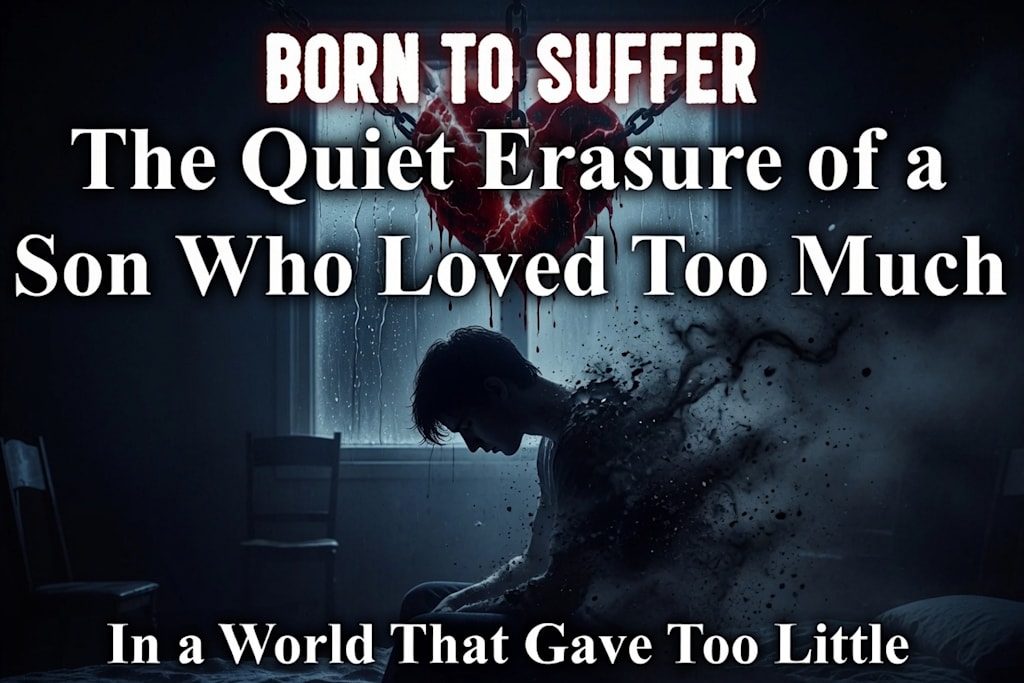
BORN TO SUFFER
The Quiet Erasure of a Son Who Loved Too Much in a World That Gave Too Little

Have you ever held something so incredibly fragile that you were actually terrified to breathe?
I’m not talking about a physical object, like a glass ornament or a dried leaf. I mean that feeling in your chest when you realize someone you care about is hanging by a thread, and you are completely, utterly powerless to fix it. It’s a specific kind of helpless. The kind that hollows you out.
I’ve been thinking a lot about that feeling lately. Mostly because I’ve spent the last few months digging into the life of a man named Arthur. You’ve never heard of him. Nobody has. And honestly, that’s the saddest part of the whole thing. Arthur lived for forty-two years, loved with a ferocity that most of us only read about in books, and then he just… faded.
It breaks my heart just typing his name. I mean, we live in a world that obsessively celebrates the winners, right? The self-made millionaires, the people who beat the odds. But what about the people who fight the exact same battles and lose? What about the people who do everything right, love everyone deeply, and still get crushed by the sheer, unfair weight of just being alive?
Arthur was one of those people.
To understand Arthur, you have to understand where he started. He wasn’t just born into poverty; he was born into a kind of generational, suffocating gravity that pulls you down before you even learn to stand. He came into the world in a cramped, single-room apartment above a laundromat. The air always smelled like cheap bleach and damp lint. The radiator clanked so loudly at night it sounded like someone hitting pipes with a wrench.
But Arthur didn’t care about the noise. Or the cold. Because he had his mother, Elena.
Elena was a woman made of sharp angles and soft eyes. She worked double shifts cleaning office buildings downtown. Her hands were always cracked, the skin rough like sandpaper, stained yellow from industrial floor cleaners. But when she held Arthur, those hands were the gentlest things in the world.
She was his entire universe. And he was hers.
You know how kids are. They just absorb everything. Arthur absorbed his mother’s exhaustion, her quiet sacrifices, the way she would skip dinner so he could have a slightly larger portion of the generic-brand macaroni. He saw it all. And from the time he was barely tall enough to reach the kitchen counter, he made a silent, ironclad promise: I am going to take care of her. I am going to give her the world.
It’s a beautiful promise. Really, it is. But it’s also a dangerous one when you’re born with absolutely nothing.
Arthur’s childhood wasn’t marked by any dramatic, movie-style tragedies. There was no sudden fire, no evil step-parent, no lottery-winning twist. It was just… a slow, grinding erosion of hope.
He was a smart kid. Quiet. Observant. He did his homework on the floor of the laundromat while his mother worked, using the warm dryers as a desk. He got a scholarship to a decent state college. For a brief, shining moment, it looked like he was going to break the cycle.
But then, during his sophomore year, Elena collapsed.
It wasn’t a sudden heart attack. It was her kidneys. They had been failing for years, silently, because she couldn’t afford to go to a doctor for her own check-ups. She had spent every dime she had on Arthur’s tuition, on his winter coat, on his bus pass.
Arthur dropped out the next week.
He didn’t make a big speech about it. He just packed his bags, took the bus back to the city, and started working. Three jobs. Sometimes four. He washed dishes at a diner until his fingers pruned and bled, then he went to clean offices-just like his mother-until 2 AM, and then he delivered groceries in the early morning.
He was twenty years old, and he looked forty.
I found an old photograph of him from this time. He’s standing in front of the laundromat. He’s so thin you can see the outline of his ribs through his flannel shirt. But he’s smiling. It’s this small, tight, determined smile. He thought he could outwork the universe. He thought if he just bled enough, the universe would eventually say, “Okay, you win. Here’s your prize.”
But the universe doesn’t work like that.
For fifteen years, Arthur fought. Fifteen years of saving every single penny. He lived on rice and beans. He wore shoes with holes in the soles, stuffing them with cardboard when it rained. He never went to the movies. He never went on a date. He never bought himself a single thing that wasn’t strictly necessary for survival.
He was building a fund. A medical fund for Elena’s dialysis, and eventually, a transplant. And a little bit on the side, he hoped, for a small house with a porch. Elena always talked about wanting a porch. Just a tiny wooden porch where she could sit and drink her coffee in the morning sun.
They were so close. I mean, they were so close.
Arthur had managed to save about twelve thousand dollars. It wasn’t enough for the transplant, but it was enough to keep her comfortable, to keep her on the list, to maybe get her a better treatment facility. He kept the money in a locked metal box under his bed.
And then, the winter of 2014 hit.
It was a brutal, biting cold. The kind that gets into your joints and stays there. Arthur was working his night shift at the diner when he got the call. Elena had slipped on the ice outside their building. She hit her head.
By the time he got to the hospital, she was already slipping away. The fall had caused a brain bleed. The doctors told him there was nothing they could do. It was just a matter of hours.
Arthur didn’t cry. Not at first. He just sat by her bed, holding that rough, sandpaper hand of hers, stroking it with his thumb. He whispered to her. He told her about the porch. He told her about the coffee she was going to drink. He told her he loved her.
Elena squeezed his hand. Just once. Weakly. And then she was gone.
This is the part where the story usually pivots, right? This is where the protagonist finds strength in his grief, turns his pain into purpose, and eventually builds a beautiful life in her memory.
That’s how it works in the stories we tell ourselves to feel better.
But Arthur’s story didn’t pivot. It just… stopped.
When you spend your entire life as a shield for someone else, what happens when they’re gone? Who are you protecting? What is the point of the armor?
Arthur went back to the apartment. It was completely silent. The radiator still clanked, but it just sounded empty now. He opened the metal box under his bed and looked at the cash. The twelve thousand dollars. The porch money. The survival money.
He didn’t need it for her anymore.
And honestly? I think the grief just broke something fundamental inside his brain. The sheer, overwhelming unfairness of it all crushed whatever resilient spirit he had left. He had done everything right. He had loved her perfectly. And it didn’t matter. It didn’t change a single thing.
He stopped going to work.
At first, it was just a few days. Then a week. The diner manager called, then showed up, but Arthur just stared at him through the chain-link on the door and shook his head. He lost the dishwashing job. Then he lost the office cleaning gig because he stopped showing up.
The eviction notice came two months later.
He didn’t fight it. He just packed a single duffel bag. He took his mother’s blue ceramic mug-the one she always drank her coffee from. He took the metal box with the money. And he walked out into the cold.
I tracked his final years through shelter records, soup kitchen sign-ins, and a few scattered police reports. It’s agonizing to read, honestly. It’s like watching a slow-motion car crash that you can’t look away from.
Arthur didn’t turn to drugs or alcohol. He didn’t become violent or angry. He just became a ghost.
He slept in his car for a while, until the car broke down and he couldn’t afford to fix it. Then he moved into the shelter system. The people who worked there remembered him. They said he was incredibly polite. Always said please and thank you. Always kept his bunk perfectly made.
But he never really spoke. He just carried that blue ceramic mug everywhere he went. He’d sit in the day room, staring at it, tracing the rim with his thumb.
One of the shelter volunteers, a woman named Sarah, told me a story that I just… I can’t get it out of my head. She said that one night, during a particularly bad snowstorm, the shelter was overflowing. People were sleeping on cots in the hallways. Arthur had a bed, but an elderly man came in shivering, clearly sick, with nowhere to go.
Without a word, Arthur got up, handed the man his blanket, and took the cot in the drafty hallway.
Sarah went to check on him later. He was sitting on the edge of the cot, holding his blue mug. She asked him why he gave up his bed.
Arthur just looked at her, his eyes completely hollow, and said, “My mom always said you have to make sure the people who need it most get warm. I’m not cold. Not really.”
He wasn’t cold. Because he had been cold inside for three years.
Arthur died on a Tuesday in March.
He was thirty-nine, though his body looked like it was in its late sixties. He had caught pneumonia. The shelter took him to the county hospital, but his immune system was just… gone. His heart was just… tired.
He passed away in a shared room, surrounded by the beeping of machines and the coughing of strangers. There was no one there to hold his hand. No one to stroke his hair. No one to tell him it was okay to let go.
When the nurses cleaned out his belongings, they found the duffel bag. Inside was a change of clothes, a worn-out Bible he never opened, the blue ceramic mug, and the metal box.
They opened the box.
Inside was the twelve thousand dollars in cash. But tucked beneath the money was a piece of paper. It was a letter, written in Elena’s shaky, looping handwriting. It was dated the day before she fell.
She had written it because she knew she was getting weaker. She wanted to leave him something.
The letter was short. It just said:
“My dearest Arthur. I know you are working yourself to the bone for me. I see your tired eyes. I see your bleeding hands. Please, my sweet boy, stop. Use this money I’ve been hiding in your box to buy yourself a ticket out of this city. Go to the ocean. You’ve never seen the ocean. Go see it for me. Don’t spend it on me. I have had a beautiful life because I had you. Let me go, my love. Live your life.”
She had been secretly hoarding her own meager pension checks, skipping her own medications, hiding the cash in his box, trying to buy him a way out.
He never found it. He was too busy working himself to death to look inside the box. And by the time he finally did look, it was too late.
I sat with that letter for a long time after I read it. I just sat there in my quiet, warm office, and I cried. Ugly, gasping tears.
Because it’s just so profoundly, devastatingly unfair.
Arthur spent his whole life trying to give his mother the world, completely unaware that she was quietly trying to give him his life back. They were both sacrificing everything for each other, and in the end, it just resulted in two empty chairs and a whole lot of silence.
It makes you wonder, doesn’t it? What is the actual point of a good heart in a world that only seems to reward a sharp elbow? We tell our kids that if they are kind, if they work hard, if they love deeply, things will work out. But Arthur was the kindest, hardest-working, most deeply loving man I’ve ever researched. And the world just chewed him up and spat him out.
I don’t have a neat bow to tie this up with. I don’t have a moral of the story that will make you feel better.
But I do know this: Arthur’s life wasn’t a waste. The love he gave his mother was real. The sacrifice he made was real. The fact that he gave up his bed for a stranger in a freezing hallway-that was real.
The world didn’t see him. The world didn’t reward him. But he was here. He loved, and he was loved, fiercely and completely, by the only person who mattered to him.
Still… it’s hard. It’s so hard to accept that some people are just born to suffer, not because they deserve it, but just because the universe is indifferent.
So, the next time you see someone who looks like they’ve given up… the next time you see a guy sleeping on a park bench, or a woman counting pennies at the grocery store… don’t just look away. Don’t just assume they made bad choices.
Because you don’t know what they’re carrying in their metal box. You don’t know what they’ve already lost. And you definitely don’t know how heavy that blue ceramic mug really is.
What do we owe to the Arthurs of the world? Is it enough to just remember them after they’re gone? Or should we be doing something while they’re still here, shivering in the hallway, trying to keep everyone else warm?
I don’t know the answer. But I think about it every single day.
About the Creator
KWAO LEARNER WINFRED
History is my passion. Ever since I was a child, I've been fascinated by the stories of the past. I eagerly soaked up tales of ancient civilizations, heroic adventures.
https://waynefredlearner47.wixsite.com/my-site-3
Enjoyed the story? Support the Creator.
Subscribe for free to receive all their stories in your feed.
Comments
There are no comments for this story
Be the first to respond and start the conversation.