Analysis
America's Forgotten Concrete Arrows
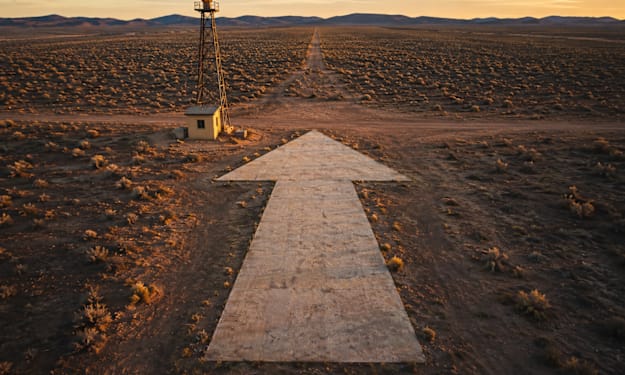
Imagine you're hiking through a lonely stretch of desert in the American West. The landscape is silent except for the wind; sagebrush sways in the distance, and the nearest highway is miles away. Then, without warning, you stumble across something that makes absolutely no sense: a gigantic concrete arrow. It stretches nearly seventy feet across the ground, pointing toward an empty horizon. There are no roads nearby, no signs explaining its purpose, no obvious destination. Just an enormous arrow, weathered by decades of sun and rain, as though some long-forgotten civilization left behind a monument no one bothered to explain. It sounds like the beginning of a mystery novel, but instead, it's one of the most fascinating chapters in American engineering history.
By The Iron Lighthouse3 months ago in History
Davis Richardson on Ukraine’s Bombardments, Civilian Resilience, and Cultural Targeting
Davis Richardson is a commentator and communications professional with extensive experience in Ukraine since Russia’s full-scale invasion. Since 2022, he has visited Ukraine 12 times, including stays in Kyiv and the Odesa region. His work has included pro bono publicity for Nahirna 22, a group of Gen Z Ukrainian artists affected by Russian attacks. Richardson reflects on air raid alerts, bombardments, cultural targeting, civilian resilience, and the evolving nature of modern warfare.
By Scott Douglas Jacobsen4 months ago in History
25 Mind-Blowing Facts That Sound Fake but Are 100% True
25 Surprising Facts That Seem Unreal But Are Actually True Introduction and facts one through eight Picture yourself chatting with pals when one drops a quiet remark: sharks existed before trees, or the gut replaces its lining often. Laughter might follow, chalked up to online silliness. Still, truth hides in the oddest claims. Some real things sound made up.
By Abdul Lateef4 months ago in History
Hidden Underground Tunnels in London
Hidden Underground Tunnels in London Most people know London as a busy city full of buses, red double-deckers, black taxis, and famous places like Big Ben and the London Eye. But very few people know that under this modern city, there is another hidden world. A world of tunnels, passages, and forgotten underground spaces that were built for different reasons across history. Beneath the streets where millions walk every day, an entire hidden layer of history still exists. Some of these tunnels are still in use, but many are hidden, abandoned, or even sealed. They tell a silent story about war, survival, transportation, and secret government plans. Over hundreds of years, London has grown upward and outward, but also deeper underground, creating one of the most complex underground systems in the world. One of the most famous underground systems is the London Underground, also known as “The Tube.” It is the oldest metro system in the world, first opened in 1863. While millions of passengers use it daily, very few know that beyond the active lines, there are countless forgotten tunnels. Some were part of early railway designs that were later changed, while others were abandoned because new routes made them unnecessary. These unused tunnels still remain under the city like hidden time capsules. During World War II, London faced heavy bombing attacks known as the Blitz. To protect civilians, the government used underground spaces as shelters. Many Tube stations were transformed into safe places where thousands of people slept during air raids. However, there were also specially built secret tunnels used for military communication, storage, and emergency movement of important officials. These underground spaces became lifelines during one of the darkest times in London’s history. Another fascinating underground system is the “Mail Rail.” This hidden railway was built in the 1920s to transport mail quickly across the city without facing traffic above ground. It ran silently under the streets, connecting major postal offices. For decades, it worked without most people even knowing it existed. Today, parts of it have been reopened for visitors, but much of the original system still remains hidden beneath the city. London’s underground world also includes mysterious passages beneath historic buildings such as churches, castles, and old government sites. One well-known example is the Tower of London, where hidden rooms and tunnels were used for guards, prisoners, and secure movement inside the fortress. Some stories even suggest the existence of escape tunnels, although many of these remain unconfirmed and part of local legend. There are also hidden government bunkers spread beneath London. During the Cold War, secret underground facilities were built to protect political leaders in case of nuclear attacks. These bunkers were designed to operate independently, with food storage, communication systems, and secure rooms. Many of these locations are still classified or not fully open to the public, adding to the mystery of London’s underground network. Some tunnels in London are even more mysterious because they were never completed. Engineers working in the Victorian era began constructing railway tunnels that were later abandoned due to financial problems, engineering challenges, or changing city plans. Today, these tunnels suddenly end in empty darkness, creating curiosity among urban explorers and historians who study them. Even in modern times, London continues to reveal its hidden underground world. During new construction projects, workers sometimes discover old tunnels, forgotten chambers, and buried structures from centuries ago. Each discovery adds another layer to the city’s deep and complex history. What makes London’s underground system so fascinating is that it is not just one network, but many layers built across different eras. It includes transport systems, wartime shelters, secret government facilities, and abandoned engineering projects. Together, they form a hidden city beneath the visible one. Most people walking through the streets of London never realize that just a few meters below them lies a world filled with history, mystery, and forgotten stories. Under the noise of modern life, the underground remains silent, carrying the secrets of the past and waiting for discovery by those who are curious enough to look beneath the surface.
By Hafiz afridi4 months ago in History
Shilajit Myths vs. the Actual Facts of Shilajit.
If you are into health content, then while scrolling on your phone, you must have come across posts that say, "Boost your testosterone levels in a few days with the help of shilajit" or "Increase your stamina in a few days by consuming shilajit." But do you think shilajit actually works like this?
By Everest Shilajit4 months ago in History
Evolution Is A Lie. Content Warning.
Introduction Yes, the title is clickbait, but so many people see that as a truth, too many in fact. The fact is that people who think that way will probably not evolve themselves, but evolution is with us every day in so many forms.
By Mike Singleton 💜 Mikeydred 4 months ago in History
A New Zealand cave that has been sealed for a million years exposes frogs that have never altered and birds that have disappeared, along with a new Kākāpō progenitor close to Waitomo.
A million-year-old secret was hidden in one cave on the North Island of New Zealand. Fossils of birds from extinct species and frogs that still resembled them were found on its floor.
By Francis Dami4 months ago in History
Ten thousand years ago, humans were already dwelling high in the Pyrenees.
Altitude is typically viewed in archaeology as a variable rather than a barrier. Sites above the treeline are written off, whereas sites below it are dug. The high Pyrenees appeared to be vacant on maps during the majority of the 20th century. Animals, and sometimes humans as well, traversed this area before returning to lower land.
By Francis Dami4 months ago in History
A mysterious cave collapse reveals a 300,000-year-old "advanced human time capsule"
A surprisingly well-preserved prehistoric cave discovered by archaeologists is assisting scientists in piecing together a significant period in human evolution. Stone tools, animal remains, and signs of controlled fire from between 400,000 and 250,000 years ago have been found at the site, which is close to the village of Fureidis south of Haifa.
By Francis Dami4 months ago in History
John Clare Voice of the English Countryside
Most people have never heard of John Clare, yet he wrote some of the most vivid nature poetry in English literature. John Clare emerged from rural England during the late eighteenth and early nineteenth centuries, bringing a voice shaped by farm life, seasonal work, and close observation of the natural world. Born in Helpston in Northamptonshire in 1793, he grew up in a family of agricultural laborers where daily survival depended on field work and local trade. This environment became the foundation of his poetic imagination.
By Tim Carmichael4 months ago in History
The Hidden Networks Behind Global Influence
The question of who really rules the world has fascinated people for centuries. It has inspired political theory, historical investigation, philosophical debate and countless books exploring the nature of power. While governments and elected leaders appear to hold authority, many people suspect that influence extends far beyond parliaments, congresses and presidential offices. Some point to wealthy individuals, multinational corporations and financial institutions, while others look towards secretive organisations, ancient societies and elite networks that operate largely outside public view.
By Alan Spencer4 months ago in History