
Davis Richardson on Ukraine’s Bombardments, Civilian Resilience, and Cultural Targeting
How does Davis Richardson describe Ukraine’s bombardments, air raid alerts, civilian resilience, and Russia’s targeting of Ukrainian cultural sites?

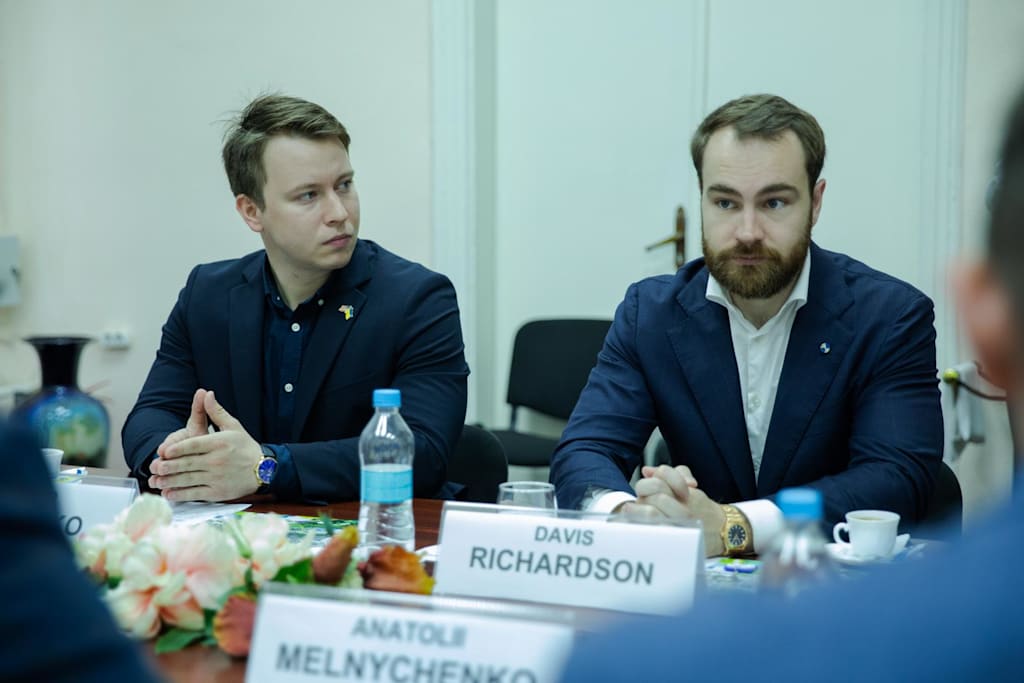
Davis Richardson is a commentator and communications professional with extensive experience in Ukraine since Russia’s full-scale invasion. Since 2022, he has visited Ukraine 12 times, including stays in Kyiv and the Odesa region. His work has included pro bono publicity for Nahirna 22, a group of Gen Z Ukrainian artists affected by Russian attacks. Richardson reflects on air raid alerts, bombardments, cultural targeting, civilian resilience, and the evolving nature of modern warfare.
Scott Douglas Jacobsen and Davis Richardson discuss major Russian bombardments of Ukraine on May 24, June 2, and June 15, focusing on Kyiv, civilian targets, and psychological responses to air raid alerts. Richardson describes shorter warning times, heavier strikes, and cultural targeting, including attacks on the Lavra, museums, and artists. Jacobsen reflects on involuntary fear, disrupted sleep, and how Ukrainians continue daily life amid escalating missile and drone warfare.
Scott Douglas Jacobsen: I was here in Ukraine during the May 24, June 2, and June 15 bombardments. Thinking about it now, “bombardments” is probably the better term because they were significant. The May 24 bombardment alone involved 90 missiles and 600 drones.
The June 2 bombardment involved 73 missiles and 656 drones, while the June 15 bombardment involved 70 missiles and 611 drones. Kyiv was substantially targeted during the May 24, June 2, and June 15 bombardments. Were you here for any of those? I want to compare notes on responses and interpretations.
Davis Richardson: I was here. First, I have been in Ukraine for about a month now. This is my 12th visit to the country since 2022. At the end of May and in June, I was in the Odesa region.
In early June, I was in Odesa, and I have been in Kyiv ever since. Regarding 2026, I was in Kyiv in February during the heat shortages and power outages. In comparing the notes you mentioned, I have noticed this time that the alerts are often shorter.
However, there is heavier bombardment during them. With some of the earlier alerts I experienced in 2023, there seemed to be more of an open-ended question about when they began and ended. You did not necessarily know what was happening during that period.
The challenge now is that they can be announced on very short notice. I think that during the attack last night, as soon as the alert was issued, just a minute or two later, the ballistic missiles struck outside the city. So there is less time to react. That has been my experience.
Jacobsen: How do you experience them? I am talking about physiological interpretations and emotions.
Richardson: I think a lot of it depends on what you are going through at the time. I do not think there is an exact science to it because there have been times when the attacks were more severe, and I was not nervous at all.
In fact, I might be walking around Kyiv during one of the most serious ballistic missile strikes. Then there are other times when it may not be as serious, and everybody else is walking about, but I may be in my hotel room, very anxious.
I do not know the exact science behind these things, but I think there are psychological factors involved, depending on what you went through that day. Are you happy? Are you angry?
All of that can contribute to whether you experience fight-or-flight or choose to ignore it. There have been times when I have been more nervous than at other times.
Jacobsen: I have been here for more than four months. Across my three trips here, these three bombardments have been the most substantial ones during which I have been present.
During those three events, the feeling of terror was completely involuntary. Other bombardments had not really instigated an involuntary response like that.
During the May 24 and June 2 bombardments, I had trouble sleeping, so I slept in the bathroom, which, for me, has three walls as a barrier. During the June 15 bombardment, I slept in the closet.
Those were relatively large bombardments. So it is hit-or-miss what people consider dangerous. But the physiological sensation was completely involuntary.
The emotional interpretation usually came afterward, after processing the experience a bit more. Sleep deprivation can be a particular issue when first coming here. Then, over time, you get more used to it. You get over it, and your sleep cycle becomes more regular.
Even on regular days, when walking down the street and an air raid alarm goes off, no one really cares. People go about their day. They stay in the café, have their coffee, their croissants, their work, or whatever else.
So I want to make sure we have a conversation about those particular days, because they were substantially different from the others.
When residences, civilian centres, UNESCO sites, religious sites, museums, and cultural institutions are targeted, what does this signify to you about the use of these very expensive ballistic missiles to kill a dozen people and injure 50 to 150?
Richardson: I do not think it is a coincidence that you had the attack on the Lavra, and shortly after that, the attack on the Chornobyl Museum and other key sites. These are cultural targets. These are not military sites.
We provided pro bono publicity for Nahirna 22, a collection of Ukrainian Gen Z artists. They were bombed twice, once last August and then again in November. That is not a military site. That is the Russian military specifically targeting Gen Z artists.
So, yes, with the most recent bombing, it was surprising to see the Lavra targeted because you have a regime in Moscow that claims its entire political legitimacy from Kyivan Rus’. Then what does it do? It bombs the most holy site within that framework. So it begs the question: what are they trying to capture?
What you see is death and destruction. We saw that before with Chechnya. That is what we are seeing in many of the occupied territories here in Ukraine. There is a pattern with the Russian military: death and destruction.
So, no, I do not think it was a coincidence at all. They have been doing this for quite a while because the biggest threat to the Kremlin is Ukrainian culture and the Ukrainian people not wanting any part in Russian culture. It is a pretty significant marker of the difference between the two.
Jacobsen: How do people you know who have lived here for the full length of the full-scale invasion describe these bombardments?
Richardson: A lot of people sleep through them. Recently, the attacks have been harder to sleep through.
With the ones involving FPVs or Shaheds, you can sleep through them, especially now that the interceptors for Shaheds have gotten so good. But death evolves, and war evolves. Now, I do not think there are many people concerned about the Shaheds because the interceptors have gotten so good.
Russia is continuing to crank out the production of ballistic missiles. So, yes, I think it all depends on the person. It generally helps that it is summer right now. You are not having to go through persistent blackouts as you did in the winter. There is running water. I think it cannot be overstated how painful this winter was for people who were here.
Unfortunately, many innocent people were without heat.
Jacobsen: There was a Holocaust survivor who died of hypothermia.
Richardson: It is terrible. It was the coldest winter Ukraine had had since the 1990s. I think there is optimism now, though, with the strikes Ukraine is carrying out deep inside Russian territory, including strikes on oil refineries near Moscow.
So there is more optimism right now. But I think it is important to remember where we were in February, to be realistic about everything, and to enjoy the wins. Still, there is more to be done.
Jacobsen: Davis, thank you very much for your time.
Richardson: All right. Sounds good. Thanks, Scott.
Jacobsen: Bye, Davis.
Scott Douglas Jacobsen is a blogger on Vocal with more than 200 publications on the platform. He is the Founder and Publisher of In-Sight Publishing (ISBN: 978–1–0692343; 978–1–0673505) and Editor-in-Chief of In-Sight: Interviews (ISSN: 2369–6885). He writes for International Policy Digest (ISSN: 2332–9416), The Humanist (Print: ISSN, 0018–7399; Online: ISSN, 2163–3576), Basic Income Earth Network (UK Registered Charity 1177066), Humanist Perspectives (ISSN: 1719–6337), A Further Inquiry (SubStack), Vocal, Medium, The Good Men Project, The New Enlightenment Project, The Washington Outsider, rabble.ca, and other media. His bibliography index can be found via the Jacobsen Bank at In-Sight Publishing, comprising more than 10,000 articles, interviews, and republications across more than 200 outlets. He has served in national and international leadership roles within humanist and media organizations, held several academic fellowships, and currently serves on several boards. He is a member in good standing in numerous media organizations, including the Canadian Association of Journalists, PEN Canada (CRA: 88916 2541 RR0001), Reporters Without Borders (SIREN: 343 684 221/SIRET: 343 684 221 00041/EIN: 20–0708028), and others.
Image Credit: Davis Richardson.
About the Creator
Scott Douglas Jacobsen
Scott Douglas Jacobsen is the publisher of In-Sight Publishing (ISBN: 978-1-0692343) and Editor-in-Chief of In-Sight: Interviews (ISSN: 2369-6885). He is a member in good standing of numerous media organizations.
Enjoyed the story? Support the Creator.
Subscribe for free to receive all their stories in your feed.
Comments
There are no comments for this story
Be the first to respond and start the conversation.