
A New Zealand cave that has been sealed for a million years exposes frogs that have never altered and birds that have disappeared, along with a new Kākāpō progenitor close to Waitomo.
Between two eruptions, a cave

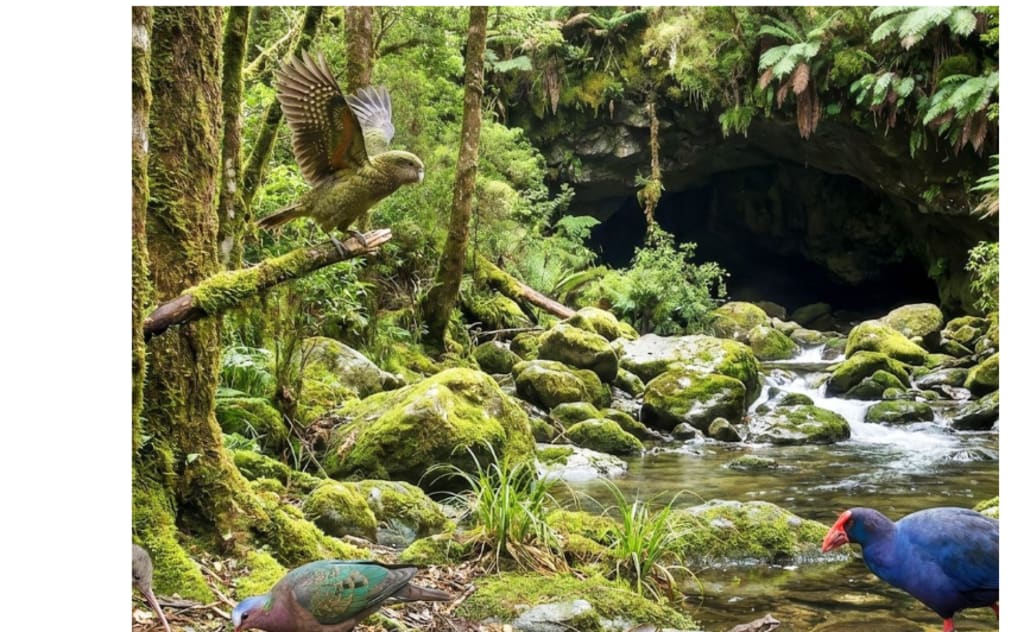
A million-year-old secret was hidden in one cave on the North Island of New Zealand. Fossils of birds from extinct species and frogs that still resembled them were found on its floor.
New Zealand is well known for having lost a large portion of its fauna once human settlers arrived. This cave demonstrates that long before humans arrived, the nation's birds were already changing over.
That record was broken by a group under the direction of palaeontologist Trevor Worthy. On the North Island, near the well-known Waitomo Caves, they operated out of a solitary cave.
Between two eruptions, a cave
Moa Eggshell Cave is located approximately 920 feet (280 meters) above a neighbouring creek. The ancient cave was split in two by erosion, which made the buried bones more visible.
This is the clever part. Scientists have already determined the age of each fossil, which was wedged between two layers of volcanic ash. About 1.55 million years ago, during the Ngaroma eruption, the earlier ash fell and adhered to the cave's walls and roof.
Around one, the Kidnappers erupted, washing the younger layer over the floor. Therefore, any bone underneath that newer ash had to be more than a million years old. The timeline was completed from above by a 535,000-year-old stalagmite on the silt. This provided the team with an uncommon resource: a fossil deposit that was firmly dated between two natural clocks.
Frogs that are frozen in time
Four types of native frogs belonging to the species Leiopelma had their bones removed by the researchers as they sieved the sediment. The earliest known fossils of frogs from the North Island are these ones.
This is the strange part. Each of those species of frogs still corresponds to a frog that has lived in the same region much more recently. The frogs hardly moved throughout the course of a million years. identical sizes, forms, and species.
These frogs are perched on an old limb of the amphibian tree that broke apart from all other frogs at an early age. They provide scientists with a consistent baseline since they are frozen in time while the animals around them churn.
Fossils of birds from New Zealand
Out of just 21 viable bones, the cave yielded 12 different species of birds. At least four and most likely six of those twelve can be found at no younger fossil site in New Zealand.
In other words, between one-third and one-half of the birds that lived close to Waitomo a million years ago ultimately vanished from the record. Some became extinct, some were replaced, and some evolved into modern birds.
From so few bones, that is a significant amount of change. The team anticipates that the actual number of extinct species is far higher. It found out that two of them were completely novel to science.
There are two new species called
The first is related to the heavy, flightless parrot known as the kākāpō in New Zealand. It was given the name Strigops insulaborealis by the team. Its foot bones indicate that it was a less adept climber than the modern Kākāpō. Tiny gnaw marks, which termites and other friendly insects leave on old bone, were even visible on one wing bone.
The second new species is a large, flightless rail that bears Warren Clayton-Greene's name, Porphyrio claytongreenei. To keep goats out, he, the proprietor, fenced the cave. That bird is a member of the same family as the extinct moho and the extant takahē.
Given that Cook Strait split the land in two, the experts believe it may even be their common progenitor. For the first time, a third bird—a species of pigeon—appeared in the fossil record of New Zealand.
When the ash fell
So why did the frogs remain still while the birds underwent such drastic changes? Particularly noteworthy are two suspects who might have collaborated. Climate is the first. Around this time, the ice age cycles became more severe, changing which shrublands and forests could endure.
The volcano is the second suspect. About 17,000 square miles (44,000 square kilometres) of the North Island were covered in ash that was 33 feet (10 meters) deep as a result of the Kidnappers eruption.
A second eruption poured considerably more on top a few decades later. Imagine a forest, its birds, and the frogs in its streams, all suffocated by intense heat. A second eruption poured considerably more on top a few decades later. Imagine hot pumice suffocating a forest, its birds, and the frogs in its streams. The worst affected were ground birds that had nowhere to fly.
The team believes that bird populations were torn apart by these eruptions, and that this division persisted long enough for the birds to follow different routes. DNA functions similarly in moa and kiwi points.
The significance of this cave
The deep fossil gap in New Zealand raised a persistent question prior to this discovery. Scientists were aware that significant changes occurred between the distant past and the present, but they were unsure of when.
At last, Moa Eggshell Cave provides them with a dated checkpoint. It demonstrates that long before humans came, the ancient birds were already turning over and The team views this as an initial assessment rather than the last word because they only sampled a small portion of the floor.
About the Creator
Enjoyed the story? Support the Creator.
Subscribe for free to receive all their stories in your feed.
Comments
There are no comments for this story
Be the first to respond and start the conversation.