
The Hidden Networks Behind Global Influence
Understanding the Complex Web of Global Power
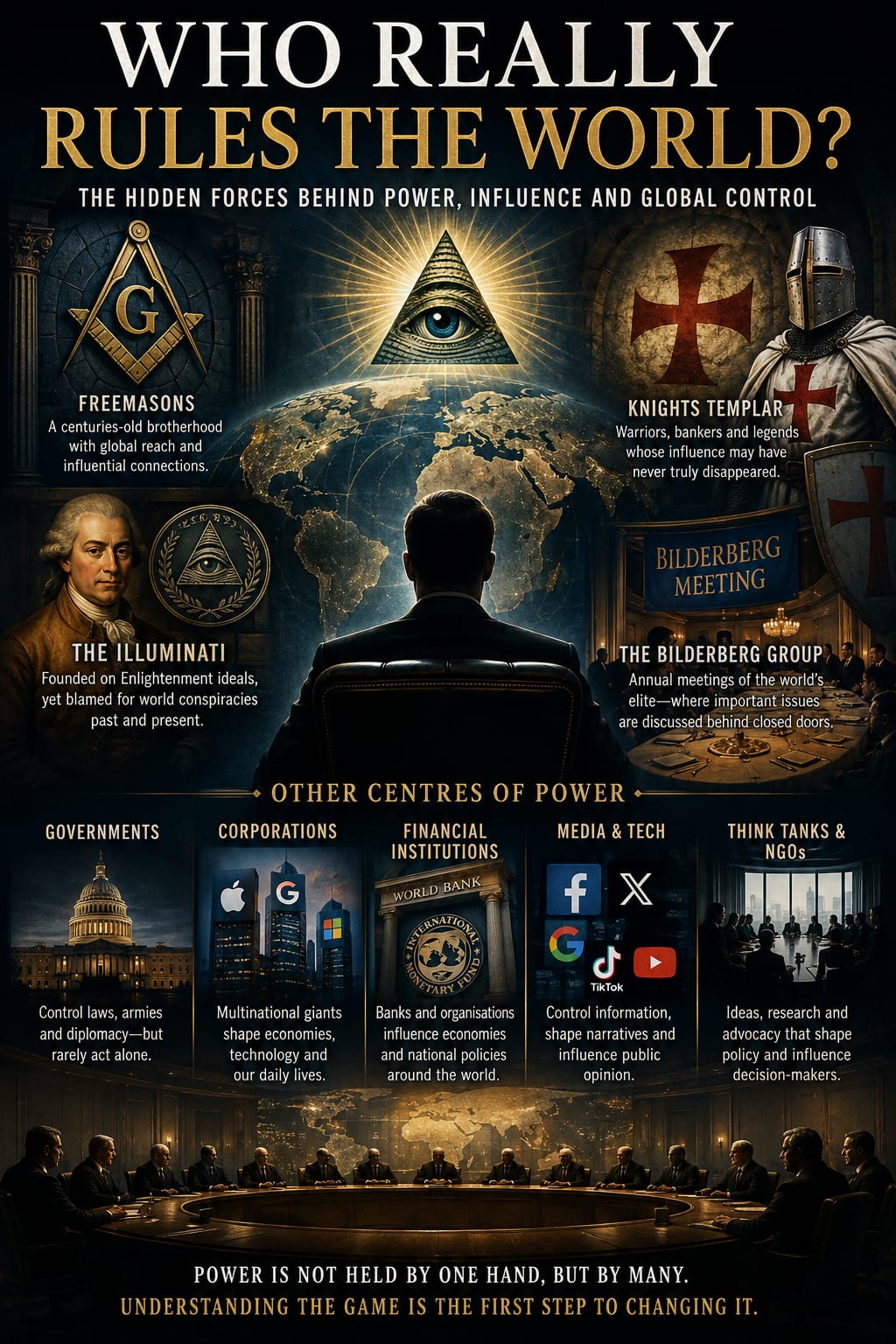
The question of who really rules the world has fascinated people for centuries. It has inspired political theory, historical investigation, philosophical debate and countless books exploring the nature of power. While governments and elected leaders appear to hold authority, many people suspect that influence extends far beyond parliaments, congresses and presidential offices. Some point to wealthy individuals, multinational corporations and financial institutions, while others look towards secretive organisations, ancient societies and elite networks that operate largely outside public view.
At first glance, the answer seems straightforward. Governments pass laws, collect taxes, command armed forces and negotiate treaties. Major powers such as the United States, China, Russia and the nations of Europe influence global events through military strength, economic power and diplomatic relationships. Yet governments themselves are subject to pressures from financial markets, corporate interests, public opinion and international organisations. Political leaders may appear powerful, but they rarely operate without constraints.
Economic power is often overlooked when discussing who rules the world. Some multinational corporations generate revenues larger than the economies of many nations. Technology companies control communication platforms used by billions of people. Financial institutions influence investment, lending and economic development across entire continents. Decisions made in corporate boardrooms can affect employment, manufacturing, information flows and even public policy. While corporations do not formally govern countries, their influence can be substantial.
Alongside these visible centres of power are organisations that attract both curiosity and controversy. One of the most frequently discussed is the Bilderberg Group, an annual gathering of political leaders, business executives, academics and media figures. Since its first meeting in 1954, the group has provided a forum for informal discussions about global issues. Critics argue that such meetings allow powerful individuals to shape future policy away from public scrutiny, while supporters contend that they are simply opportunities for frank discussion without the pressures of public debate. Whatever the reality, the secrecy surrounding the meetings has fuelled speculation for decades.
The Freemasons have also long been associated with influence and power. Freemasonry emerged from stonemason guilds and developed into a fraternal organisation that spread throughout Europe and beyond. Its members have included politicians, military officers, scientists, business leaders and members of royalty. Masonic lodges promote moral development, charity, and fellowship, yet their traditions, rituals, and symbols have given rise to theories that they exert a hidden influence over governments and institutions. Historians generally find little evidence that Freemasonry operates as a coordinated global power, but its historical connections to influential individuals continue to attract attention.
The Knights Templar occupy a unique place in both history and legend. Founded during the Crusades, the Templars became one of the wealthiest and most powerful military orders in medieval Europe. They developed sophisticated banking systems, accumulated vast property holdings and enjoyed considerable political influence. Their sudden suppression in the fourteenth century created mysteries that persist to this day. Some theories suggest that remnants of the order survived in secret and influenced later organisations, although definitive evidence remains elusive. Nevertheless, the Templars continue to feature prominently in discussions about hidden power structures.
No discussion of influential groups would be complete without mentioning the Illuminati. Historically, the Illuminati was a real organisation founded in Bavaria in 1776 with the aim of promoting Enlightenment ideals and reducing the influence of superstition and authoritarian control. The group was short-lived and officially dissolved within a few years. However, the name has taken on a life of its own. In popular culture and conspiracy literature, the Illuminati is often portrayed as a secret organisation manipulating governments, economies and world events from behind the scenes. Despite countless claims, there is no credible evidence that a modern Illuminati controls world affairs, although the concept remains deeply embedded in popular imagination.
Other organisations frequently mentioned in discussions of global influence include the World Economic Forum, major think tanks, international banking networks and policy institutes. These groups often bring together political leaders, business executives and academics to discuss challenges facing the world. Critics argue that such forums allow unelected individuals to shape agendas and priorities. Supporters counter that complex global problems require cooperation between governments, businesses and experts. The truth may lie somewhere between these positions.
Media organisations and technology platforms have become another major source of influence. Control of information has always been important, but the digital age has amplified its significance enormously. A small number of technology companies now influence how billions of people communicate, obtain information and form opinions. Algorithms determine what news is seen, what ideas gain attention and what narratives dominate public discussion. This influence is not equivalent to direct political control, but it represents a powerful force in shaping societies.
Public opinion itself remains an important factor. Governments can be voted out of office, corporations can lose customers, and influential organisations can face public backlash. Throughout history, popular movements have challenged established power structures and forced significant changes. The civil rights movement, the fall of communist governments in Eastern Europe and numerous democratic reforms demonstrate that power does not always flow from the top down.
Perhaps the most important point is that power is rarely concentrated in a single place. The notion that a single secret organisation controls every major event is appealing because it offers a simple explanation for a complex world. Reality is usually far more complex. Different groups possess different forms of influence, and their interests often conflict rather than align. Governments compete with one another, corporations pursue their own objectives, financial institutions respond to economic pressures, and social movements emerge unexpectedly.
History suggests that power is constantly shifting. Great empires rise and fall. Financial centres move from one region to another. New technologies disrupt established industries. Ideas that once seemed dominant can rapidly lose influence. What appears to be an all-powerful institution in one century may be largely forgotten in the next.
In the end, the question of who really rules the world may not have a single answer. The modern world is shaped by a complex web of governments, corporations, financial institutions, international organisations, influential networks and ordinary citizens. Some operate openly, while others prefer discretion. Some are well documented, while others exist mainly in speculation and legend. Understanding the difference between the two is essential for anyone seeking to understand how power truly works.
Rather than being controlled by a single hidden hand, the world appears to be influenced by many competing forces, each attempting to shape events according to its own interests, priorities, and vision of the future.
About the Creator
Alan Spencer
Have been an author and writer for over 20 years. Have been a journalist, editor, proofreader, and a designer and presenter of training courses. Have written over 100 articles, two books, and around 20 training courses.
Enjoyed the story? Support the Creator.
Subscribe for free to receive all their stories in your feed. You could also become a paid subscriber, letting them know you appreciate their work.
Comments
There are no comments for this story
Be the first to respond and start the conversation.