
A mysterious cave collapse reveals a 300,000-year-old "advanced human time capsule"
According to archaeologists, the exceptionally well-preserved site provides a unique window into a critical time when early humans were acquiring ever-more-advanced abilities.

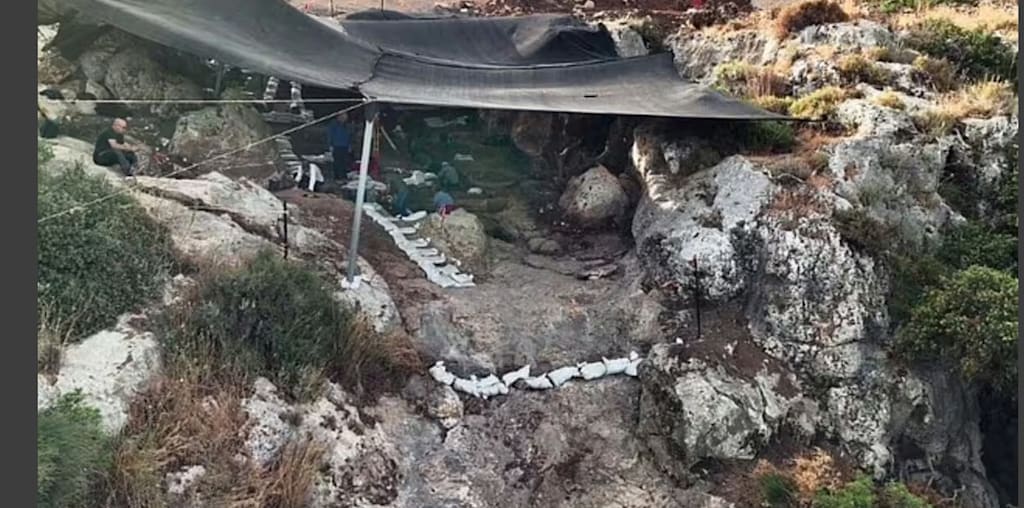
A surprisingly well-preserved prehistoric cave discovered by archaeologists is assisting scientists in piecing together a significant period in human evolution. Stone tools, animal remains, and signs of controlled fire from between 400,000 and 250,000 years ago have been found at the site, which is close to the village of Fureidis south of Haifa.
Researchers found evidence that the cave's occupants hunted a variety of animals, regulated fire, extracted flint from neighbouring rock outcrops, and made intricate stone tools, all of which suggested they had remarkably advanced skills for the time.
According to the study, these people were already exhibiting behaviours that would eventually become characteristics of Neanderthal and modern human communities, as evidenced by the advanced tools, hunting evidence, and indicators of controlled fire.
According to experts, the cave was inhabited during the little-known Acheulo-Yabrudian epoch, which preceded the appearance of modern humans and classic Neanderthals. After its roof collapsed, the cave's contents were sealed for hundreds of thousands of years, keeping what scientists have called an ancient "time capsule" intact.
Why does the discovery thrill researchers?
The excavation offers a unique window into a time when behaviours linked to later human cultures were starting to emerge and older human traditions seem to have been disappearing.
According to researchers, the cave provides insights about how prehistoric people hunted, utilised fire, manufactured tools, and arranged themselves socially at a crucial period in prehistory.
"This is probably the last culture of a very long continuum [of cultures]," Dr. Kobi Vardi, co-director of the excavation and head of the Prehistory Branch of the Israel Antiquities Authority, told The Times of Israel.We are currently in a period of transition because Neanderthals and Homo sapiens developed a completely distinct culture between 250,000 and 50,000 years ago."
Despite the fact that no human remains have been discovered at the site, archaeologists speculate that the inhabitants may have been members of an ancient population that inhabited the Levant prior to the emergence of Homo sapiens and classic Neanderthals.
Who lived in the cave?
According to the Daily Mail, scientists are unable to definitively determine who lived in the cave given the absence of human bones. Nonetheless, some experts speculate that the population might have descended from closely related people, or Homo heidelbergensis.
Most people agree that Homo heidelbergensis is the last common ancestor of modern humans and Neanderthals. According to researchers, the inhabitants of the cave might be a transitional population that shares traits with both subsequent groups and occupies a crucial place in the human family tree.
What was found within the cave?
By examining the stone tools found during the dig, the team was able to date the location. About 100 side scrapers, which are thought to be one of the distinguishing characteristics of the Acheulo-Yabrudian culture, were among the most important discoveries.
According to researchers, the instruments were employed for things like preparing hides and butchering animals. Additionally, a number of exquisitely made handaxes were discovered.
Although handaxes continued to be an essential part of human technology for around a million years during the Palaeolithic era, Vardi claimed that the sophisticated design of the examples discovered at Fureidis made them stand out. Researchers were able to determine that the cave's occupants belonged to the Acheulo-Yabrudian culture because of the combination of side scrapers and handaxes.
"This is very important because sites from this phase are very rare; there are about ten sites in the Near East, two in Syria, one in Lebanon, and six in Israel," stated Vardi.
"However, this is the only site in the Carmel Ridge where this phase was discovered, where we have this culture in pristine condition, meaning not covered by later layers, except for a small part of the cave."
What can be learned about everyday life from the evidence?
The results imply that the people who lived in the cave had advanced survival techniques. Researchers discovered evidence that they hunted a variety of animals and extracted flint from neighbouring rock outcrops.
Fallow deer, gazelles, ancient horses, and wild cattle were among the remains found; several of them had evidence of human slaughter. Animal bones of this antiquity are rarely discovered in such excellent condition, according to scientists.
In comparison to previous populations, evidence from the site indicates that the people lived in comparatively large and socially connected groupings. Additionally, researchers think the cave might have been next to a spring, giving the locals a reliable supply of water.
When taken as a whole, the findings are assisting researchers in filling in important knowledge gaps on how prehistoric people lived and adapted during a poorly recorded period.
About the Creator
Enjoyed the story? Support the Creator.
Subscribe for free to receive all their stories in your feed.
Comments
There are no comments for this story
Be the first to respond and start the conversation.