Painting
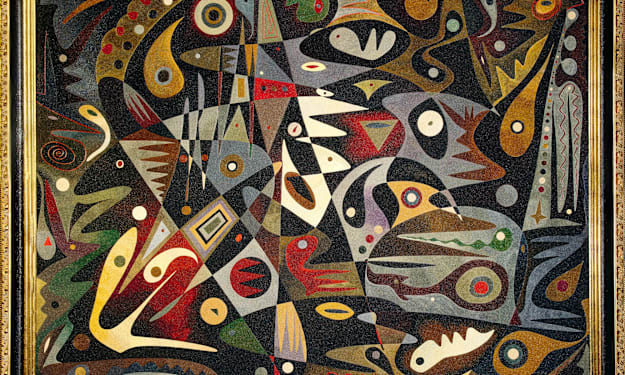
Babylonian Human (2008)
Throughout history, civilizations have sought to define the human condition through systems of belief, power, language, and cultural memory. Among the earliest and most influential of these was Babylon, a civilization whose achievements in law, astronomy, architecture, and administration helped shape the foundations of organized society. In Babylonian Human (2008), Gheorghe Virtosu turns away from the monumental scale of military history explored in 6 Wars: The Architecture of Conflict and instead directs his attention toward the individual as a vessel of cultural memory. The result is a powerful meditation on identity, consciousness, and the enduring relationship between humanity and civilization.
By Daniel Varzari5 months ago in Art
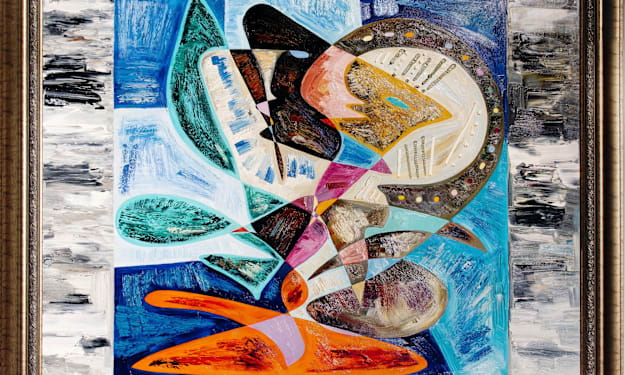
The Diplomatic Jew (2015)
In The Diplomatic Jew (2015), identity, negotiation, cultural continuity, and historical resilience are transformed into a symbolic architecture of abstraction. Rather than presenting a literal portrait, the painting constructs a complex visual entity through intersecting forms, chromatic contrasts, and layered symbolic relationships. The result is a work that examines diplomacy not merely as political activity, but as a condition of survival, adaptation, and intellectual engagement across history.
By Daniel Varzari5 months ago in Art
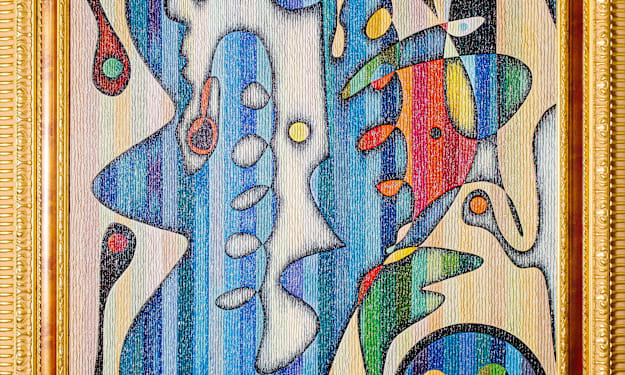
Philip II of Macedonia (2020–2021)
Few rulers have exercised a greater influence on the course of ancient history than Philip II of Macedonia. While often overshadowed by the achievements of his son, Alexander the Great, Philip was the architect of the political, military, and institutional foundations that made Macedonian expansion possible. In Philip II of Macedonia (2020–2021), Gheorghe Virtosu approaches this pivotal historical figure not through conventional portraiture but through a highly symbolic language of abstraction. The result is a meditation on leadership, strategic vision, and the processes through which historical power is constructed and sustained.
By Daniel Varzari5 months ago in Art
Caodaism (2019–2021)
Emerging in Vietnam during the early twentieth century, Caodaism represents one of the most ambitious attempts in modern religious history to reconcile diverse spiritual traditions within a unified philosophical framework. Drawing upon elements of Buddhism, Taoism, Confucianism, Christianity, Islam, and other systems of thought, the religion proposes a vision of humanity linked through shared spiritual origins despite cultural and historical differences. In Caodaism (2019–2021), Gheorghe Virtosu approaches this unique tradition through abstraction, constructing a monumental visual field that investigates synthesis, coexistence, and the possibility of unity within diversity.
By Daniel Varzari5 months ago in Art
The King of Revolution (2021)
The King of Revolution presents itself as a psychological architecture of power rather than a literal portrait. Through symbolic abstraction, fractured geometry, and chromatic tension, the painting constructs a figure that appears simultaneously sovereign, unstable, celebratory, and internally divided. The work operates within a lineage that recalls elements of Cubism, biomorphic abstraction, and modern symbolic painting, yet it resists becoming derivative by transforming those influences into a contemporary meditation on authority and transformation.
By Daniel Varzari5 months ago in Art
American Policy in the 21st Century (2015)
In American Policy in the 21st Century (2015), political power is transformed into an unstable visual language of fragmentation, collision, and reconstruction. Rather than presenting policy through recognizable national symbols or narrative imagery, the painting approaches geopolitics as a psychological and structural condition — a system defined by contradiction, acceleration, and perpetual negotiation between order and disruption.
By Daniel Varzari5 months ago in Art
The Protector of the Souls (2015)
Throughout human history, civilizations have sought ways to understand the relationship between material existence and the unseen dimensions of consciousness, memory, and spirit. Whether through religion, philosophy, mythology, or ritual, cultures across time have imagined forms of protection that extend beyond the physical world. In The Protector of the Souls (2015), Gheorghe Virtosu approaches this enduring theme through abstraction, constructing a monumental visual structure that investigates spiritual continuity, transformation, and the persistence of identity beyond fixed forms. Rather than depicting a guardian figure in a conventional sense, the painting presents protection as a dynamic process emerging through interconnected systems of memory, perception, and transcendence.
By Daniel Varzari5 months ago in Art
Shintoism (2021–2023)
Among the world's enduring spiritual traditions, Shinto occupies a distinctive position through its profound relationship with nature, place, and presence. Rather than emerging from a single founder, scripture, or theological doctrine, Shinto developed through centuries of cultural experience, ritual practice, and reverence for the living forces believed to inhabit the natural world. Mountains, rivers, forests, stones, ancestors, and seasonal cycles become sites of sacred encounter through which humanity experiences its connection to a larger cosmic order. In Shintoism (2021–2023), Gheorghe Virtosu transforms these principles into a monumental abstract composition that explores the architecture of harmony between human consciousness and the living environment.
By Daniel Varzari5 months ago in Art
Battle of Gaugamela (2000–2002)
In the long tradition of battle painting, artists have typically relied on narrative clarity, heroic protagonists, and recognizable episodes of conflict. From ancient depictions of Alexander the Great’s campaigns to the grand military panoramas of the nineteenth century, the visual language of war has historically been rooted in representation. Battle of Gaugamela (2000–2002), a monumental oil painting measuring 3.44 by 3.23 meters, proposes a radically different approach. Rather than depicting the famous confrontation between Alexander III of Macedon and Darius III of Persia, the work reconstructs the battle as a dynamic system of forces, tensions, and interactions expressed through abstraction.
By Daniel Varzari5 months ago in Art
Illuminati (2015)
In Illuminati (2015), systems of hidden influence, symbolic authority, and concealed structures of power are translated into an intricate visual language of fragmentation, geometry, and psychological ambiguity. Rather than illustrating conspiracy literally, the painting examines the broader cultural fascination with invisible networks of control — the idea that power often operates beneath visibility, embedded within systems of knowledge, ritual, surveillance, and institutional architecture.
By Daniel Varzari5 months ago in Art
The Protector of Humanity (2017)
In much of art history, protection has been represented through identifiable figures of authority: rulers, warriors, saints, guardians, or mythological beings who embody strength, defense, and order. In The Protector of Humanity (2017), Gheorghe Virtosu radically redefines this tradition. Rather than presenting a singular heroic protector, the painting proposes protection as a distributed condition emerging from the interaction of interconnected forces. Through abstraction, Virtosu transforms the concept of guardianship into a dynamic system of relationships, balance, and collective continuity.
By Daniel Varzari5 months ago in Art
Buddhism (2016–2018)
Among the world’s major philosophical and spiritual traditions, Buddhism occupies a distinctive position through its sustained exploration of consciousness, impermanence, and the nature of reality. Rather than centering belief upon a fixed metaphysical authority, Buddhist thought investigates the processes through which perception, attachment, suffering, and liberation emerge. In Buddhism (2016–2018), Gheorghe Virtosu approaches this intellectual and spiritual tradition through a monumental language of abstraction, constructing a visual environment that explores transformation, interdependence, and the continual unfolding of awareness.
By Daniel Varzari5 months ago in Art