
Buddhism (2016–2018)
Impermanence, Interdependence, and the Architecture of Awakening
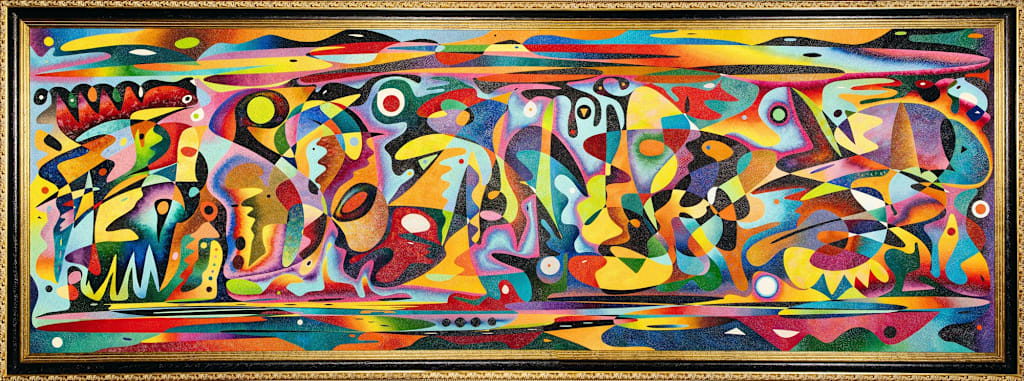
Among the world’s major philosophical and spiritual traditions, Buddhism occupies a distinctive position through its sustained exploration of consciousness, impermanence, and the nature of reality. Rather than centering belief upon a fixed metaphysical authority, Buddhist thought investigates the processes through which perception, attachment, suffering, and liberation emerge. In Buddhism (2016–2018), Gheorghe Virtosu approaches this intellectual and spiritual tradition through a monumental language of abstraction, constructing a visual environment that explores transformation, interdependence, and the continual unfolding of awareness.
Measuring 2 by 6 meters, the oil painting extends horizontally across an expansive pictorial field animated by extraordinary chromatic complexity. Rather than presenting recognizable religious imagery, Virtosu develops a fluid network of interwoven forms, shifting spatial relationships, and luminous color transitions. The composition functions less as an illustration of Buddhist symbolism than as an experiential structure through which viewers encounter the principles of movement, change, and interconnected existence.
“Buddhism examines belief as a process of awakening rather than adherence. Through abstraction, Virtosu constructs a visual architecture in which impermanence, interdependence, and transformation become perceptible conditions of experience, revealing consciousness itself as a continually evolving field of relations.”
— Daniel Varzari, El Arte Monumental, 10 Religions: The Architecture of Belief, Catalogue Entry: Buddhism (2018).
At first encounter, the composition appears to resist stability. Forms emerge from one another only to dissolve into surrounding structures. Boundaries remain fluid, and distinctions between foreground and background continuously shift. Faces, symbolic fragments, organic contours, and geometric configurations become visible before merging into larger systems of movement. This perpetual state of transformation is one of the painting’s defining characteristics, reflecting a worldview in which permanence is understood as an illusion generated by perception.
The chromatic structure plays a central role in creating this effect. Brilliant yellows, deep blues, luminous violets, greens, oranges, reds, and turquoise tones interact across the surface with remarkable intensity. Yet despite the richness of the palette, the composition avoids visual conflict. Colors flow into one another through gradual transitions, creating a sense of continuity and interconnectedness. The painting suggests that apparent differences remain part of a larger field of relational existence.
Particularly significant is the horizontal organization of the work. Elongated bands near the upper and lower edges establish rhythmic pathways that guide movement across the canvas. These visual currents create a sensation of flow rather than progression. The eye does not travel toward a singular destination but circulates through an interconnected environment. This spatial structure evokes the cyclical nature of existence and the continual processes of becoming emphasized throughout Buddhist philosophy.
Become a Medium member
The absence of a dominant focal point further reinforces the painting’s conceptual framework. No single image or symbolic form claims authority over the composition. Instead, visual significance remains distributed across the entire surface. Individual elements gain meaning through their relationships with surrounding structures rather than through isolated prominence. The work proposes a vision of reality based on interdependence rather than hierarchy.
Throughout the painting, viewers may perceive fleeting suggestions of human faces, eyes, pathways, natural forms, and symbolic signs. Yet these references remain intentionally unstable. Virtosu avoids fixed iconography in favor of a visual language capable of expressing states of transition and awareness. The painting does not ask viewers to recognize specific symbols; it invites them to experience the conditions through which meaning emerges and changes.
This approach distinguishes Buddhism from many traditional forms of religious art. Rather than illustrating doctrinal teachings or sacred narratives, the work investigates modes of perception. The painting becomes a meditation on how consciousness organizes experience and how attachment to fixed forms can obscure deeper patterns of relation and transformation.
Art historically, Buddhism occupies a distinctive place within contemporary abstraction. Echoes of Kandinsky’s spiritual aspirations, Klee’s symbolic systems, and aspects of color-field experimentation can be identified throughout the work. Yet Virtosu’s objective remains fundamentally different. The painting is not concerned solely with formal innovation but with constructing a perceptual environment capable of embodying philosophical inquiry.
The monumental dimensions intensify this experience. At six meters in length, the painting surrounds viewers with a continuous field of visual activity. Relationships between forms reveal themselves gradually through sustained observation. No single viewing exhausts the work’s complexity. Instead, the composition encourages repeated engagement, mirroring the contemplative processes through which insight and understanding gradually emerge.
Within the broader context of 10 Religions: The Architecture of Belief, Buddhism represents an exploration of belief understood not as certainty but as awareness. The work investigates a tradition that emphasizes direct experience, self-examination, and the recognition of interconnected existence. Through abstraction, Virtosu translates these philosophical concerns into a visual language of remarkable fluidity and depth.
“The composition derives its vitality from the continual interaction between emergence and dissolution. Forms become visible only to transform into new configurations, creating a perceptual condition in which stability is replaced by dynamic continuity. Through this structure, Virtosu transforms abstraction into a meditation on awareness, impermanence, and the relational nature of existence.”
— Daniel Varzari, El Arte Monumental, Curatorial Essay: Buddhism (2018).
Ultimately, Buddhism succeeds because it avoids reducing a complex philosophical tradition to symbolic illustration. Instead, the painting investigates the experiential conditions through which Buddhist concepts become meaningful. Through color, movement, and relational structure, Virtosu constructs a visual environment that embodies transformation itself.
In doing so, the work expands the possibilities of contemporary spiritual abstraction. Rather than representing belief, it creates a space in which viewers encounter processes of change, perception, and interconnectedness directly. The painting becomes not an image of awakening, but an architecture through which awakening can be contemplated.
About the Creator
Daniel Varzari
American art curator.
Enjoyed the story? Support the Creator.
Subscribe for free to receive all their stories in your feed.
Comments
There are no comments for this story
Be the first to respond and start the conversation.