
Shintoism (2021–2023)
Nature, Presence, and the Architecture of Harmony
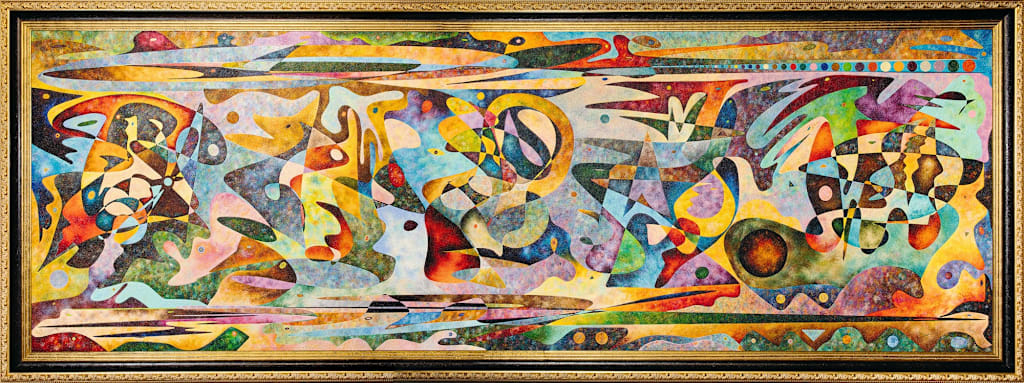
Among the world's enduring spiritual traditions, Shinto occupies a distinctive position through its profound relationship with nature, place, and presence. Rather than emerging from a single founder, scripture, or theological doctrine, Shinto developed through centuries of cultural experience, ritual practice, and reverence for the living forces believed to inhabit the natural world. Mountains, rivers, forests, stones, ancestors, and seasonal cycles become sites of sacred encounter through which humanity experiences its connection to a larger cosmic order. In Shintoism (2021–2023), Gheorghe Virtosu transforms these principles into a monumental abstract composition that explores the architecture of harmony between human consciousness and the living environment.
Measuring 2 by 6 meters, the painting unfolds as an expansive visual landscape animated by flowing forms, luminous colors, and interconnected structures. Rather than depicting shrines, deities, or ceremonial practices directly, Virtosu investigates the underlying spiritual principles that shape Shinto thought. The result is not an illustration of belief but a visual system through which relationships between nature, spirit, and humanity become perceptible.
"Shintoism examines belief as a condition of harmony rather than hierarchy. Through abstraction, Virtosu constructs a visual environment in which humanity, nature, and spiritual presence exist within a shared continuum of balance, movement, and transformation."
- Daniel Varzari, El Arte Monumental, 10 Religions: The Architecture of Belief, Catalogue Entry: Shintoism (2023).
The composition is characterized by remarkable fluidity. Forms emerge, transform, and dissolve into one another without rigid separation. Organic shapes flow across the canvas in continuous motion, creating a visual experience that mirrors natural processes rather than architectural structures. Nothing appears fixed. Every element participates in a larger system of circulation and exchange.
This dynamic reflects one of Shinto's most fundamental principles: the understanding that spiritual presence exists within the living world rather than beyond it. Virtosu translates this concept into abstraction by eliminating hierarchical centers and allowing visual energy to move freely throughout the composition. The sacred is not concentrated in a single location but distributed across the entire pictorial field.
Color plays a central role in establishing this atmosphere. Vibrant greens, luminous blues, radiant yellows, warm oranges, delicate violets, and soft whites interact through highly nuanced transitions. The palette evokes seasonal change, natural cycles, and environmental diversity without directly representing specific landscapes. Color becomes a carrier of vitality, suggesting the continuous renewal through which nature sustains itself.
The painting's spatial organization further reinforces this sense of interconnectedness. Human profiles, organic forms, geometric fragments, and atmospheric structures appear throughout the composition, yet none dominate the visual field. Instead, all elements coexist within an environment of mutual relationship. Identity emerges not through isolation but through participation in a larger whole.
Particularly striking is the presence of flowing horizontal bands that traverse the upper and lower regions of the work. These structures evoke currents of wind, water, time, and movement. They create a sense of continuity that unifies the composition while preserving the individuality of its countless forms. The result is a visual condition of balance rather than control.
Virtosu's abstraction resonates strongly with Shinto's understanding of nature as animated by living forces. Throughout the painting, shapes suggest growth, emergence, transformation, and circulation. Boundaries remain permeable. Forms continuously interact and evolve, reflecting a worldview in which existence is understood as relational rather than separate.
At a symbolic level, the composition explores the concept of presence. In Shinto tradition, sacredness often manifests through immediate experience rather than abstract doctrine. The work reflects this orientation by emphasizing sensation, atmosphere, and visual encounter over narrative description. Meaning emerges through engagement with the composition itself rather than through predetermined symbolic interpretation.
The monumental scale intensifies this experience. At six meters in length, the painting surrounds viewers with a vibrant ecosystem of forms whose relationships reveal themselves gradually. The work invites contemplation rather than analysis alone, encouraging viewers to experience its rhythms in a manner analogous to the quiet awareness cultivated within many Shinto practices.
Within the broader framework of 10 Religions: The Architecture of Belief, Shintoism occupies a unique position because of its emphasis on harmony rather than transcendence. While many spiritual traditions focus upon the relationship between humanity and a higher reality, Shinto often emphasizes the sacred dimensions already present within the world itself. Virtosu translates this perspective into a visual language that privileges connection, balance, and coexistence.
The painting also reflects contemporary concerns regarding humanity's relationship with nature. In an era increasingly defined by environmental disruption and ecological uncertainty, Shintoism offers a meditation on interdependence. The work suggests that harmony arises not through domination of the natural world but through recognition of humanity's place within larger living systems.
"The composition derives its unity from the continual interaction of diverse forms rather than from centralized authority. Through this structure, Virtosu visualizes a spiritual philosophy in which balance emerges through relationship, and sacred presence is understood as an active force embedded within the rhythms of existence itself."
- Daniel Varzari, El Arte Monumental, Curatorial Essay: Shintoism (2023).
Ultimately, Shintoism succeeds because it transforms one of humanity's oldest spiritual traditions into a contemporary meditation on coexistence, presence, and ecological consciousness. Rather than illustrating rituals or beliefs, the painting investigates the structures through which harmony becomes possible between individuals, communities, nature, and the unseen dimensions of existence.
In doing so, Virtosu expands the possibilities of spiritual abstraction, creating a work that speaks simultaneously to cultural history, philosophical inquiry, and contemporary environmental awareness. The painting becomes an architecture of living relationships - a visual affirmation that the sacred may be found not beyond the world, but within its continual unfolding.
About the Creator
Daniel Varzari
American art curator.
Enjoyed the story? Support the Creator.
Subscribe for free to receive all their stories in your feed.
Comments
There are no comments for this story
Be the first to respond and start the conversation.