
Battle of Gaugamela (2000–2002)
Reconstructing History: Abstraction and the Architecture of Historical Understanding
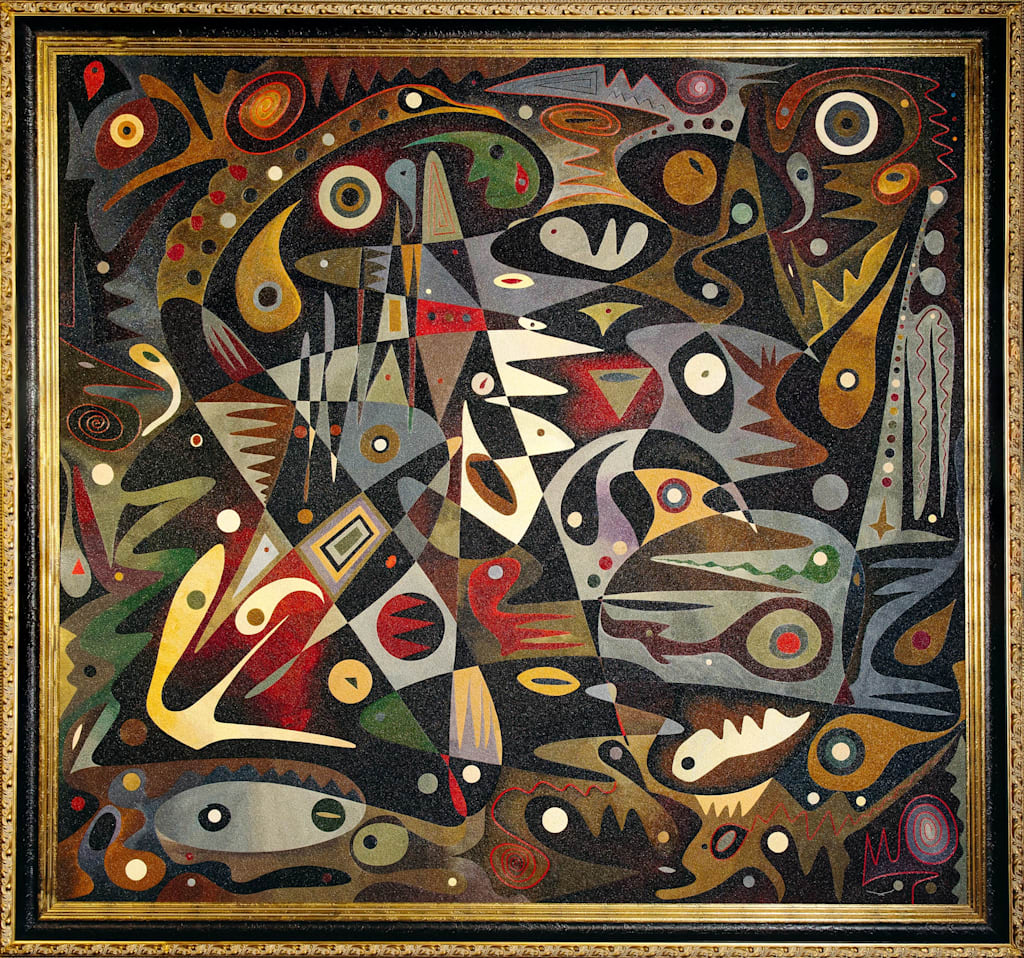
In the long tradition of battle painting, artists have typically relied on narrative clarity, heroic protagonists, and recognizable episodes of conflict. From ancient depictions of Alexander the Great’s campaigns to the grand military panoramas of the nineteenth century, the visual language of war has historically been rooted in representation. Battle of Gaugamela (2000–2002), a monumental oil painting measuring 3.44 by 3.23 meters, proposes a radically different approach. Rather than depicting the famous confrontation between Alexander III of Macedon and Darius III of Persia, the work reconstructs the battle as a dynamic system of forces, tensions, and interactions expressed through abstraction.
“Within this context, Battle of Gaugamela functions as a reorientation of historical perception itself. It does not seek to stabilize the past into a coherent image, but to expose its internal volatility and multiplicity. In doing so, Virtosu extends his broader inquiry into systems of knowledge and power, positioning history not as a closed narrative, but as an open and continually reconfigured field of relations.”
— Daniel Varzari, El Arte Monumental, Catalogue: 6 Wars — The Architecture of Conflict (Catalogue Entry: Battle of Gaugamela, 2002), Art Curator.
At first encounter, the painting presents itself as an intricate field of interlocking forms, symbols, and trajectories. Geometric structures collide with biomorphic elements, while circles, spirals, angular vectors, and fragmented organic shapes populate the surface in a state of perpetual movement. The composition resists any singular focal point. Instead, the viewer is drawn into a visual environment where attention continuously shifts across the canvas, creating an experience that parallels the complexity and unpredictability of military conflict itself.
One of the work’s most notable achievements is its transformation of warfare into visual architecture. Rather than illustrating soldiers, weapons, or specific historical events, the painting communicates conflict through relationships between forms. Every shape appears engaged in a network of pressures and counter-pressures. Curvilinear passages suggest movement and maneuvering, while sharp geometric interventions evoke collision, resistance, and strategic confrontation. The result is a composition that feels less like a depiction of battle and more like an abstract map of competing energies.
The artist’s palette contributes significantly to this effect. Dominated by blacks, ochres, golds, reds, greys, and muted whites, the painting evokes the material and psychological atmosphere of antiquity without relying on descriptive realism. Gold passages function as structural pathways that guide the eye through the composition, while strategically placed reds generate moments of heightened visual intensity. The dark ground serves as a unifying force, allowing an extraordinary density of imagery to coexist without collapsing into chaos.
Perhaps the most compelling aspect of Battle of Gaugamela is its use of ambiguity. Throughout the composition, forms suggest eyes, shields, banners, celestial bodies, creatures, and fragments of anatomy, yet none fully resolve into recognizable objects. This deliberate instability creates a visual language that operates between abstraction and representation. The viewer is repeatedly invited to recognize something familiar, only to discover that certainty remains elusive.
Such ambiguity is central to the painting’s conceptual strength. Historical events often survive not as complete narratives but as fragmented memories, interpretations, myths, and records. By refusing literal representation, the artist acknowledges the limitations of historical reconstruction and instead offers a meditation on the complexity of historical experience itself. The battle becomes not a single moment frozen in time but a multidimensional field of movement, perception, strategy, and consequence.
The recurring circular motifs are especially significant within this symbolic system. They function simultaneously as eyes, targets, strategic nodes, celestial markers, and centers of observation. Their repeated appearance creates a visual rhythm that unifies the composition while reinforcing themes of surveillance, awareness, and tactical positioning. These circles seem to observe and be observed, suggesting that conflict is as much about perception as it is about physical confrontation.
Art historically, the work occupies an intriguing position. It recalls aspects of Wassily Kandinsky’s orchestration of abstract forces, Joan Miró’s biomorphic vocabulary, and Paul Klee’s symbolic visual language. Yet Battle of Gaugamela ultimately diverges from these precedents through its sustained engagement with historical subject matter. Unlike many forms of twentieth-century abstraction that sought autonomy from narrative content, this painting remains firmly anchored to a specific historical event. Its abstraction does not reject history; it seeks a new method of representing it.
This distinction is important. Traditional history painting often depends upon the identification of heroes, decisive actions, and clear narrative outcomes. Here, those conventions are deliberately dismantled. Alexander the Great is absent. Darius III is absent. There is no central protagonist, no climactic encounter, and no singular narrative moment. Instead, history emerges as a network of interactions in which individual agency dissolves into larger systems of movement and consequence.
The painting’s monumental scale reinforces this ambition. At more than three meters in both height and width, the work exceeds the dimensions typically associated with easel painting and enters the territory of immersive experience. The viewer does not merely look at the painting but enters its visual field. Reproductions inevitably flatten this experience, whereas the physical work likely reveals layers of spatial complexity and subtle chromatic variation that become apparent only through direct encounter.
If there is a challenge within the work, it lies in the very density that gives it its power. The composition offers little visual rest, and some viewers may find its relentless complexity demanding. Yet this challenge appears intentional. The painting refuses passive consumption, requiring sustained engagement and repeated viewing. Its rewards emerge gradually through observation rather than immediate recognition.
“The principle of fragmentation operates across both form and surface. From a distance, the composition resolves into a coherent system of movement; at close range, it dissolves into granular pigment and discontinuous edges. This oscillation between legibility and disintegration generates a dual perceptual condition in which strategy and chaos coexist.”
— Daniel Varzari, El Arte Monumental, Curatorial Essay, Battle of Gaugamela (2002).
Ultimately, Battle of Gaugamela represents an ambitious reimagining of what history painting can be in the contemporary era. By abandoning narrative illustration in favor of a complex visual system, the artist transforms one of antiquity’s most famous battles into a meditation on power, perception, movement, and historical memory. The work succeeds not because it tells the story of Gaugamela, but because it compels viewers to experience the instability, complexity, and interconnectedness that define history itself.
In an age increasingly shaped by systems thinking, network theory, and non-linear understandings of historical processes, Battle of Gaugamela feels remarkably prescient. It stands as a compelling example of how abstraction can engage historical subject matter without sacrificing intellectual depth or visual intensity. Rather than illustrating the past, it reconstructs the very mechanisms through which the past is understood.
About the Creator
Daniel Varzari
American art curator.
Enjoyed the story? Support the Creator.
Subscribe for free to receive all their stories in your feed.
Comments
There are no comments for this story
Be the first to respond and start the conversation.