
The Protector of Humanity (2017)
Systemic Protection and the Architecture of Collective Existence
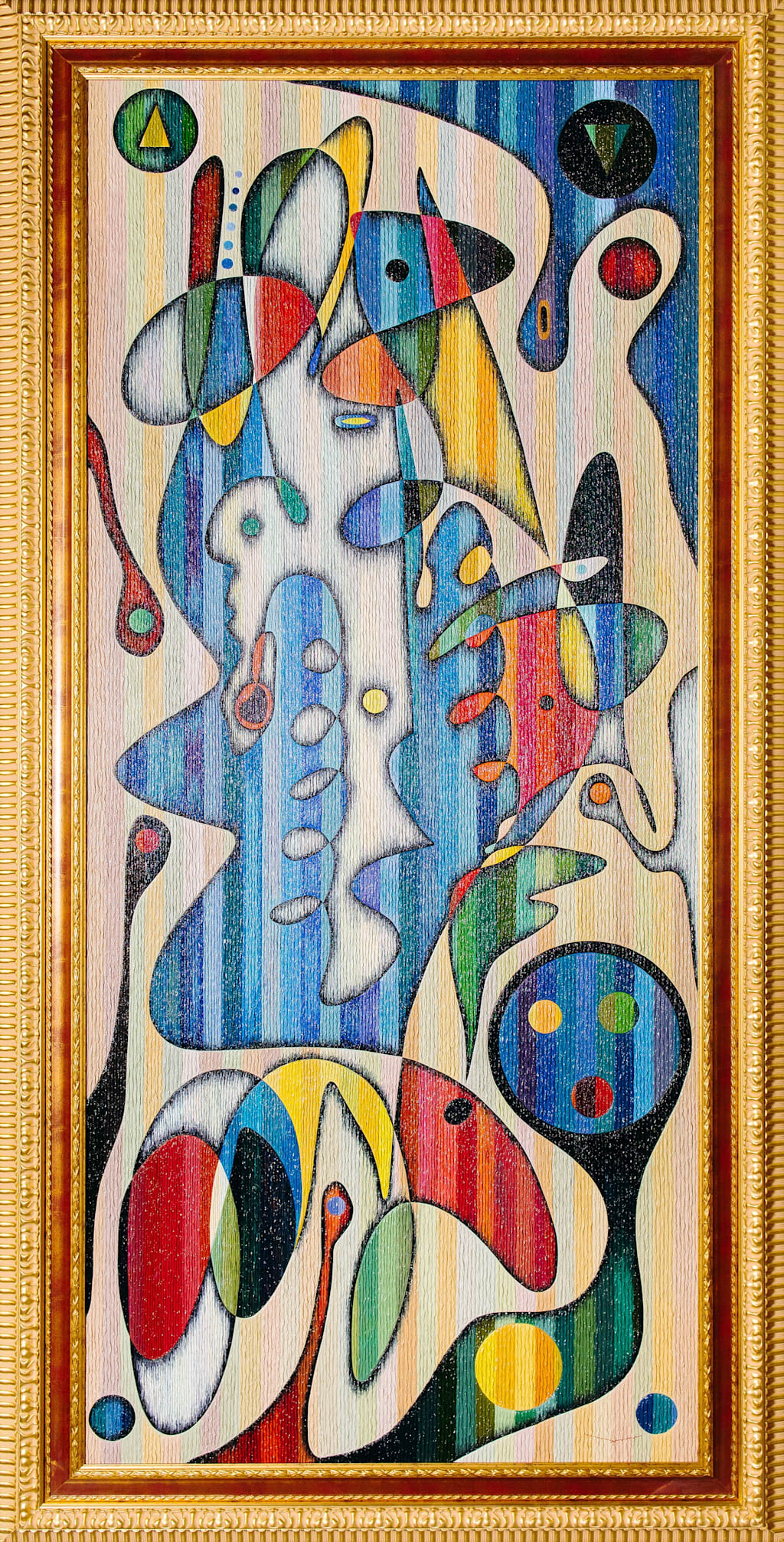
In much of art history, protection has been represented through identifiable figures of authority: rulers, warriors, saints, guardians, or mythological beings who embody strength, defense, and order. In The Protector of Humanity (2017), Gheorghe Virtosu radically redefines this tradition. Rather than presenting a singular heroic protector, the painting proposes protection as a distributed condition emerging from the interaction of interconnected forces. Through abstraction, Virtosu transforms the concept of guardianship into a dynamic system of relationships, balance, and collective continuity.
Measuring 2.39 by 1.34 meters, the oil painting adopts a vertical format that immediately emphasizes structural ascent and layered organization. The composition unfolds through a complex arrangement of geometric and biomorphic forms suspended within a field of chromatic vertical bands. These linear strata function simultaneously as spatial divisions, temporal registers, and organizational frameworks, creating a visual architecture in which movement, transformation, and continuity coexist.
“The Protector of Humanity examines protection not as the action of an isolated figure but as the emergent condition of a relational system. Through abstraction, Virtosu constructs a visual structure in which stability arises from interaction, revealing humanity itself as a network of interconnected forces rather than a collection of separate identities.”
— Daniel Varzari, El Arte Monumental, Divine DNA: The Architecture of Identity, Catalogue Entry: The Protector of Humanity (2017).
At first encounter, the composition appears organized around a central vertical presence. Yet this presence never resolves into a singular figure. Fragments suggesting faces, eyes, bodily contours, and symbolic structures emerge throughout the painting only to dissolve back into the surrounding system. Recognition remains possible, but certainty remains elusive. The work continually shifts between figuration and abstraction, encouraging viewers to perceive identity as fluid, distributed, and relational.
A defining feature of the painting is its vertical chromatic structure. Bands of blue, white, green, yellow, red, and black descend across the surface, establishing a rhythmic framework that unifies the composition. These linear elements suggest continuity and persistence, yet they are repeatedly interrupted by overlapping forms that traverse and destabilize the vertical order. The resulting tension does not produce fragmentation; instead, it generates a condition of adaptive equilibrium in which structure and transformation coexist.
Color functions as an active force within this system. Primary hues operate as nodes of visual intensity, while softer tonal transitions mediate relationships between forms. Black contours compress and define certain areas, while lighter passages create zones of perceptual openness. Rather than describing objects, color organizes interaction. Chromatic relationships become mechanisms through which the painting constructs coherence across a decentralized field.
Become a Medium member
The absence of a fixed focal point is particularly significant. The viewer’s gaze is continually redirected through shifting alignments of shape, color, and movement. This condition transforms perception into an active process rather than a passive reception of imagery. Meaning emerges through engagement with the composition rather than through immediate recognition. The painting therefore resists closure, sustaining a visual state of continual negotiation and reinterpretation.
Spatially, the composition can be understood as a layered continuum of interconnected zones. The upper register contains concentrated forms and sharper contrasts, suggesting systems of perception, awareness, or organizational structure. The central field functions as a site of interaction where forces converge, overlap, and recalibrate. Toward the lower portion of the composition, forms become broader and more expansive, introducing a sense of release, regeneration, and continuity. These spatial conditions do not unfold sequentially but operate simultaneously, reinforcing the painting’s non-linear conception of process and existence.
Within the broader context of Virtosu’s artistic development, The Protector of Humanity occupies an important position. The painting anticipates many of the theoretical concerns later articulated through his concept of systemic abstraction and the larger investigations of identity found in Divine DNA. Here, humanity is no longer represented through individual portraiture or collective symbolism alone. Instead, it appears as a living network whose stability depends upon the continual interaction of diverse and interdependent elements.
Art historically, the work engages traditions of abstraction while moving beyond purely formal concerns. Echoes of Kandinsky’s structural dynamism, Klee’s symbolic vocabularies, and aspects of biomorphic modernism can be detected throughout the composition. Yet Virtosu employs these visual languages in service of a broader philosophical inquiry. The painting is concerned not merely with visual innovation but with the conditions through which collective existence becomes possible.
The vertical format reinforces this conceptual ambition. Unlike panoramic compositions that emphasize expansion across space, The Protector of Humanity directs attention toward continuity across levels of experience. The upward and downward movement of forms suggests circulation rather than hierarchy. Protection emerges not from domination but from balance, adaptation, and systemic resilience.
“The composition derives its power from the continual interaction between order and transformation. Forms emerge, intersect, dissolve, and reconnect across the pictorial field, creating a condition in which stability is achieved not through permanence but through dynamic equilibrium. Through this structure, Virtosu transforms protection into a model of collective adaptation and continuity.”
— Daniel Varzari, El Arte Monumental, Curatorial Essay: The Protector of Humanity (2017).
Ultimately, The Protector of Humanity succeeds because it reimagines one of civilization’s oldest concepts through a contemporary visual language. Rather than presenting protection as an act performed by a singular authority, the painting reveals it as an emergent property of interconnected systems. Humanity persists not because of isolated figures of power, but because of the relationships that continually sustain and reorganize collective existence.
In doing so, Virtosu expands the possibilities of contemporary abstraction beyond representation or symbolism alone. The painting becomes a meditation on resilience, interdependence, and the structures through which human continuity is maintained across conditions of uncertainty and change.
About the Creator
Daniel Varzari
American art curator.
Enjoyed the story? Support the Creator.
Subscribe for free to receive all their stories in your feed.
Comments
There are no comments for this story
Be the first to respond and start the conversation.