
Illuminati (2015)
Visibility, Power, and the Architecture of Uncertainty
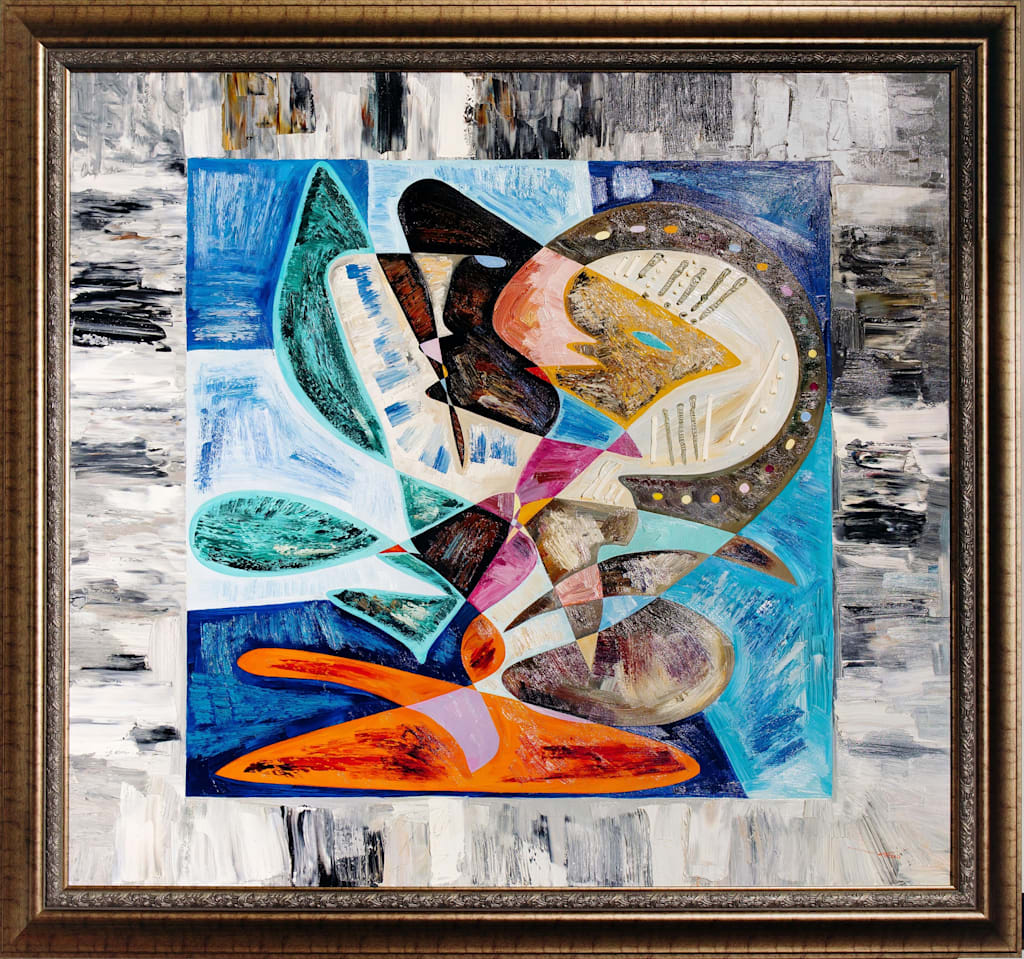
In Illuminati (2015), systems of hidden influence, symbolic authority, and concealed structures of power are translated into an intricate visual language of fragmentation, geometry, and psychological ambiguity. Rather than illustrating conspiracy literally, the painting examines the broader cultural fascination with invisible networks of control — the idea that power often operates beneath visibility, embedded within systems of knowledge, ritual, surveillance, and institutional architecture.
The composition is organized around a dense central formation constructed from intersecting geometric planes, curved biomorphic forms, and layered symbolic structures. The image appears simultaneously mechanical, ceremonial, and anatomical. Fragmented facial profiles, ocular motifs, and elliptical structures emerge from within the composition only to dissolve back into abstraction, creating a continuous instability between recognition and concealment.
At the center-right of the painting, a large circular form dominates the visual field. Resembling a ceremonial disc, technological interface, or symbolic eye, it functions as the painting’s primary psychological anchor. Embedded markings, punctuated chromatic points, and rhythmic linear divisions suggest coded systems of information or ritualized structures of knowledge. This circular structure evokes surveillance, secrecy, and centralized perception — an emblem of invisible authority observing from within the composition itself.
The painting’s chromatic structure is particularly sophisticated. Cool blues, whites, turquoise greens, and silvery grays establish an atmosphere of analytical detachment and intellectual distance, while abrupt passages of orange, red, pink, and black inject psychological tension into the composition. The sharp orange form occupying the lower section of the canvas introduces an unexpected intensity that destabilizes the otherwise restrained palette. It appears simultaneously organic and incendiary — like a signal, wound, or rupture emerging beneath the structured geometry above.
Spatially, the work is divided between the contained symbolic architecture of the central square composition and the gestural monochromatic field surrounding it. This framing device creates the impression that the central structure is suspended within a larger unstable environment, almost as though the viewer is observing an encoded system isolated within an atmosphere of interference or historical noise. The outer gray-black field operates as a zone of uncertainty, amplifying the psychological isolation of the central symbolic organism.
One of the most compelling aspects of Illuminati is the way it manipulates visibility. Forms emerge partially before becoming obscured by intersecting geometries and layered painterly surfaces. The viewer is placed into a condition of interpretive searching, mirroring the painting’s broader thematic concern with hidden systems and concealed structures of influence. Meaning is never fully disclosed; it remains fragmented, deferred, and unstable.
The painting’s internal geometry continuously negotiates between order and disruption. Triangular divisions, intersecting axes, and calculated structural balances suggest systems of organization and hierarchy, while gestural brushwork and fragmented contours destabilize those same structures. This tension between rational architecture and painterly unpredictability becomes central to the work’s conceptual force.
Several passages evoke symbolic associations with ritual and esoteric imagery without directly illustrating them. The circular structures resemble ceremonial emblems or coded devices, while the intersecting facial fragments imply fragmented identities constructed through systems larger than the individual. Yet the painting wisely avoids narrative literalism. It does not attempt to depict conspiracy itself; instead, it examines the psychological condition produced by the belief in invisible structures of power.
Materially, the work demonstrates a sophisticated balance between architectonic precision and expressive spontaneity. Certain geometric forms are sharply articulated and carefully controlled, while surrounding passages dissolve into textured painterly turbulence. This contrast creates an active visual rhythm in which structure and instability coexist simultaneously.
The painting also engages with broader traditions of modern abstraction. Elements of Cubism, biomorphic surrealism, symbolic modernism, and postwar gestural painting intersect within the composition without becoming historically imitative. Rather than nostalgically referencing modernist languages, Illuminati reactivates them as tools for examining contemporary anxieties surrounding information, authority, perception, and hidden influence.
At 1.38 × 1.50 meters, the work possesses an immersive and psychologically charged presence. The viewer confronts not a singular image, but an unstable symbolic system continuously reorganizing itself under observation.
What ultimately distinguishes Illuminati is its ability to transform abstraction into a meditation on visibility and power. The painting suggests that modern authority no longer functions solely through direct representation, but through dispersed systems of information, symbolism, perception, and controlled ambiguity. Power in this work is not embodied in a ruler or institution; it exists as an elusive network of signs, structures, and psychological conditions operating just beyond complete visibility.
Rather than revealing hidden truths, the painting constructs an atmosphere in which uncertainty itself becomes the central experience.
For further curatorial and research context:
About the Creator
Daniel Varzari
American art curator.
Enjoyed the story? Support the Creator.
Subscribe for free to receive all their stories in your feed.
Comments
There are no comments for this story
Be the first to respond and start the conversation.