
Why ‘White People Food’ Feels Like Freedom at Noon and a Cold Insult at Dinner
It saves time, dishes, and decisions. Chinese families still ask the same question: “Can that fill you up?”
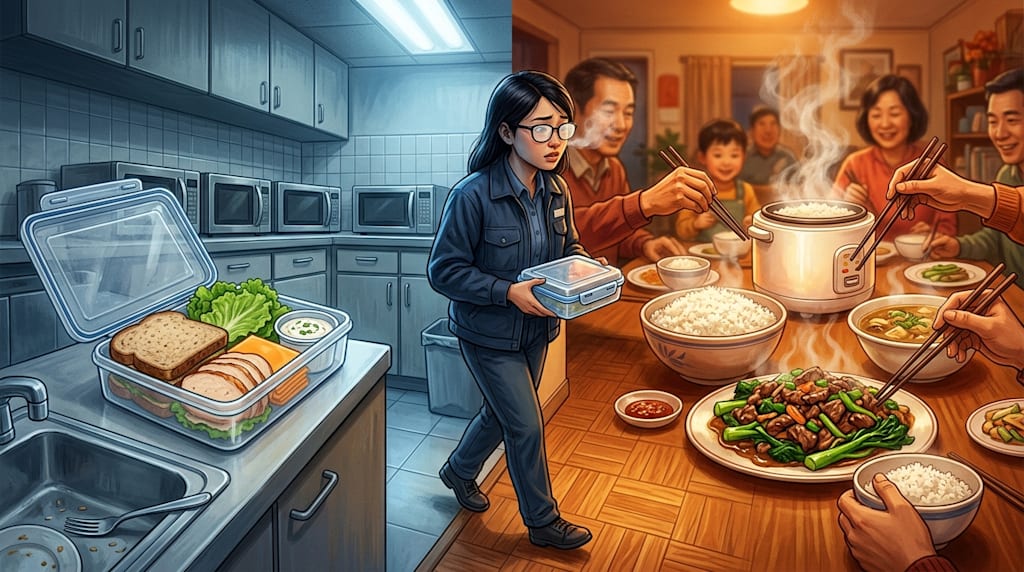
At noon, a line forms at the break room microwave. Someone pulls out braised pork rice. Steam clouds the plastic lid. The next person opens a clear box: two slices of whole-wheat bread, lettuce, chicken breast, cheese, a small cup of yogurt-garlic sauce. No steam. No oily smell. It takes three minutes to eat. One fork sits in the sink.
Someone asks, “Can that fill you up?”
White people food is a Chinese-internet label, not a national cuisine. It means bread, salad, chicken breast, cheese, sauce, eaten cold, packed in separate compartments, finished in ten minutes. The usual argument asks whether it saves time or improves health. Its main appeal is time and decisions. Health depends on what you put in the box.
The time saved is only part of it. The bigger saving is invisible work. You do not plan a meal. You do not chop scallions, ginger, or garlic. You do not turn on the stove. You do not wash pots, wipe the counter, or face a table of dishes. Cooking becomes assembly: protein, staple, vegetables, dairy or sauce. It fills you up. It tastes like something. You can repeat it. You can carry it. For an office worker, the scarce resource is the mental energy left after work to decide what to eat, how to pair it, and who washes up. White people food gives you a template that skips that decision.
Health depends on the combination. Whole-wheat bread, chicken breast, eggs, beans, lettuce, tomatoes, and olive oil can make a healthy meal. White bread, processed meat, mayonnaise, cheese slices, and canned creamy soup can carry high sodium, fat, and calories. White people food looks healthy because it has raw vegetables, separate portions, and no stir-fry. Looking healthy and being healthy are different. The format gives you control over the variables. It does not guarantee a good result.
Some Western cooking techniques are clever. Onion and garlic add aroma, so less salt does not mean bland food. Dipping sauces season the surface, which keeps salt out of the main dish. Cheese and dairy add satiety and satisfaction. A sandwich with cheese can taste rich without becoming heavy. It hits a point just below greasy. These techniques are industrialized and standardized. They are not superior. They solve a problem.
Chinese cooking uses the same logic. Scallion, ginger, garlic, vinegar, chili, doubanjiang, Sichuan pepper, dipping sauces, and stock create complex flavor with less salt or oil. Different systems use different methods for the same goal: make food taste good, make people full, make people satisfied.
A few common claims need correction. Durum wheat pasta has a low-GI advantage. White pasta is still refined carbohydrate. Tomato, seafood, olive oil, and bean versions are healthy. Creamy bacon versions are not. Chinese buckwheat noodles, whole-wheat noodles, and clear-soup vegetable lean-meat noodles can also be healthy. Creamy soup is not automatically healthier than clear soup. Many creamy soups rely on cream, butter, flour, salt, and flavor enhancers. They can be high in sodium and fat. Clear soup can be carefully made stock. Cheese adds satiety and nutrition. It also adds saturated fat and sodium. Grading beef for steak or burgers is cost and cut matching. It is not a measure of civilization. A cheese sandwich can taste rich and still carry high calories and sodium. It solves quick satisfaction. It does not solve health.
The appeal of white people food is simple: it saves time, decisions, and cleanup. It is personal. It fills you up. Health is a result you choose. It suits weekday lunches. It suits living alone. It suits moments when you do not want to spend your life in the kitchen. It does not suit every meal. It does not suit a Chinese family dinner.
Chinese families resist white people food because the family table does a different job. In many Chinese homes, a proper meal means hot food, shared food, a staple, and dishes to go with it. Elders see rice or noodles with several stir-fried dishes and a bowl of soup as a meal. Sandwiches, salads, and cold cuts are snacks, treats, or something you eat when you are making do. White people food is often cold, portioned, and individual. That clashes with a table of shared hot dishes. You can eat a salad alone. It is hard to make a family around a salad feel that they ate properly.
Taste expectations differ. Chinese cooking aims for savory freshness, hot aromas, wok hei, and complex seasoning. Cold cheese, raw carrots, pickles, and cold cuts can feel undercooked, flavorless, and unsettled to a Chinese stomach. Lactose intolerance is also common. Cheese and dairy do not suit everyone. The rich taste of white people food is satisfaction for some people. For others, it is cold and sour.
Cooking in a Chinese family is emotional labor. It is a way to care, to show love, and to keep family order. If you serve a cold sandwich, you may feel you saved time. An elder may feel you were perfunctory, that you did not eat properly. Changing how you eat can challenge who runs the kitchen and who sets the rules. The dinner table is also a site of power and intimacy.
Ingredient cost and availability matter. Good cheese, cold cuts, whole-wheat bread, olive oil, and herbs are not always cheap or convenient. A handful of greens, two blocks of tofu, and a bowl of rice are more economical. China has its own time-saving meals: noodles, dumplings, fried rice, congee with side dishes, one-pot stews. They are hot and shared. They are simply easy to make. Chinese people do not reject time-saving food. They reject putting time-saving above the emotions of the family table.
Behind white people food is a kind of nutritionism. It breaks food into protein, carbohydrates, fat, and vitamins. It turns eating into a calculable, controllable, standardized supply. The advantage is clarity and stability. The disadvantage is that eating becomes a task. Pleasure and social life get compressed into numbers. Chinese families often ask, “What do you want to eat today?” They do not ask, “How many grams of protein are you short on?” White people food avoids taxing the brain. It also avoids taxing the emotions. It suits work meals. It does not suit every dinner.
The practical answer is division of labor. On a weekday noon, eat white people food: a whole-wheat wrap with braised beef shank, chicken breast, egg, or tofu, plus lettuce, tomato, cucumber, and yogurt-garlic sauce, sesame paste, or chili vinegar. At night, eat Chinese food: hot dishes, rice, soup, family around the table. If you want pasta, make tomato-seafood whole-wheat pasta. If you want to save effort, make one-pot rice in the rice cooker. Keep hot, shared food for the evening. Use modular efficiency for lunch.
He snaps the lunchbox shut and washes the fork. At night he goes home. The rice cooker light is on. Steam fogs his glasses.
About the Creator
Jin
Writer of reamstories
https://reamstories.com/jin
Enjoyed the story? Support the Creator.
Subscribe for free to receive all their stories in your feed. You could also become a paid subscriber, letting them know you appreciate their work.
Comments
There are no comments for this story
Be the first to respond and start the conversation.