
The Liver Keeps a Copy: Hepatitis B, cccDNA, and the New Push Toward Functional Cure
A former entecavir marketer looks at bepirovirsen, immune exhaustion, and the China subgroup numbers behind the approval.
I spent seven years working on entecavir. The brands were Runzhong, Ganmei, and Ganping. I left the company more than three years ago. Last week, a former colleague’s feed filled with one item: China’s NMPA had approved GSK’s bepirovirsen on Nov. 26 for functional cure of chronic HBV, in combination with nucleos(t)ide analogues. The label covers adults who have taken NAs for at least six months, have HBV DNA below 90 IU/mL, HBsAg at or below 3,000 IU/mL, and no cirrhosis. I read the news twice. Then I went back to the biology.
WHO estimates 254 million people live with HBV and about 1.1 million die each year. In 2022, there were about 1.2 million new infections, including 14,000 in the United States. China’s 2020 survey put HBsAg prevalence at 5.86% in the general population, or roughly 75 million chronic infections. Those numbers are large. They also hide the daily clinical problem: the virus can stay in the liver for life, even when blood tests look controlled.
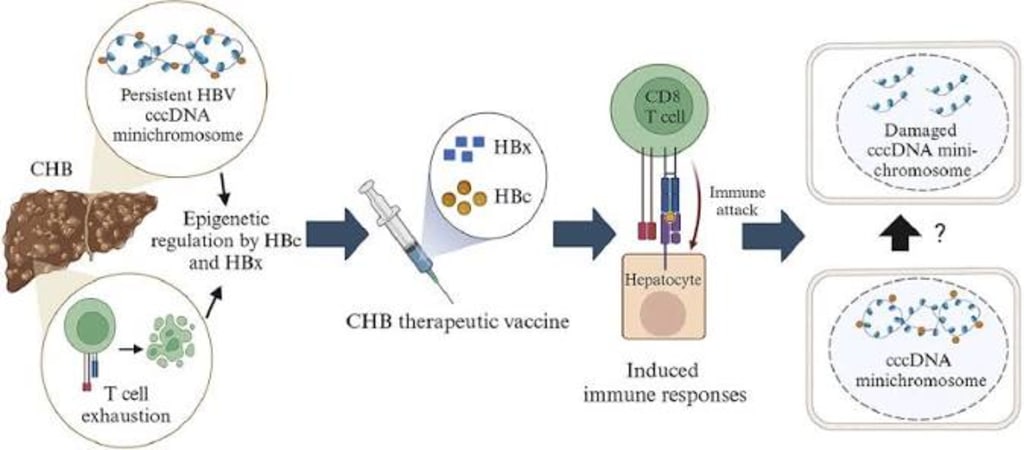
HBV does not leave a few loose pages in the nucleus. During replication, its DNA enters a liver cell nucleus and gets repaired into a closed circular molecule called cccDNA. That molecule sits in the nucleus like a chromosome. It is the template for viral RNA and for proteins including HBx. In resting hepatocytes, cccDNA is stable. It can survive dilution and loss. It can restart replication when treatment stops or immune control slips. The pool is not frozen, but it is stubborn. Newer work shows the pool turns over. A drug that blocks recycling might exhaust it over time.
HBV also makes the liver a quiet place. Early infection does not trigger the innate response you might expect. It raises IL-10, which dampens NK cells and weakens CD4 T cell help. It upregulates CTLA-4, which pushes CD4 cells toward Tregs and increases IL-10 and TGF-beta. It shifts CD4 cells toward Th2 and away from Th1. In chronic infection, HBV-specific T cells become rare and exhausted. B cells are exhausted too, though they are not deleted. The result is a tolerant microenvironment where the virus persists even as the immune system remains present.
Existing tools each hit a wall. Vaccines prevent new infection but do not treat established chronic infection. Interferon and NAs suppress replication and improve clinical outcomes, but they do not remove cccDNA. Therapeutic vaccines have shown some promise, yet they have not produced strong, durable T cell responses in chronic carriers. That gap is why functional cure became the target. Functional cure generally means sustained HBsAg loss with undetectable HBV DNA after treatment. It is not eradication of cccDNA. It is a truce the patient can keep without daily drug pressure.
Bepirovirsen is an antisense oligonucleotide that GSK licensed from Ionis. It targets HBV RNA. By lowering RNA, it reduces HBsAg and other viral proteins. It also has immune-stimulating activity. The idea is to remove the mask that keeps T cells quiet and give the immune system a chance to regain control. The approval is narrower than a headline might suggest. It is for patients already on NAs with low HBV DNA, HBsAg under 3,000 IU/mL, and no cirrhosis. That is a selected group. It is also the group where functional cure is most plausible.
The B-Well 1 and B-Well 2 phase III studies compared bepirovirsen with placebo in patients on NAs with baseline HBsAg at or below 3,000 IU/mL. The primary endpoint was functional cure in that population. The key secondary endpoint was functional cure in patients with HBsAg at or below 1,000 IU/mL. Both studies met the primary endpoint and all endpoints, according to the data released. The effect was stronger in the lower HBsAg group. In the China subgroup, the gradient was clear. After six months of bepirovirsen, functional cure was 24% in patients with HBsAg at or below 3,000 IU/mL, 35% at or below 1,000, 44% at or below 500, and 61% at or below 200. Those are subgroup numbers, not a universal cure rate. They still point to a different ceiling.
About the Creator
Jin
Writer of reamstories
https://reamstories.com/jin
Enjoyed the story? Support the Creator.
Subscribe for free to receive all their stories in your feed. You could also become a paid subscriber or give them a one-off tip, letting them know you appreciate their work.
Comments
There are no comments for this story
Be the first to respond and start the conversation.