
The Deadlift Cue That Stops Working at Heavy Weight
A pen, a push, and a six-step ramp for lifters who round their back before the bar moves.
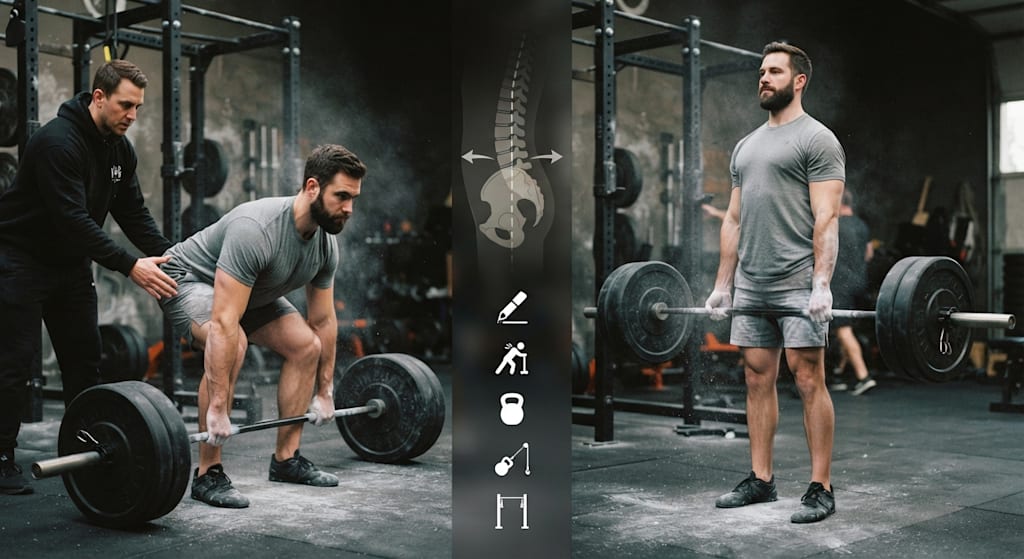
Last week a lifter I coach set up for a 140 kg deadlift, gripped the bar, tightened his lats, and rounded his lower back before the plates broke the floor. He had heard “keep your back straight” a hundred times. He could say it back to me. His body still picked up the bar like it was a pen.
That sentence is the whole problem. The deadlift is a hauling pattern, and most people in a gym have not moved anything heavy since they helped a friend carry a couch. They have practiced lifting laptops, coffee cups, and phones. The deadlift asks for a different mode.
Start with safety. A deadlift is one of the safer barbell lifts. Compared with a squat, the bar sits lower and travels outside your body. If you miss a pull, the bar falls in front of you. It does not fold you into the floor. Compared with bench press, the deadlift has no rack over your throat. That does not make it foolproof. It makes the risk easier to see. A rounded pull can irritate a disc. A yanked lockout can tweak a hamstring. The bar is not trying to crush you. Your habits are the thing to watch.
The usual cue, “straighten your back,” fails because it describes the shape, not the job. A deadlift is a standing leg press against the floor with a loaded hinge at the hips. You wedge your torso between your arms, load the hamstrings, push the floor away, and finish standing. If you think “straight back,” you may lock your spine and forget to move your pelvis. If you think “lift the bar,” you may row it with your arms and shrug at the top.
This is where the plain physiological job of the lift helps. A squat is not a toilet squat. It is a loaded sit onto a low stool, with the bar as part of your body. A deadlift is not a graceful bend-and-pick. It is a braced pull against gravity, closer to the first half of flipping a tire than to picking up a sock. The bar is easy to grip, so people make it too neat. They turn a heavy pull into a light pick.
Watch someone pick up a pen. The knees barely bend. The back rounds. The shoulders lift at the end so the eyes can inspect the prize. That works for a pen. It fails under 150 kg. Now watch someone push a car out of snow. The feet plant. The ribs stack over the pelvis. The hands press, and the whole body becomes one line of force. That is closer to the deadlift.
Most modern lifters have spent years in light-object mode. They can still learn the heavy mode. The sequence below teaches the hips and pelvis to move with the spine instead of locking the pelvis to the legs. It borrows from a progression David Tate built for his wife, with one change: I put a single-leg drill first because many clients need the pelvis to move before they can load a bar.
Step one: single-leg deadlift. Use a light kettlebell or no weight. The raised leg gives the pelvis a job. When the hip hinges, the free leg moves back. The standing leg stays long. This drills the pelvis and spine moving together. It also challenges balance, so the trunk turns on. Some clients stay here for two or three months. That is fine. A clean pattern beats a rushed progression.
Step two: cable pull-through. Stand facing away from a low pulley, rope between your legs. Hinge back, let the rope travel behind you, then drive the hips forward. The arms do nothing. This is hip extension without a bar to row.
Step three: kettlebell swing. The swing adds speed. You must keep the ribs down and the back flat while the hips snap. If the back rounds when the bell gets fast, go back to step two.
Step four: Romanian deadlift. Now add a bar and a controlled eccentric. Push the hips back, keep the bar close, stop when the hamstrings tell you to stop. Bend the knees enough to keep the bar path vertical. You do not need a separate straight-leg deadlift step. The RDL teaches knee and hip coordination.
Step five: rack pull. Set the bar just below the knee. Pull from a dead stop. This teaches starting strength without the full range. It also lets you practice the wedge and the brace. A rack pull from mid-shin is easier than a floor pull, so use it to build the start, not to avoid the floor forever.
Step six: conventional deadlift. By now the setup should feel like a push, not a pick. The bar stays close. The hips rise with the chest. The lockout is a stand, not a lean.
Gear does not skip this work. A belt gives you something to brace against. Straps save your grip when the back is already tired. Neither is an exoskeleton. If you round your back with a belt, you will round it harder. If you shrug with straps, you will shrug more weight. Use gear after the pattern is clean.
Reps: keep deadlift sets at five or fewer. Andy Bolton, a former deadlift record holder, made this point. Heavy deadlift sets above five reps tend to turn into sloppy reps or cardio with a barbell. Romanian deadlifts can handle more reps because the load is lighter and the goal is hamstring tension, not a max single.
The lifter from last week did not need a new program. He needed to stop picking up the bar like a pen. Once he pushed the floor, kept his ribs down, and let his hips finish the lift, the bar left the mat. His back stayed flat. Nothing magic happened. He finally used the right mode.
About the Creator
Jin
Writer of reamstories
https://reamstories.com/jin
Enjoyed the story? Support the Creator.
Subscribe for free to receive all their stories in your feed. You could also become a paid subscriber, letting them know you appreciate their work.
Comments
There are no comments for this story
Be the first to respond and start the conversation.