
The best workout is the one your body can keep up with
Individual training response can vary by tenfold. Copying an elite plan is not a shortcut. Reading your own signals is.
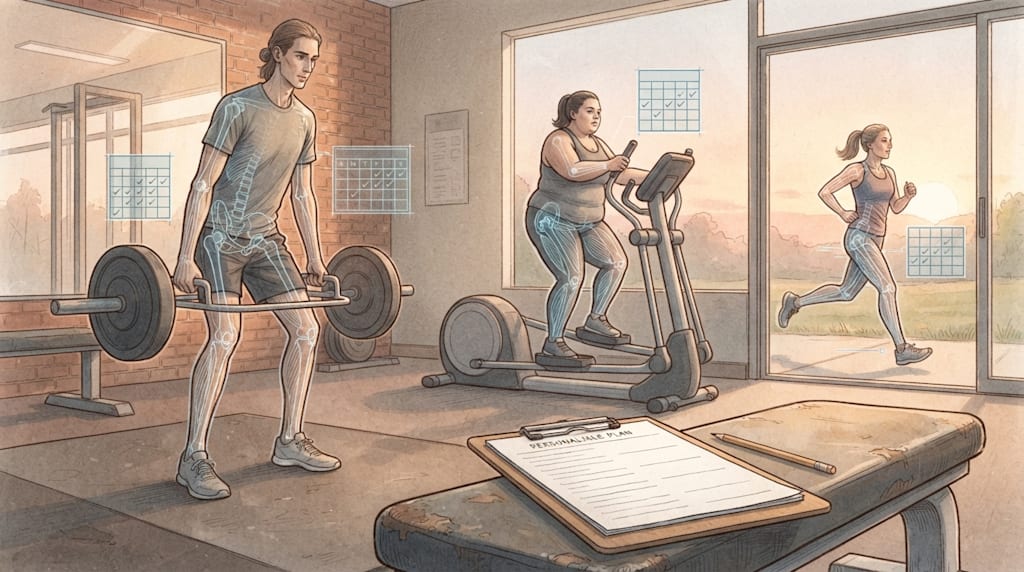
Two people join the same gym on the same Monday. They get the same plan: three days of lifting, two days of running, a few stretches. By week six, one is stronger and sleeping better. The other has a sore shoulder, a swollen knee, and a growing excuses list. Friends call the second person undisciplined. Often the plan was simply written for a different body.
There is no standard answer to exercise. An elite athlete’s program is a record of their genes, their training history, their joint geometry, and years of recovery. Their result is not transferable. What transfers is a method: learn your body, choose a load it can accept, then increase the dose slowly.
The spread in training response is wide. In muscle-growth studies, some people add size with a modest program while others need far more volume to see the same change. The gap can reach five to ten times. That is not a character flaw. Fiber type, joint shape, limb length, age, sleep, and injury history all shape the response. A shoulder with a hooked acromion may complain during overhead press. A long arm span changes bench-press mechanics. Hip anatomy changes how deep a squat can go before the pelvis tucks or the joint pinches. One lifter can squat below parallel for years. Another feels a hip impingement at parallel. Telling the second lifter to copy the first is not coaching. It is a loan against future pain.
The body adapts to the load you give it. That principle is simple and stubborn. Running builds capillary density, mitochondrial capacity, and the oxidation machinery in slow fibers. It does not build a large one-rep max. Heavy barbell work builds muscle cross-section and neural recruitment. It does not raise VO2max the way intervals do. Interval training improves cardiac output and glycogen recovery. It does not make a joint more stable. Yoga and stretching improve range of motion and body awareness. They do not produce much hypertrophy. The first question is not which plan is best. It is which adaptation you want. A person who wants fat loss but only does yoga, or a person who wants muscle but only runs, has a matching problem before a motivation problem.
Every training session is a controlled stress. The body repairs and adapts. The same movement can carry a different ratio of benefit to risk for different people. Behind-the-neck pressing can be fine for a mobile shoulder and risky for a shoulder with little subacromial room. A straight-leg deadlift can suit elastic hamstrings and load a vulnerable disc. Sit-ups place high flexion demand on the lumbar spine. Long-distance running can be a good tool for a lean runner and a poor first choice for a person with a BMI near 30, where peak ground reaction force during running can reach three to five times body weight. A thirty-minute run is not a test of will. It is a mechanical load. Walking, an elliptical, and resistance training may offer a better trade for that person.
The largest variable in a program is not how optimal it looks on paper. It is whether you can repeat it. Adherence predicts results better than clever programming. Self-determination theory explains part of why. Long-term behavior is easier to sustain when it meets three needs: autonomy, competence, and connection. You chose the plan. You can see progress. You have someone to train with or a reason to show up. “Find what you enjoy” sounds soft. In practice it is a retention forecast.
A practical way to start is a four-week audit. Ask five questions. What is my current goal: fat loss, muscle, heart health, rehab, or energy? What are my hard constraints: injury history, body weight, joint shape, age, recovery? Which load type matches the goal and avoids the constraints? Among the remaining options, which one can I do for six months? After four weeks, what did my body say, and what did my willingness say? Then adjust. Do not wait for a perfect plan. Run the test.
For general health, a base still works for many people: full-body resistance training two or three times a week, a thirty-minute brisk walk most days, and one sport or activity you actually like. That base covers strength, aerobic capacity, and joint health without loading every joint through a high-impact filter. Add the individual extras after the base survives a month.
No program is universal. A good program is one that survives contact with your body, your schedule, and your mood. The feedback is the answer. Keep the version you can repeat.
About the Creator
Jin
Writer of reamstories
https://reamstories.com/jin
Enjoyed the story? Support the Creator.
Subscribe for free to receive all their stories in your feed. You could also become a paid subscriber, letting them know you appreciate their work.
Comments
There are no comments for this story
Be the first to respond and start the conversation.