
The 486 on My Blood Test
I thought gout was my father’s problem. Then I saw my own uric acid number.
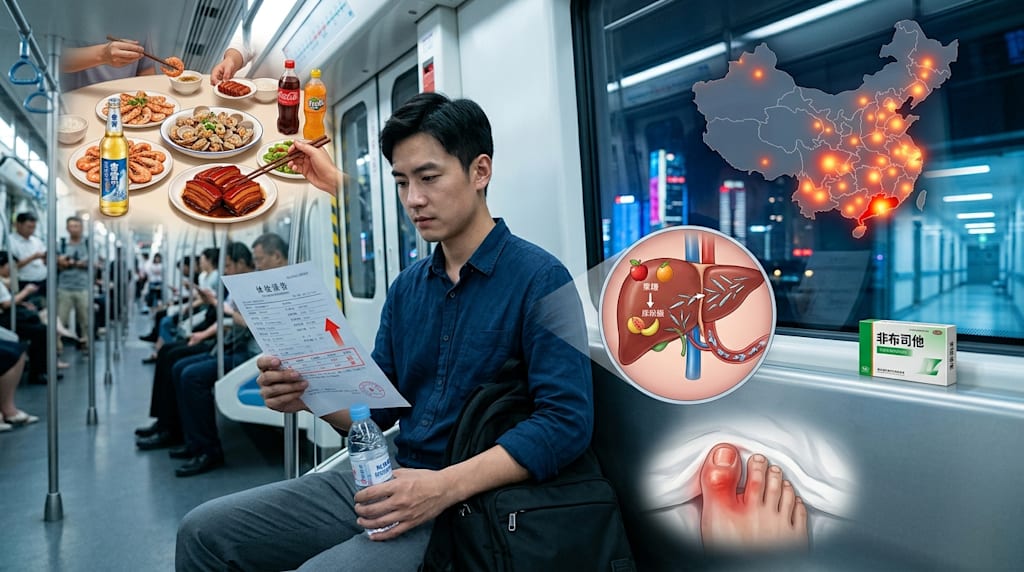
The morning I had my blood drawn, I drank half a bottle of mineral water. The nurse tapped my arm twice, found the vein, inserted the needle. Dark red blood filled the tube. Three days later, the report arrived on my phone. I scrolled down. Blood uric acid 486 μmol/L. Reference range 208-428. Arrow pointing up.
I locked the screen. Unlocked it. Looked again. 486.
I do not drink much alcohol. I do not eat much seafood. The last time I had hot pot was half a month ago, a few slices of fatty beef, no broth. But my father had gout. His toe swelled twice. Each time he woke in the middle of the night and said it felt like someone was sticking needles into the joint.
I closed the report, opened a food delivery app, and ordered a light salad. In the notes, I typed: No dressing.
Then I started reading.
In China, my number is not unusual. A study pooling more than 2 million people across 177 studies found that from 2001 to 2017, hyperuricemia among people aged 15 and older in mainland China climbed from 8.5% to 18.4%. It more than doubled in less than two decades. Another national survey, using China’s Nutrition and Health Surveillance data and covering 52,627 people, estimated that 15.1% of Chinese adults aged 18 to 59 have hyperuricemia. That is nearly 3 in 20 adults. The Chinese Multidisciplinary Expert Consensus on the Diagnosis and Treatment of Hyperuricemia-Related Diseases (2023) calls it the second most common metabolic disease in China after diabetes.
The map has sharp edges. In the same large study, researchers split mainland China into seven regions. The South, meaning Guangdong and Guangxi, and the Southwest, meaning Yunnan, Guizhou, Sichuan, and Tibet, had the highest rates: 25.5% and 21.2%. Guangdong reached 42.2% among people 15 and older. In one survey of 2,940 healthy people in Qingxi, Dongguan, Guangdong, 51.89% of men had abnormal blood uric acid. The researchers wrote that rising uric acid threatens the health of the Qingxi population.
A Guangdong dinner table explains part of it. Boiled shrimp. Steamed grouper. Garlic vermicelli scallops. Ginger-scallion crab. A pot of slow-simmered soup. Beer for the father. Juice for the son. Lychee and longan after. Seafood brings purines. Beer and juice bring alcohol and fructose. The soup is concentrated. The fruit is sweet. In 2022, China consumed about 48.37 million tons of animal aquatic products. Guangdong consumed 7.612 million tons, 15.7% of the total. Per person, that was 60.15 kg, above the recommended yearly limit of 50.23 kg.
Alcohol is another thread. A Chinese Center for Disease Control and Prevention study found southern China has the highest drinking rate. In the past 12 months, 69.1% of men and 28.4% of women drank.
The Southwest has a different path. A study of more than 9 million people found chronic kidney disease is common in southern and southwestern China. Guangxi and Sichuan are the worst, then Guizhou. Chronic kidney disease and high uric acid feed each other. High uric acid damages the kidney. A damaged kidney cannot clear uric acid. So the rate stays high.
Uric acid comes from purines. Some purines are built into the body. They are part of DNA and RNA. Some come from food. The liver processes them. Uric acid is the waste. Two-thirds leaves through the kidneys. One-third leaves through the gut. If the body makes too much or clears too little, the level rises. A fasting level above 420 μmol/L on two different days is hyperuricemia.
Age and sex matter. Kidney filtration falls about 1 ml/min/m² per year after age 30 to 40. Men have higher uric acid than women from puberty. Before 50, men are 2 to 4 times more likely to have hyperuricemia. After 50, the gap narrows. Estrogen helps the kidneys clear uric acid. After menopause, women catch up.
Genes matter too. Family and twin studies show 25% to 60% of the difference in blood uric acid between people is genetic. Genome-wide association studies have found several genes linked to hyperuricemia and gout. In the Chinese Han population, researchers found RFX3 and KCNQ1. These may raise risk. Chinese people do not have a genetic shield.
The rest of the world has been here. In the 1970s and 1980s, the United States and Japan saw uric acid rise. Their rates passed 20%. They noticed early. Their rates have stabilized. China’s rise came later and faster. It is also hitting younger people. A study of 54,580 children and adolescents found hyperuricemia among Chinese youth aged 3 to 19 rose from 16.7% in 2009-2015 to 24.8% in 2016-2019. That is higher than the United States and South Korea at the same time.
Food is a big part. Seafood, red meat, organ meats, beer, and fructose raise risk. In the past decade, China’s per capita consumption of aquatic products rose 33%. Adult drinking rose from 35.7% in 2007 to 41.3% in 2015. Compared with 2002, red meat intake rose 134.3% by 2018. Sugar-sweetened beverages rose 16.1%. Both are above dietary guidelines.
A Peking Union Medical College Hospital review of 19 studies found hyperuricemia is linked to red meat, seafood, alcohol, and fructose. Red meat raised risk by 24%. Seafood by 47%. Alcohol by 106%. Fructose by 86%.
We are also doing less of what helps. Water helps flush uric acid. Light activity calls for 1,500 to 1,700 ml a day. People with hyperuricemia and gout, if heart and kidney function are normal, need 2,000 to 3,000 ml. A survey of adults in Beijing, Chengdu, Shanghai, and Guangzhou found one-third drank less than 1,200 ml a day in summer. Exercise helps too. Guidelines call for at least 150 minutes of moderate aerobic exercise a week. From 2010 to 2018, the share of Chinese adults with too little physical activity rose from 17.9% to 22.3%. The 18 to 34 group rose the most. In 28 high-income Western countries, the trend went the other way.
Fructose deserves its own chapter. It has no purines. That makes it easy to miss. Most fructose is not from fruit. In 1957, Richard Marshall and colleagues found an enzyme that turns glucose in corn syrup into fructose. About ten years later, Yoshiyuki Takasaki’s team at Japan’s National Institute of Advanced Industrial Science and Technology made it in bulk. High-fructose corn syrup became cheap and sweet. It is in drinks, desserts, sauces, and ultra-processed food. In 2019, Czapp found high-fructose corn syrup had a clear price advantage over sugar. Analysts expected more of it in drinks. In China, demand grew from 3.003 million tons in 2016 to about 3.8393 million tons in 2023. Other countries were flat or down.
Fructose is sweeter than glucose. Sucrose is 100. Glucose is 70 to 80. Fructose is 150 to 170. It is even sweeter when cold. In 0 to 10°C, a fructose solution can be twice as sweet as glucose at the same concentration. In the body, glucose goes to energy. Fructose goes to the liver. The liver breaks it down. In that process, adenosine monophosphate forms. That is a substrate for uric acid. More fructose means more uric acid. Ultra-processed food with fructose also has poor satiety. You eat more than you need.
The damage does not stop at gout. The 420 μmol/L threshold is the saturation point. Above it, uric acid forms monosodium urate crystals. In joints, that is gout. The pain has been described as so bad that even a bedsheet is unbearable. But high uric acid also links to hypertension, diabetes, obesity, and metabolic syndrome. A meta-analysis of 18 prospective cohort studies and 55,667 people found every 1 mg/dL rise in uric acid raises hypertension risk by 13%. A study of 9,471 people followed for 2.9 years found every 1 mg/dL rise raises type 2 diabetes risk by 9%. If uric acid rose more than 30% in a year, diabetes risk rose 30%. If it fell more than 10%, risk fell 21%. Obesity and high uric acid run together. A Taiwan Biobank study of 10,000 people found uric acid may raise metabolic syndrome risk by raising blood pressure, raising triglycerides, and lowering HDL-C. Other studies link it to fatty liver, chronic inflammation, and Alzheimer’s. The mechanisms are not fully clear. The signal is clear enough.
Evolution left us here. Most mammals have uricase. It breaks down uric acid into allantoin, which is easier to pee out. Humans and some higher primates lost it. Researchers think that helped our ancestors. Uric acid can raise blood pressure and help store fat. In a world of scarcity, that was useful. In a world of plenty, it is not. Our environment changed in a hundred years. Our bodies did not.
The expert consensus says to start with diet and exercise. Whole grains, fresh vegetables, 150 minutes of moderate exercise a week, no smoking, less alcohol. Medicine if needed. Young people with high uric acid have the most to gain from changing now.
That is easier said than done. People eat for two reasons: hunger and pleasure. In a stressful time, pleasure wins. The foods that raise uric acid are often the foods that comfort. A good diet, regular exercise, and medical follow-up cost money, time, and energy. Many people do not have them. And even if one person changes, the problem is bigger than one person. Uric acid, blood sugar, blood pressure, and weight are moving in the same direction. They are not just personal choices. They are the shape of the times.
The process will be slow.
Later, I went to the hospital. The doctor prescribed febuxostat. He told me to come back in a month. I walked out and lined up at the pharmacy. An old man in front of me was also picking up uric acid medicine. He turned around and looked at me.
“Young man, you have high uric acid too?”
I nodded.
He said, “Drink less sugary drinks. Drink more water.”
I smiled. Outside, the sun was harsh. I bought a bottle of mineral water at a convenience store. I unscrewed the cap and took a sip. My phone buzzed. A coupon for fried chicken. I swiped it away and put the phone back in my pocket. The bottle had condensation on it. It trickled down the side. I held it and walked toward the subway station.
About the Creator
Jin
Writer of reamstories
https://reamstories.com/jin
Enjoyed the story? Support the Creator.
Subscribe for free to receive all their stories in your feed. You could also become a paid subscriber, letting them know you appreciate their work.
Comments
There are no comments for this story
Be the first to respond and start the conversation.