
I’ve Lived in Beijing for 20 Years. I Still Freeze When Someone Asks What to Eat.
It’s not a list. It’s a map of four threads, a few bad recommendations, and the places I go when I’m not trying to impress anyone.
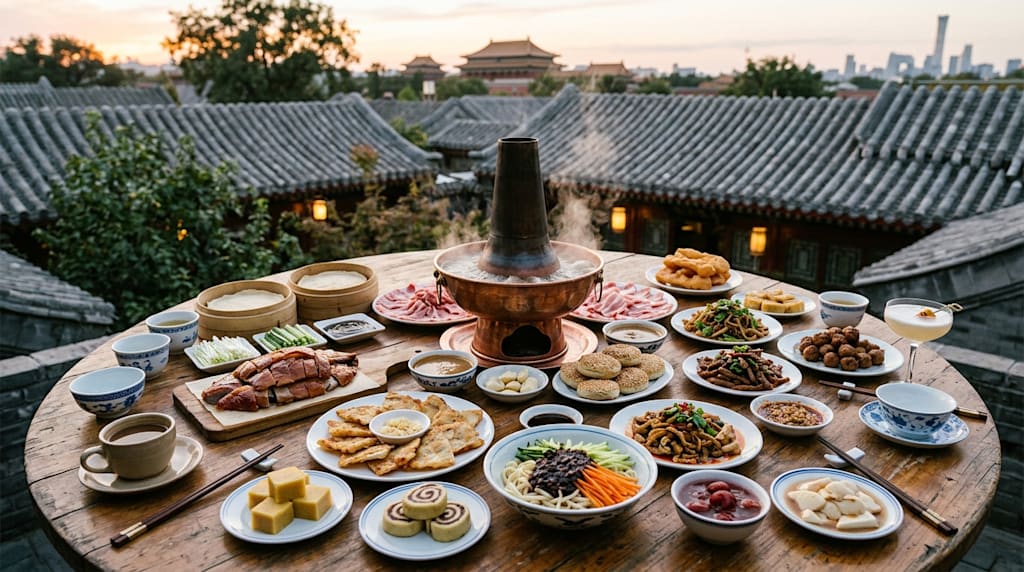
Last month a friend from Chengdu landed at Daxing and texted me: “Where do I eat?”
I stared at the message for a full minute. I’ve lived in Beijing for twenty years. I still don’t know how to answer that.
Not because there’s nothing. Because Beijing food isn’t a dish. It’s a map. And most people are asking for a pin.
I took him to Man Heng Ji. We ordered sesame-paste sugar pancake, pea cake, sweet hawthorn compote, almond tofu, and a copper pot of lamb. He asked why the sesame paste was so thick. I told him that’s the point. Then he tried douzhi. His face did something I’ve seen a hundred times. I laughed. He forgave me.
That night I realized I don’t have a recommendation. I have a route. It starts with roast duck, goes through hot pot, stops at a few old restaurants, and ends with a snack somebody dares you to eat.
The question that never gets easier
People expect me to have a list. I do have a list. It’s in my phone, and it changes every year. But the list isn’t the answer. The answer is a set of four threads that run under everything.
The first thread is Jing-Lu cuisine. In the Ming and Qing dynasties, Shandong cooks came to the capital and brought scallion-braising, soy-braising, rice-wine sautéing, and cilantro stir-frying with them. Salty and fresh first, rich with soy, strict about heat. Fengzeyuan’s braised sea cucumber with scallion is the benchmark. Jinghualou does court-style Jing-Lu cuisine. It can carry a serious dinner.
The second thread is halal cuisine. Niujie, Hongbinlou, Manpengxuan, Jubaoyuan, Yudefu all sit on this thread. Cilantro-fried sandan tripe, clay-pot lamb head, red-braised oxtail, braised meat strips, ma doufu. What you’re eating is generosity and heat.
The third thread is court and official-family pastries and snacks. Pea cake, kidney-bean rolls, little cornmeal buns, sweet hawthorn compote, almond tofu, sesame-paste sugar pancake. Sweet but not cloying, clean but not thin. This is the category out-of-town friends accept most easily.
The fourth thread is street snacks. Douzhi and jiaoquan, chaogan, luzhu, baodu, zhajiangmian, guanchang, sugar fried cake, lamb offal soup. This layer is the most Beijing, and the most picky. Those who love it love it. Those who fear it fear it.
Remember these four threads, and the next time someone asks what to eat in Beijing, you won’t be stuck on “roast duck.”
Roast duck is the beginning, not the whole story
Roast duck is Beijing’s most reliable hosting dish. Bar none.
Years ago, when I hosted people, I went first to Da Dong, Quanyaji, or Haitian Ge. Environment, service, and execution are steady. Duck skin dipped in sugar. Lotus-leaf pancake wrapped around sweet bean sauce, scallion, and cucumber. The whole set is presentable and doesn’t go wrong. If a friend insists on checking off a famous spot, I’ll go to Siji Minfu. The line is brutal, the tourists are many, and the experience often gets diluted. If it’s just nearby, Shijiu is fine. For close friends, Sheng Yong Xing.
Roast duck has two big schools. Bianyifang is the closed-oven style. Quanjude is the open-oven style. Da Dong came out of the Quanjude system and walks the refined path of the open-oven line. You don’t need to explain all that to a friend. You only need to know: roast duck has ritual, has standardization, and is made for the table. It isn’t necessarily what Beijingers eat most in daily life. It is the lowest-risk starting point for a first trip to Beijing.
But don’t treat roast duck as everything.
One night I took a client to a duck place near Guomao. He was from Shanghai and had already decided he wouldn’t like it. He ate one slice of skin, dipped in sugar, and stopped talking. Then he ordered a second plate. That’s the thing about roast duck. It doesn’t need a speech. It does the work itself.
Hot pot is the lining
Roast duck is the face. Hot pot is the lining.
Copper pot, charcoal, hand-cut fresh meat, sesame paste dip, sweet garlic, shaobing. Lamb goes into the boiling water, changes color, and comes out. Dip it in sesame paste. One bite: tender and fragrant. Beijing hot pot doesn’t rely on chili. It doesn’t rely on novelty. It relies on good meat, honest dip, and exact heat.
Years ago, Jubaoyuan on Niujie was the standard. Later there were too many people, quality fluctuated, and it wasn’t so good anymore. The newly opened Mabeier is just average. Now my first choice is Man Heng Ji. I’ll also go to Ritan, Fumanlou, or Xin Jing Xi depending on the situation. Yudefu and Lao Jin, if a friend asks for them, I’ll go. I usually don’t go on my own. If I want convenience, Beiping Three Brothers and the like can get a meal done.
Man Heng Ji has another advantage. You can arrange the snacks in one trip. Sesame-paste sugar pancake, pea cake, sweet hawthorn compote, almond tofu, all can be ordered. For out-of-town friends short on time, this is much more efficient than going to a separate snack shop.
Hot pot is one of the few participatory foods in Beijing. You cook it yourself, mix your own sesame paste, and talk while you eat. Best in winter. In summer, eating it in an air-conditioned room is also satisfying. It’s lively rather than refined. It has rules rather than complications.
I took a friend there in January. It was minus ten outside. We sat by the window, and the glass fogged up so badly we couldn’t see the street. She asked me what I liked most about Beijing. I pointed at the pot. She laughed. I wasn’t joking.
The old restaurants are the real answer
If a friend isn’t here to check off tourist spots but wants a serious Beijing meal, I take them toward Jing-Lu cuisine and halal Beijing cuisine.
Jing-Lu cuisine means places like Jinghualou and Fengzeyuan. Braised sea cucumber with scallion, nine-turn large intestine, sautéed three whites in fermented rice wine sauce, dry-fried meatballs, cilantro-fried sandan tripe. What you’re eating is stock, heat, soy aroma, and clean freshness. Beijing food doesn’t rely on chili for excitement. It relies on a thick base flavor. Fengzeyuan is an old Shandong-cuisine brand. Jinghualou does court-style Jing-Lu. It suits banquets and suits people who know how to eat.
For halal Beijing cuisine, my recent first choice for hosting is Manpengxuan. Braised meat strips, cilantro-fried sandan tripe, ma doufu, all home-style flavors that show skill in halal Beijing cuisine. I even think it’s the best restaurant in China World Mall, bar none. For everyday eating, I’ll go to somewhere like Fumanyuan. It’s an older home-style restaurant, not dazzling but dependable.
The serious flavor of Beijing food isn’t in internet-famous shops. It’s deep in the menus of these old restaurants. You have to know how to order, and you have to give the kitchen a little patience.
I took a colleague from London to Manpengxuan last spring. He ordered the ma doufu without asking what it was. He ate the whole plate. Then he asked me what was in it. I told him. He went quiet for a second, then ordered another plate. That’s the thing about Beijing food. It doesn’t explain itself. It just sits there until you try it.
Snacks are a dare, not a requirement
Out-of-town friends don’t necessarily have to take on douzhi.
I usually take them first to Man Heng Ji and arrange sesame-paste sugar pancake, pea cake, sweet hawthorn compote, and almond tofu in one trip. If we don’t go to Man Heng Ji, then Dehezhai, Ziguangyuan, or the like, pick one. Douzhi, chaogan, luzhu, meat pie, depends on willingness. I myself don’t eat these. Baodu: I still don’t know which place does it best. That’s a blind spot for me.
If I can get up early, I’ll find a halal breakfast place, like Li Xiaolao, and eat beef shaobing and lamb offal soup. But it’s just okay. Not as good as the lamb soup and shaobing on Wanhong Road, and not as good as a newly opened Xining beef offal soup place. I used to go around Niujie, the halal supermarket, buying this-ji and that-ji. These years I don’t go much. Now I prioritize Longfusi. Fengnian guanchang, sugar fried cake, Laofangu’s Chengyun zhajiangmian, and the slightly fresher Daoxiangcun No. 0 Store.
For pastries, if you don’t like Daoxiangcun, then Fuhuazhai. Jinghualou is fine too. Fuhuazhai’s court pastries are finely made. Jinghualou’s pastries also have old-school care.
Beijing snacks are hard to recommend because the threshold is high. Douzhi is fermented sour. Chaogan is heavy with garlic. Luzhu has a strong offal taste. Baodu is all about heat and which part. But once you find the few you can accept, they become a bite you can’t do without in daily life.
The first time I tried douzhi, I was with a Beijinger friend who grew up in Dongcheng. He watched me take one sip. I put the bowl down. He nodded like he had expected it. Then he finished my bowl. That’s the other thing about Beijing food. It belongs to the people who grew up with it. The rest of us just visit.
Atmosphere is part of the meal
Some places aren’t traditional snacks, but they count as Beijing life.
Mandarin Oriental’s MO Bar, terrace view of the Forbidden City at sunset, and the food is edible. Guantan, Tiantan-themed, not good. For close friends, I choose SOE Eight Square Coffee. You can see a bit of Yonghegong, and the coffee is good. This part doesn’t count as Beijing signature snacks, just filling a slot. Local eats are just these.
But Beijing is not a food desert. Other regional and international cuisines are still plentiful. It’s just that the four words “Beijing signature” are too narrow, so narrow that they’re often filled up by roast duck and douzhi.
I took a friend to MO Bar last autumn. We got there just before sunset. The Forbidden City turned orange, then gray. She didn’t take a photo. She just watched. I ordered a cocktail I didn’t like. It didn’t matter. Some meals are about the view. Some views are about the meal. Beijing does both, just not always at the same time.
A few more things worth knowing
If you want to add a few more things for a friend, I’d mention these.
Griddle-grilled meat. Kaorou Wan’s grilled beef, Kaorou Ji’s grilled lamb. National-level intangible cultural heritage. Marinated and grilled on a griddle. Good for friends to experience martial-style eating. Yueshengzhai’s soy-braised beef and lamb, an old brand from the Qianlong era, works as a souvenir. Nanlaishun’s snack banquet, with hundreds of snacks in one shop, is good for giving a friend a crash course all at once.
If a friend only has one day
I picked up a friend at 9 a.m. last October. We went to Longfusi first. Sugar fried cake, Fengnian guanchang. He asked if this was breakfast or a snack. I told him it was both.
At noon we went for roast duck. Siji Minfu, because he wanted the famous one. We waited forty minutes. He said it was worth it. I didn’t argue.
In the afternoon we walked through Niujie. He bought pastries at Daoxiangcun No. 0 Store. I bought nothing. I just watched him try to decide between Fuhuazhai and Jinghualou. He chose both.
At night we went to Man Heng Ji. Sesame-paste sugar pancake, pea cake, sweet hawthorn compote, almond tofu, and a copper pot of lamb. He tried douzhi. He didn’t finish it. I did.
We ended at MO Bar. The Forbidden City was dark by then. He said he finally understood why I still live here. I didn’t say anything. I just ordered another cocktail I didn’t like.
What I actually tell people
Next time someone asks, I’ll just send them this.
First eat roast duck and hot pot. Then Jing-Lu and halal Beijing cuisine. Then try the snacks. Don’t treat douzhi as the only answer. Don’t treat roast duck as everything.
And if you’re still hungry after all that, ask me again. I’ll have a new list by then.
About the Creator
Jin
Writer of reamstories
https://reamstories.com/jin
Enjoyed the story? Support the Creator.
Subscribe for free to receive all their stories in your feed. You could also become a paid subscriber, letting them know you appreciate their work.
Comments
There are no comments for this story
Be the first to respond and start the conversation.