
I Tried Murakami’s 4 A.M. Routine for One Night. The Real Lesson Wasn’t Waking Up Early.
The novelist’s famous schedule isn’t a productivity hack. It’s a lesson in repetition, social jetlag, and why sleeping at the same time matters more than sleeping early.
Repetition itself
I
Last night at nine, I lay down.
Falling asleep wasn’t easy. My body still carried the momentum of the day, like a hard drive that had been shut down but was still spinning. So I went for a run in the evening and wore myself out. This morning I woke at four. It was still dark, and the room had an unreal quiet. Seven hours, no more and no less, just at the starting point of the recommended sleep duration for adults. I was alert in a way I did not expect. Not wired. Just clear enough that the bandwidth was finally sufficient.
Usually I don’t fall asleep until after midnight. During the day I am more or less in an online state: present, but without enough bandwidth. It takes three seconds to buffer before I can answer a sentence.
One night proves nothing. But it made me think of Haruki Murakami again.
II
“Wake at four in the morning, work five or six hours, go to bed at nine at night.” This line circulates widely on the Chinese internet, like a self-discipline aphorism you can paste anywhere.
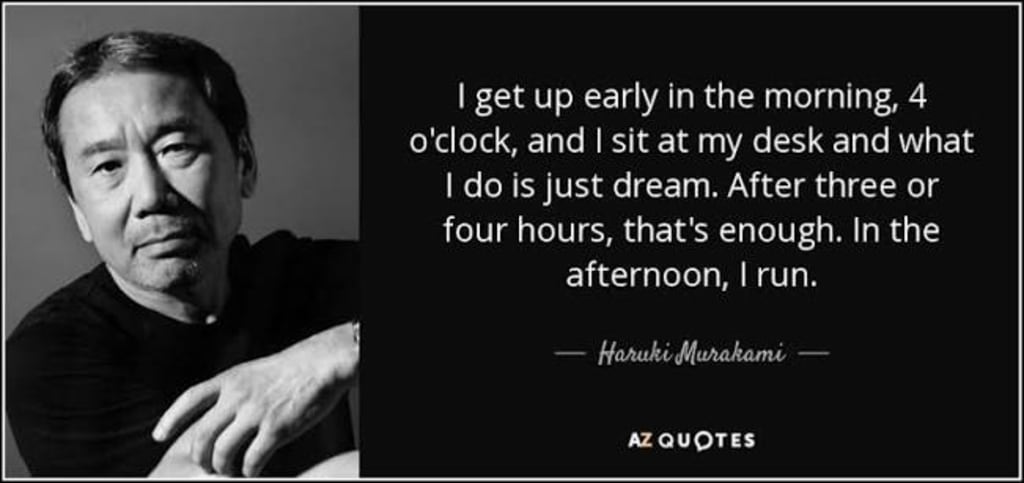
Its most direct source is Murakami’s 2004 interview with The Paris Review. In substance, he said: When I’m in novel-writing mode, I get up at four in the morning and work five or six hours straight. In the afternoon I run ten kilometers or swim fifteen hundred meters, or do both. Then I read a little and listen to some music. I go to bed at nine at night. I repeat this schedule every day and never change it. The repetition itself becomes important, like a kind of hypnosis. I hypnotize myself in order to reach a deeper mental state.
He says “when I’m in novel-writing mode.” This is not his absolute daily routine for forty years. It is a phase-based system he enters in order to write a long work. His changes were also never isolated. Around that time, he quit a habit of sixty cigarettes a day, moved out of Tokyo, and began running every day. Put those things together, and “waking at four” is not a part you can detach and install in just anyone. It is one corner of a whole reorganized way of life showing on the surface.
Learn only that corner, and the effect is hard to predict.
III
The most direct answer to why I was alert is plain to the point of being disappointing: I slept seven hours. Not because I woke up early. Usually I don’t fall asleep until after midnight, and my sleep time is probably compressed. Once I make up the duration, my mental state improves. Whether I get up at four or five may not matter that much. What matters is that I slept enough.
The deeper reason is regularity. Even for one night, I put my falling-asleep and waking times in a fixed position. That usual state, “present, but without enough bandwidth,” has a more accurate name: social jetlag.
The concept was formally proposed by Wittmann and Roenneberg in 2006. The calculation is simple. Take the midpoint of sleep on workdays and subtract the midpoint of sleep on rest days. The difference is your social jetlag. It doesn’t measure how long you sleep. It measures how far the time you actually sleep is from the time your body internally wants to sleep.
For example, if you go to bed at midnight and get up at seven on workdays, your sleep midpoint is 3:30 a.m. On weekends, if you go to bed at two and get up at ten, your sleep midpoint is six in the morning. The difference is two and a half hours. That is your social jetlag. It’s as if every weekend you cross two time zones, then fly back Monday morning. Roenneberg used this measure in a large-sample survey and concluded that, beyond sleep duration, social jetlag itself is associated with a higher body mass index.
This is a structural problem, not a moral one. The social timetable is arranged according to the biological clocks of morning types. Evening types have only two choices: sleep less, or go to work with melatonin that hasn’t fully receded. Laziness and weak willpower do not explain that daytime online state. An internal rhythm has not aligned with the social schedule.
IV
Rhythm can shift. Wright’s team did a clean experiment. They took a group of young people into the wild for a week, with no artificial lighting and no alarms. After one week, the time at which these people’s morning melatonin began to drop had moved from “two hours after waking” to after sunrise. Their entire internal clock had shifted earlier by about two and a half hours.
Pure morning types and pure evening types are both minorities. Most people’s rhythms are flexible and are mainly affected by light exposure. The clock inside your body is not carved in stone. It is recalibrated by light every day.
There was also a 2019 study that used genomic data from 690,000 people to search for loci related to “morningness,” expanding the number from twenty-some to more than three hundred. Then they used Mendelian randomization to ask about causation. The conclusion: morningness has a causal relationship with better mental health, but no causal effect on body mass index or type 2 diabetes risk. In observational cohorts, however, the diabetes risk for evening types does go up, with an odds ratio of about 1.30. But there are still confounders: evening types are more likely to carry other characteristics at the same time, such as irregular schedules, drinking, smoking, and poor work flexibility. So eveningness itself may not be the direct cause. It may be the lifestyle that accompanies eveningness.
V
What made me reread that line by Murakami was a 2024 cohort study published in Sleep.
It used accelerometer data from sixty thousand people in the UK Biobank. These were not self-reports, but more than ten million hours recorded continuously on the wrist. What they calculated was how stable the times of sleeping and waking were from day to day. The conclusion: the highest quartile on this measure had an all-cause mortality risk 20 to nearly 50 percent lower than the lowest quartile. And for predicting death, it was stronger than sleep duration.
Not what time you sleep. Whether you sleep at roughly the same time every day.
Murakami’s 2004 statement, “the repetition itself becomes important,” collides with this conclusion. The reason he gave was a kind of hypnosis, for the creative state. The reason the data gives is another: the daily discipline likely mattered more than the early hour.
VI
So, back to four in the morning.
It is not a habit that can be transplanted on its own. Behind it is a whole system: quitting smoking, moving house, starting to run, putting writing into a framework repeated every day. Waking at four is only one corner of that system showing on the surface. Learn only that corner, and it is like taking the hands of a clock but not the mainspring inside.
I don’t intend to get up at four every day from now on. Last night’s attempt was more like a controlled experiment. It showed me that my usual online state comes from sleep cut apart by the social timetable, not from inherent laziness. Sleeping seven hours, whether I wake at four or five, may not matter that much. What matters is going to sleep at roughly the same time every day, and waking at roughly the same time. Being able to control when you sleep is best. Of course, for many of us, that too is a luxury.
But even just narrowing the gap between sleep midpoints on weekends and workdays is lowering the load of social jetlag. Fix your wake-up time, get light in the morning, exercise in the evening, reduce revenge bedtime procrastination that gets paid back with catch-up sleep. These are not self-discipline aphorisms. They are circadian hygiene.
Murakami’s unbroken forty-year routine may not require superhuman willpower, but a structure he can control. He fixed one variable of his life after another, and then let repetition itself do the work. That schedule worked like hypnosis because it freed him from having to decide every day when to sleep and when to wake, not because it made him get up early.
What we often lack is an order in which we don’t have to decide anew every day. Resolve matters less.
Waking at four is an illusion. Repetition is the thing.
End.
About the Creator
Jin
Writer of reamstories
https://reamstories.com/jin
Enjoyed the story? Support the Creator.
Subscribe for free to receive all their stories in your feed. You could also become a paid subscriber, letting them know you appreciate their work.
Comments
There are no comments for this story
Be the first to respond and start the conversation.